
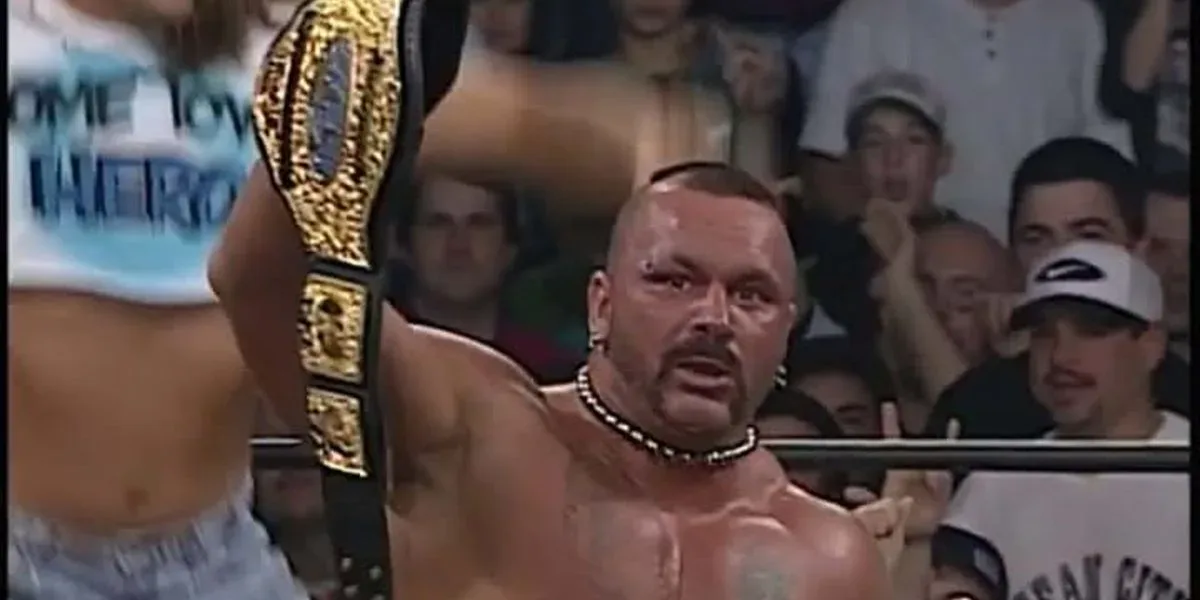
Perry Saturn has looked back on the circumstances that led to his departure from World Championship Wrestling, identifying Eric Bischoff’s removal as WCW president as a defining moment in his decision to leave the company.
Saturn was one of WCW’s most dependable in-ring performers during a turbulent period for the promotion. As a member of Raven’s Flock and later a core part of The Revolution alongside Chris Benoit, Dean Malenko and Shane Douglas, Saturn was regularly featured on television and worked a demanding live-event schedule. In early 2000, Saturn, Benoit, Malenko and Eddie Guerrero made the jump to WWE in one of the most consequential group exits of the era, arriving as The Radicalz.
Speaking with Chris Van Vliet, Saturn explained that he had a strong working relationship with Bischoff and did not see himself leaving WCW had Bischoff remained in his role. Bischoff was removed as WCW president in September 1999, having held the position for two years, and Bill Busch ultimately took over the job.
“If Eric hadn’t got fired, I’d have never left,” Saturn said. “I loved working with Eric. Eric really liked me and always took care of me.”
For more background on this topic, read Rob Conway Recalls Vince McMahon Comparing His In-Ring Work to Bret Hart.
A Major Shift Behind the Scenes
Bischoff’s WCW tenure remains one of the most discussed executive runs in modern wrestling history. During his time as president, WCW became a genuine industry leader, most notably through the launch of Monday Nitro and its extended run of ratings success during the Monday Night War. The promotion’s approach combined established stars, major outside signings and an emphasis on live weekly television.
That success also came with an increasingly complicated structure. WCW had a deep roster, major financial resources and significant television exposure, but its creative direction, talent hierarchy and booking decisions were frequently subjects of frustration among wrestlers and fans alike. Saturn’s comments offer the perspective of a performer who was heavily used but felt that the people doing much of the weekly work were not always positioned or recognized in a way that matched their contributions.
Saturn indicated that he and others in the locker room had certain views at the time about what was and was not working creatively. Looking back at old matches and programming, he said some of those assessments have changed with hindsight. He recalled that Bischoff would occasionally direct people to focus their discussions on a particular matter, while others preferred to center the conversation around the wrestlers in the ring.
“We all felt that way and watching matches and stuff now, we were wrong with a lot of the things,” Saturn said.
The key point for Saturn, however, was that Bischoff was an executive he trusted. That relationship mattered at a time when WCW’s internal environment was changing rapidly following the leadership transition.
Saturn Describes a Grueling Schedule
Beyond his feelings on Bischoff, Saturn spoke candidly about the workload carried by WCW’s mid-card talent. He said those performers were consistently on the road, often without clear knowledge of when they would next be heading home.
According to Saturn, wrestlers would receive their monthly booking sheets at the start of each month. His own schedule could run through the entire month, leaving him to wait for the next set of bookings before finding out when he would have time away from the road. It was a demanding professional reality for wrestlers relied upon to fill out television cards and work house shows across the country.
“But we worked all the time. The mid-card guys did everything,” Saturn said.
Saturn also described a point of tension concerning attendance and who bore responsibility when house-show business was down. He recalled situations in which an effort to elevate a wrestler could be met with criticism that the live-event figures did not support the move. From Saturn’s perspective, that argument missed an important part of the equation: top-level stars were not necessarily appearing on the same house shows as the wrestlers being blamed for weak numbers.
He said that the situation was frustrating because the mid-card performers were regularly tasked with the travel and match volume, while the top names were not always present for those events. The issue was not simply about receiving more television time or a higher card position. It was about the way responsibility for business results could be assigned within a roster that had sharply different schedules and levels of influence.
That distinction is important in assessing the final stretch of WCW’s major-studio era. The company had an extraordinary collection of talent at virtually every level of the card, from internationally established main-event names to technically gifted wrestlers who could deliver on any given night. Yet the challenge was often finding a consistent, effective way to connect that depth to the promotion’s larger business and creative direction.
The Benoit-Sullivan Conflict and “Residual Heat”
Saturn also addressed another issue he believes affected the group as its WCW run came to an end: the conflict involving Chris Benoit and WCW booker Kevin Sullivan.
Benoit and Sullivan had well-documented personal and professional tensions during that period. Saturn said the consequences did not stop with the two men directly involved. Instead, he felt that the wrestlers associated with Benoit were also dealing with what he called “residual heat.”
“But our problem when we left was because Benoit and Sullivan, you know, and we were all getting residual heat for that,” Saturn said.
Saturn’s account reinforces how interconnected factions and friendships could become in a wrestling locker room, particularly when creative decisions, personal disputes and company politics overlapped. Saturn, Malenko, Guerrero and Benoit were linked on screen and off screen through their shared standing as respected performers. When tensions escalated around one member of that circle, Saturn’s recollection is that the effects spread wider.
The group’s eventual WWE arrival remains a landmark moment. Benoit had won the WCW World Heavyweight Championship at Souled Out in January 2000, but departed soon afterward with Guerrero, Malenko and Saturn. Their debut in WWE created immediate intrigue, as four acclaimed WCW wrestlers appeared together at a time when the industry’s competitive landscape was still intensely divided.
For Saturn personally, the move began a new chapter that included memorable WWE programs, the development of his distinctive on-screen personality and a run that made him familiar to a far broader audience. But his latest comments make clear that he does not frame his WCW departure as an inevitable decision based solely on dissatisfaction with the company.
What Saturn’s Perspective Reveals
Saturn’s reflection is notable because it presents a more personal view of the executive change at the top of WCW. Discussions about Bischoff’s departure often focus on corporate decisions, ratings pressure, budget concerns and the promotion’s creative struggles. Saturn’s experience highlights another element: individual talent relationships with management.
To Saturn, Bischoff was not simply the public face of WCW’s front office. He was someone who liked his work, looked after him and provided a professional environment Saturn wanted to remain in. When that figure was gone, the calculation changed.
His comments also underline the value of revisiting wrestling history with perspective. Saturn acknowledged that some of the opinions held by wrestlers at the time may not look the same when examining the footage years later. That does not erase the frustrations he described regarding travel, house-show expectations or backstage tension. It does, however, show an awareness that the day-to-day pressures of a difficult environment can shape how performers view the product while they are living through it.
More than two decades later, Saturn’s WCW career remains closely tied to the company’s deep late-1990s roster and the eventual Radicalz departure. His latest remarks add a clear personal conclusion to that story: had Eric Bischoff not been fired in 1999, Saturn believes he would have stayed.

Darryl Polo
Darryl Polo is a passionate wrestling fan covering WWE, AEW, TNA and beyond. He loves great rivalries, breakout stars and the moments that keep fans talking long after the bell. How we work.