
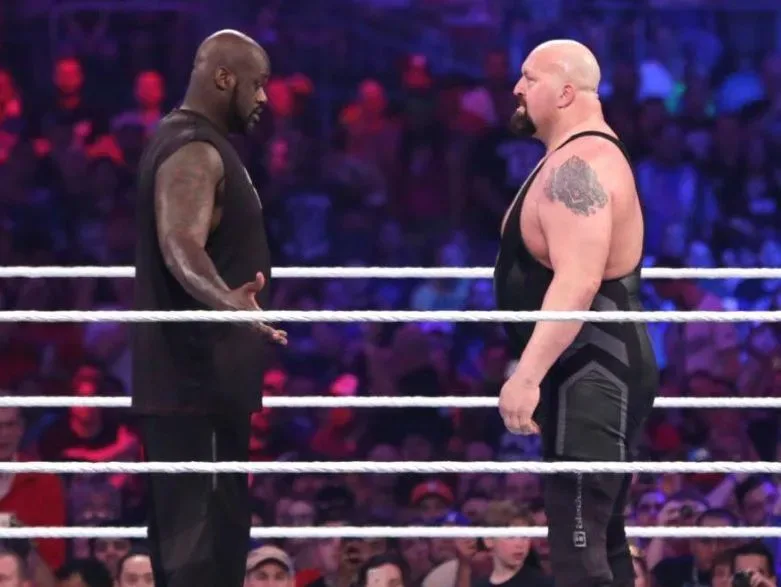
Paul Wight has shared high praise for Shaquille O’Neal, explaining that their common experience as exceptionally large public figures has made their conversations especially relatable—and unexpectedly educational for the veteran wrestler.
Wight, whose career has made him one of professional wrestling’s most recognizable giants, has crossed paths with O’Neal on multiple occasions. O’Neal’s own relationship with wrestling has included appearances in both WWE and AEW, giving the two larger-than-life personalities a natural connection whenever they meet.
Speaking about their interactions, Wight described O’Neal as a positive presence with a sincere affection for professional wrestling. More importantly, he said that the former NBA superstar is far sharper and more business-minded than some people may initially assume.
“Shaq is a wonderful, wonderful human being. We laugh every time we’re around each other. We have experienced all the same things as far as being bigger in size and whatnot.”
For more background on this topic, read Rey Mysterio Calls Mexico City Main Event With Roman Reigns a Special Career Moment.
That shared perspective is at the center of Wight’s comments. Both men have spent decades navigating environments not built for people of their size. Whether it is travel, public attention, physical expectations, or the basic practical challenges that come with being a giant, Wight indicated that he and O’Neal recognize the same realities in each other’s lives.
For Wight, that common ground appears to make their conversations easy. The two have each occupied prominent roles in entertainment, although they reached that stature through different worlds. Wight became a cornerstone attraction in professional wrestling, while O’Neal established himself as one of basketball’s most famous figures before expanding his profile into broadcasting, entertainment and business.
Wight Praises O’Neal’s Wrestling Mindset
Wight also made clear that O’Neal is not merely a celebrity who enjoys the occasional wrestling appearance. He sees a genuine fan and someone who understands the value of the business.
“He loves wrestling. He’s got a great attitude. Super keen, super keen business mind.”
O’Neal has periodically stepped into the wrestling space over the years, with notable appearances for WWE as well as AEW. His AEW involvement placed him in a high-profile mixed-tag-team attraction, demonstrating that his connection to the industry has gone beyond a passing cameo. His size, mainstream fame and willingness to embrace the spectacle have made him an unusual but natural fit for wrestling’s biggest stages.
Wight’s praise focused less on the novelty of O’Neal’s appearances and more on the person behind them. He emphasized that the basketball legend brings enthusiasm and an alert business perspective to his interactions. That assessment carries added weight coming from Wight, who has spent much of his life working in an industry where personality, presentation and commercial instincts are closely intertwined.
Professional wrestling has long benefited from athletes and celebrities who understand how to meet its heightened style without treating it as beneath them. O’Neal has consistently seemed comfortable with the scale of the presentation, whether that means taking part in physical angles, leaning into playful confrontations, or engaging with wrestling fans. Wight’s comments suggest that this comfort stems from authentic interest rather than simple promotional obligation.
A Different View of Shaq’s Public Persona
One part of Wight’s response addressed the perception that O’Neal is sometimes framed as slow-speaking in comedic settings. Wight referenced the jokes that Kevin Hart and other comedians have made at O’Neal’s expense, then offered a firm counterpoint based on his own experience.
“I know that Kevin Hart and a lot of comedians give him a hard time about him talking slow. Let me tell you something. That brother is smart.”
The point was not simply that O’Neal has been successful. His record across sports and entertainment already makes that plain. Wight instead stressed that even brief conversations with O’Neal have left an impression on him. He said he has come away from their exchanges recognizing that O’Neal has a meaningful perspective on business and life.
“I’ve learned quite a few things. Even the little conversations we’ve had about things, I was like, ‘eh, that guy’s on to something.’”
It is an especially revealing comment because Wight is hardly new to the business side of entertainment. He has been around major wrestling organizations, national television and high-pressure promotional environments for decades. His career has required him to adapt to changing audiences, changing roles and changing expectations while preserving the identity that made him a star in the first place.
For Wight to say that he has learned from O’Neal speaks to the respect he has developed for him away from the cameras. Their bond may begin with their mutual experience as giants, but Wight’s comments portray it as something broader: a mutual understanding between two people who know the demands attached to fame, physical presence and long careers in public-facing industries.
Why the Shared Experience Matters
Size has always been a defining part of Wight’s wrestling identity. From the beginning of his career, his presence made him visually different from nearly everyone around him. That distinction can create opportunities, but it also brings unique pressure. Giants are often expected to look imposing at all times, to be physically available for demanding schedules, and to function as attractions wherever they appear.
O’Neal has lived with a parallel set of expectations in basketball and popular culture. His stature made him immediately recognizable, but it also meant that he stood out in virtually every setting. Wight’s remarks underline how that type of life experience can produce an instant understanding that does not need much explanation.
There is also an obvious entertainment connection. Both Wight and O’Neal have worked in fields built on audience reaction. Wrestling depends on a performer’s ability to create a response in real time, while elite sports stars must handle the intense visibility that comes with playing before massive crowds and being discussed constantly in the media. Both careers demand confidence, adaptability and the ability to understand one’s role within a much larger production.
O’Neal’s wrestling interest has allowed that overlap to become more than a hypothetical comparison. Rather than remaining an outsider, he has participated in the industry and shown a willingness to be part of its physical, theatrical and often unpredictable format. That background gives him a more informed appreciation of what performers such as Wight do.
Respect Across Sports and Entertainment
Wight’s comments are ultimately a straightforward expression of respect. He called O’Neal a “wonderful” person, praised his attitude, and pointed to the value he has found in their private conversations. The remarks do not frame O’Neal as a wrestling expert or suggest any new in-ring plans. Instead, they offer a glimpse at a friendship built on shared experience and genuine admiration.
That distinction matters. Celebrity involvement in wrestling often draws attention because of the possibility of a major angle or match. But Wight’s perspective is more personal. He highlighted the laughs they share, the unusual realities they have both encountered because of their size, and the intelligence he believes O’Neal possesses.
Earlier this year, O’Neal also spent time with Kemalito, another moment that reflected his continuing connection to personalities within the wrestling world. His relationship with the industry has remained visible over time, even when he is not actively involved in a wrestling program.
For now, Wight’s remarks stand as a warm endorsement of someone he clearly enjoys being around. In an industry and a broader entertainment landscape often driven by outsized personalities, Wight sees more than a fellow giant in Shaquille O’Neal. He sees a thoughtful, engaged and highly intelligent friend—one whose observations have given even a longtime wrestling veteran something to think about.

Darryl Polo
Darryl Polo is a passionate wrestling fan covering WWE, AEW, TNA and beyond. He loves great rivalries, breakout stars and the moments that keep fans talking long after the bell. How we work.