
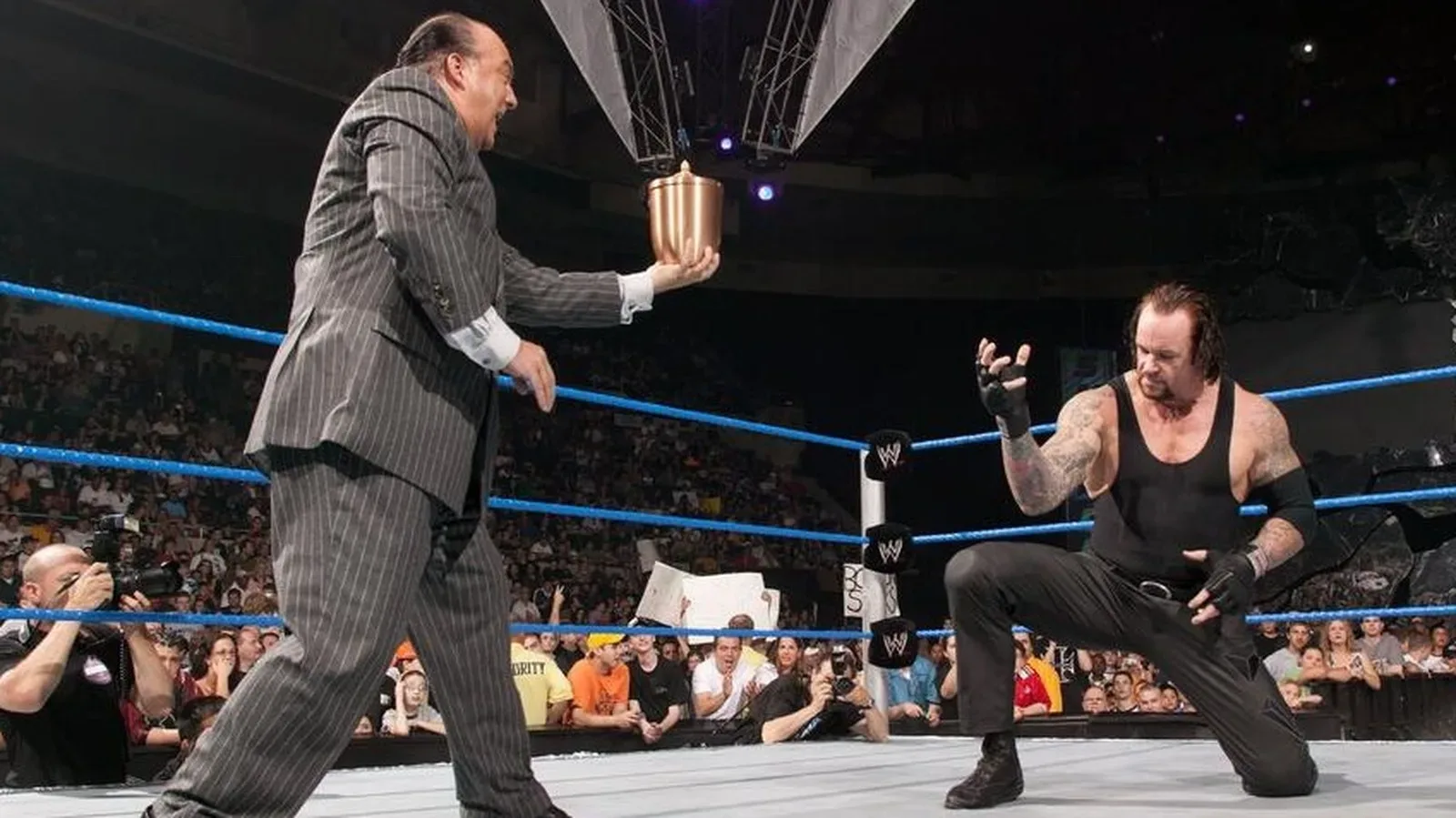
Paul Heyman has spent decades building a reputation as one of professional wrestling’s sharpest talent evaluators, promoters and on-screen strategists. From ECW’s rise as an alternative force to his lengthy WWE run alongside some of the industry’s biggest names, Heyman has consistently presented himself as someone who can identify special performers before the rest of the business catches up.
During a conversation on In Depth With Graham Bensinger, Heyman reflected on one of the most consequential examples of that belief: his role in helping Mark Calaway leave WCW and reach a meeting with Vince McMahon in 1990. Calaway would soon enter WWE as The Undertaker, beginning a legendary run that transformed him from a struggling prospect into one of the company’s most enduring and recognizable attractions.
Heyman and Calaway had worked together in WCW, where Calaway was known as Mean Mark Callous while paired with Heyman’s Dangerous Alliance-era persona, Paul E. Dangerously. At that stage, the future Undertaker had not yet found the character, presentation or platform that would ultimately define his career. Heyman, however, said he saw something in Calaway that others around him did not.
“Ole [Anderson] didn’t believe in Mark [Calaway/The Undertaker], to the point where when Mark’s contract came up in September 1990, they tried to lowball him,” Heyman said.
For more background on this topic, read Paul Heyman Reflects on Vince McMahon’s Self-Image, Work Ethic and ECW Disputes.
Ole Anderson was a major decision-maker in WCW at the time, and Heyman’s account frames Calaway’s contract situation as a turning point. Rather than accepting an offer Heyman believed undervalued the performer, Calaway was positioned to explore an opportunity elsewhere. That opportunity ultimately changed both his career and WWE history.
Heyman said a person under WCW and Turner Broadcasting contract crossed company lines to help arrange a meeting between Calaway and McMahon. In an unusually candid reveal, Heyman identified himself as the person who made that move.
“There was someone in WCW that violated their contract with Turner Broadcasting and WCW, and snuck Mark into a meeting through a mutual friend or a friend that I had in WWE, snuck him into the meeting with Vince McMahon,” Heyman said. “And that meeting led to Mark being signed by the WWE and becoming the Undertaker. I thought it was great because I was that person.”
The meeting proved pivotal. Calaway signed with WWE and was introduced later in 1990 at Survivor Series as The Undertaker, managed by Brother Love. The character immediately stood apart from the rest of the roster: a towering, supernatural presence whose deliberate movement, intimidating appearance and relentless offense created an aura unlike anything else in the company.
While WWE’s presentation of The Undertaker would evolve repeatedly over the years, the initial concept established a foundation that endured for generations. The Deadman became a centerpiece of the company’s programming through changing eras, working as a supernatural villain, a dominant heroic figure, the American Badass and multiple variations of the Undertaker persona. Few WWE acts have been able to remain relevant across so many creative and business transitions.
Heyman’s belief came before The Undertaker phenomenon
Heyman’s recollection is especially notable because it centers on a period before Calaway had become The Undertaker. Looking back from the perspective of a finished career filled with WrestleMania main events, championship reigns and Hall of Fame recognition, it can be easy to view Calaway’s eventual success as inevitable. Heyman’s story illustrates that it was not viewed that way internally during his final WCW stretch.
Before reaching WWE, Calaway had worked in several environments and under several identities while attempting to establish himself. He had the physical tools that made him difficult to overlook: imposing size, mobility for a performer of his stature, and a distinctive presence. But professional wrestling is filled with performers who have impressive attributes without being given the right character, timing or promotion to turn those traits into superstardom.
In WWE, Calaway found all three. The Undertaker was not simply another large wrestler. He was presented as an attraction with a theatrical entrance, an unmistakable visual identity and an air of danger that allowed the character to occupy a space between sports entertainment and horror-inspired mythology. WWE protected that presentation carefully, and Calaway’s commitment to the role made it believable.
Heyman’s account also speaks to a recurring element of wrestling history: careers are often redirected by personal relationships and individual acts of advocacy. A promoter, manager, veteran or executive may be the person who recognizes potential at a moment when a wrestler is not receiving meaningful support. In Calaway’s case, Heyman said he was willing to risk violating his WCW obligations because he believed the performer deserved a far larger stage.
That belief was quickly validated. The Undertaker defeated Jimmy Snuka in his first televised WWE match and continued to gain momentum. Less than a year after debuting, he defeated Hulk Hogan for the WWE Championship at Survivor Series 1991. Even though that first title run was brief, it was a major signal that WWE considered the character a top-level attraction.
A three-decade WWE legacy
The Undertaker’s WWE career ultimately became one of the longest and most decorated in company history. His WrestleMania undefeated streak grew into one of the promotion’s defining annual stories, with each appearance carrying enormous anticipation. His rivalries with Shawn Michaels, Triple H, Kane, Mick Foley, Brock Lesnar, Batista, Edge, Randy Orton and many others helped shape different periods of WWE programming.
His work was not limited to supernatural spectacle. Calaway became widely respected for his ability to adapt to the opponent and the occasion in front of him. Whether he was competing in a violent stipulation match, telling a slow-burning emotional story, leading a major stadium event or helping guide an emerging wrestler through a high-pressure bout, The Undertaker was often relied upon as a standard-bearer.
That standing also made his transition into a respected veteran presence feel natural. The Undertaker officially retired from his full-time in-ring career on November 22, 2020. Even after stepping away from regular competition, he has remained connected to the wrestling business and to the development of younger talent.
He continues to hold an influential role in WWE and Lucha Libre AAA Worldwide, including work as an in-ring coach for younger performers and as the head of AAA creative. Those responsibilities reflect the level of trust placed in a performer whose understanding of character, presentation and major-event wrestling was developed through more than 30 years at the top of the industry.
From WCW uncertainty to an immortal WWE character
Heyman’s story adds another layer to the well-known origin of The Undertaker. The character’s WWE debut, its iconic entrance and its decades of major matches are familiar parts of wrestling history. The behind-the-scenes decision that helped put Calaway in front of McMahon is less frequently emphasized, particularly because Heyman says it came at the cost of violating his own WCW contractual obligations.
For Heyman, the decision appears to have been driven by conviction rather than loyalty to a corporate structure. He believed Calaway was being undervalued, believed WWE could offer the right opportunity, and used his connections to make the conversation happen. It was a risky move, but one whose outcome became impossible to dispute.
There is no guarantee that another promotion, another creative direction or another point in time would have produced the same result. The Undertaker’s success depended on Calaway’s talent and dedication, WWE’s commitment to the character, and the creative minds who helped refine the act over the years. But none of those later chapters could begin until Calaway received the chance to walk into that meeting.
Heyman has long been associated with shaping the paths of performers who later became industry-defining names. His latest reflection places The Undertaker among the earliest and most significant examples of his eye for talent. In 1990, Heyman says he saw a future star where WCW leadership did not. The wrestler then known as Mean Mark Callous became The Undertaker, and professional wrestling was never quite the same.
In pictures

Darryl Polo
Darryl Polo is a passionate wrestling fan covering WWE, AEW, TNA and beyond. He loves great rivalries, breakout stars and the moments that keep fans talking long after the bell. How we work.