
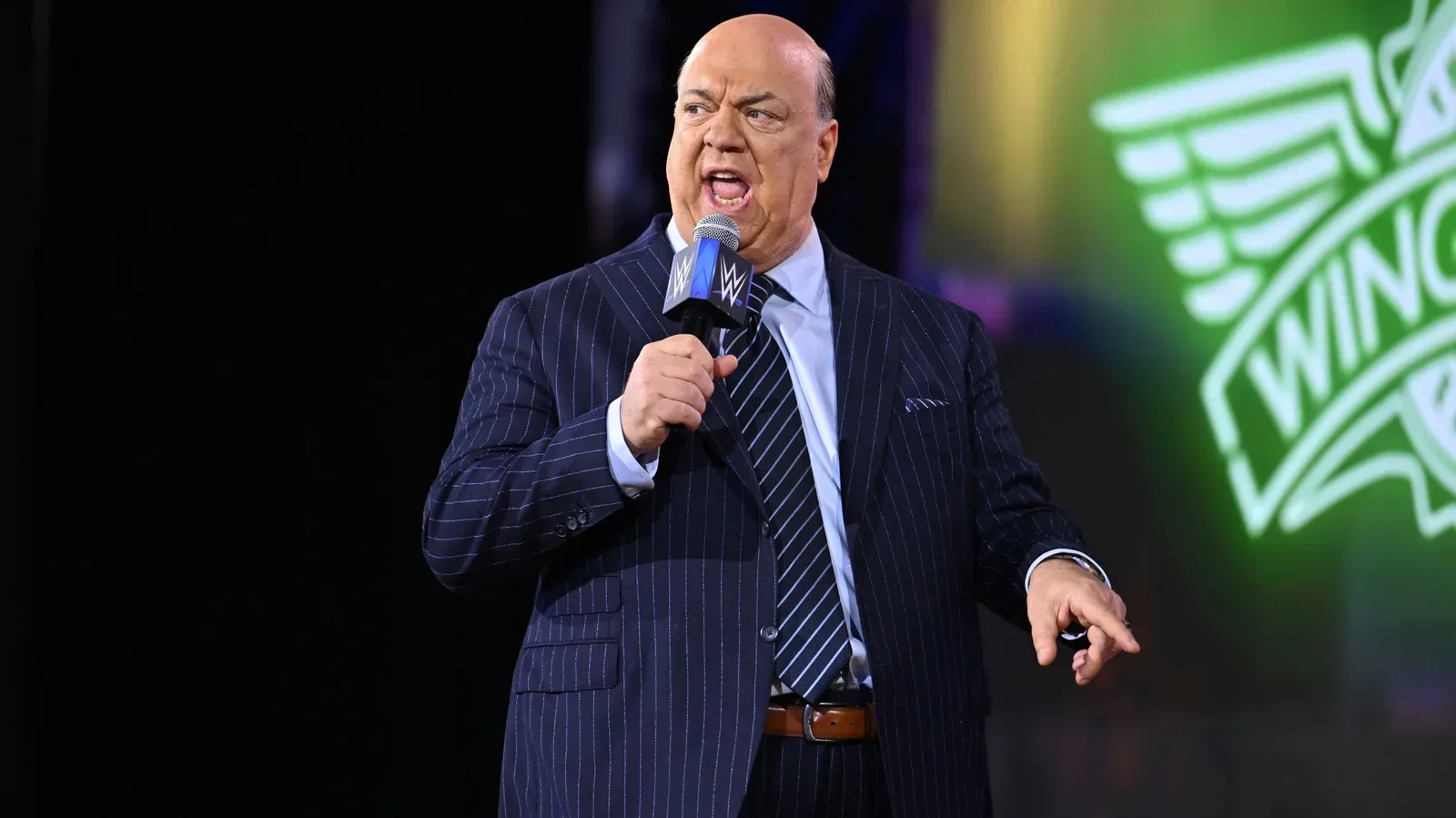
For Paul Heyman, the suit and tie are not simply a polished wardrobe choice for WWE television. They are a central part of the image he believes fans have paid to see for decades.
The WWE Hall of Famer has built one of professional wrestling’s most recognizable on-screen identities through his presentation as much as his words. Whether he has stood beside CM Punk, Brock Lesnar, Roman Reigns, or other major names across his career, Heyman’s formal attire has helped communicate authority, calculation, pressure, and a sense that every appearance is important.
Heyman recently discussed that approach while speaking with Graham Bensinger, explaining that the suit-and-tie look has become inseparable from the public’s perception of him. He acknowledged that he has been seen in ordinary casual clothing in public, but said those moments can feel jarring because they do not match the character fans associate with “The Wiseman.”
“Yeah, it’s [suit and tie] what people expect of me,” Heyman said. “I’ve also been photographed like this in flip-flops and shorts running down to the local convenience store, and, you know, I had a torn-up T-shirt, some truck will go by and the guy will stop and go, ‘Hey, Paul Heyman, how you doing? Hey, can we take a selfie?’ And I’m not going to say no. I’m not going to be rude. So, I end up with a selfie, and it ends up on the internet, and there I am, you know, with a pair of shorts, with one testicle hanging out, and flip-flops.”
For more background on this topic, read Kelani Jordan Retains NXT Women’s Title Against Returning Paige in Surprise Defense.
Heyman delivered the anecdote with humor, but his larger point was serious. In wrestling, visual consistency can be a crucial tool. A performer’s outfit, posture, facial expression, entrance, and manner of speaking can all tell an audience who that person is before a match or promo even begins. Heyman’s suit and tie have become one of those instantly identifiable elements.
He said casual photographs bother him because they can place him outside the carefully maintained image of his television persona.
“[It bothers me] because I’m out of character. That’s who they pay to see,” Heyman said. “If you ask a fan of Paul Heyman, their image of me is, I swim in this [suit and tie]. People think I shower in this. And I’m not going to deprive them of that image because this is what they come to expect of the ‘Wiseman.’”
A Look Built Around Character
Heyman’s WWE wardrobe has long served a clear storytelling purpose. The suit is not designed to make him look like an athlete preparing for competition. It establishes him as an advocate, strategist, negotiator, and adviser who operates close to power. In the world of WWE, that appearance has made it believable that Heyman belongs in the most consequential conversations surrounding championships, contracts, alliances, and family power struggles.
That is a major contrast from an earlier period of his career. During his ECW years, Heyman was known for a different visual presentation that included a long coat and hat. That look suited the raw, disruptive identity of ECW and the environment surrounding the promotion. As his role evolved in WWE, so did the image. The more corporate and formal style became a natural fit for an on-screen figure who was regularly positioned as the voice of imposing top-level stars.
Over time, the image became especially prominent during his pairings with Lesnar, Punk, and Reigns. Each association called for a slightly different version of Heyman’s character, but the core presentation remained steady. He could be protective, boastful, nervous, manipulative, devoted, or calculating, often without needing to abandon the familiar uniform that had become part of his identity.
That continuity matters because Heyman’s role is unlike that of a conventional manager who merely introduces a wrestler or interferes at ringside. His character is frequently woven into the emotional stakes of a story. He is often presented as someone with insight into the champion or faction he represents, someone whose words can influence the direction of major WWE conflicts.
Why Consistency Makes Change More Effective
Heyman also explained that maintaining the signature look gives him a useful storytelling advantage. If viewers are accustomed to seeing “The Wiseman” composed in a suit and tie, even a small break from that routine can signal that something is wrong. The impact comes from the audience recognizing the difference immediately.
Professional wrestling has always used visual changes as storytelling shorthand. A wrestler changing gear, losing a signature accessory, arriving without an entourage, or appearing physically disheveled can convey an emotional development before a single line of dialogue is delivered. Those details can make a storyline feel more personal because the audience sees evidence that a character has been affected by the events around them.
For Heyman, the effect is particularly useful because his standard presentation is so controlled. His suit projects confidence and preparation. It suggests that he has anticipated every possibility and possesses a plan for every confrontation. When the expression on his face changes or his composure begins to crack, the contrast becomes more meaningful precisely because fans know what he normally looks like under pressure.
Heyman pointed to the period when Solo Sikoa attempted to take control of The Bloodline as an example of how that approach can work. The situation was presented as taking a visible toll on Heyman, with the strain evident on his face. The emotional impact was not dependent on a complete reinvention of the character. Instead, it came through the sight of a normally composed adviser struggling with an escalating crisis around him.
That kind of performance is a recurring strength of Heyman’s WWE work. He can heighten the danger surrounding a dominant wrestler or faction through his reaction alone. If Heyman is confident, viewers are given a reason to believe his client is in control. If he appears uncertain, fearful, or overwhelmed, the audience is invited to understand that the situation has grown serious.
The Wiseman’s Image Is Part Of The Performance
Heyman’s comments underline how closely wrestling personas can extend beyond a television segment. Fans recognize performers in airports, stores, restaurants, and other everyday settings, and a photograph can travel quickly online. Heyman’s decision to take a selfie rather than refuse a fan is understandable, but he also sees the tension in those encounters: the image may show the person Paul Heyman rather than the polished WWE figure audiences recognize.
His response shows a deep awareness of the relationship between audience expectation and character work. Heyman does not appear to believe that he must literally remain in a suit at every private moment. Rather, he understands that the public image of “The Wiseman” has value, and he does not want to weaken the illusion that the character is always prepared, always formal, and always operating with purpose.
That perspective is consistent with a career defined by attention to detail. Heyman’s reputation has been built not only on memorable promos but also on understanding how every component of a wrestling act can reinforce its message. The suit and tie are one small part of that broader presentation, yet their longevity has made them powerful. They are as recognizable in their own way as the intensity of his delivery or the dramatic pauses that often accompany his biggest declarations.
In an industry where reinvention is often necessary, Heyman’s formal look has endured because it remains flexible. It can frame him as the confident representative of a dominant champion, the calculating voice behind a dangerous alliance, or the increasingly rattled adviser caught in a struggle he can no longer control. The clothing stays familiar, while the emotion underneath it changes with the story.
That is why, for Heyman, an unexpected casual snapshot can feel like more than an ordinary photo. It is a break in the visual language fans have come to associate with one of WWE’s most enduring personalities. As he sees it, people expect the suit, the tie, and the full presence of “The Wiseman” — and he intends to preserve that expectation whenever possible.
In pictures

Darryl Polo
Darryl Polo is a passionate wrestling fan covering WWE, AEW, TNA and beyond. He loves great rivalries, breakout stars and the moments that keep fans talking long after the bell. How we work.