
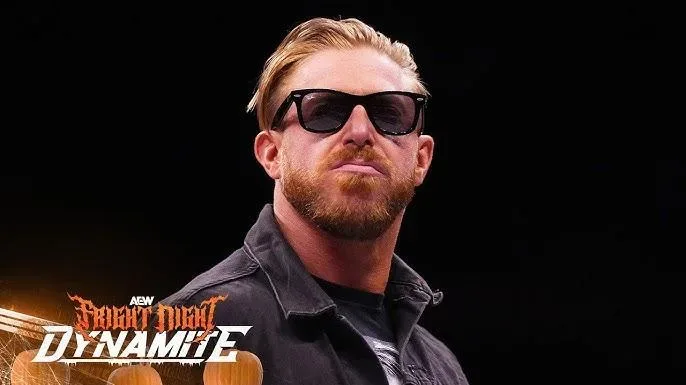
Orange Cassidy knows that AEW Blood & Guts is not a match where an individual can simply survive on instinct. The multi-person battle inside AEW’s double steel cage demands coordination, resilience and a level of confidence in one’s allies that is rarely required elsewhere. With this year’s Blood & Guts match set for next week’s AEW Dynamite, Cassidy has offered a straightforward warning to the wrestlers preparing to enter it: make sure the people fighting beside you are people you can trust.
Cassidy competed in Blood & Guts for the first time last year as a member of Darby Allin’s team, which went to war with The Death Riders inside the unforgiving double-cage structure. Reflecting on that experience, he made clear that the format changes the usual dynamics of a wrestling match. The ability of every teammate matters, because competitors are forced to depend on each other through a chaotic and physically punishing environment.
“You better hope that the people… that are in there with you on your team, you can trust them and they’re good because you rely heavily, heavily, heavily on your team. So you better have good teammates.”
It is a fitting assessment from Cassidy, whose AEW career has featured major singles accomplishments as well as crucial alliances. Blood & Guts, however, puts the emphasis squarely on the collective. It is not simply about who can endure the most punishment or create the biggest highlight. Once the cages surround the ring and the numbers rise, a wrestler’s positioning, timing and awareness can affect every other member of the team.
For more background on this topic, read AEW Fright Night Dynamite Preview: Darby Allin, FTR and Persephone Set for St. Louis.
The match’s double-cage setting leaves little room to escape mistakes. A participant can be isolated, overwhelmed or left vulnerable if the rest of the group is not able to respond. That reality is at the heart of Cassidy’s advice. A strong team is not just a collection of talented wrestlers; it has to be a group capable of functioning together when the match becomes unpredictable.
Cassidy did not seek the match last year
Despite ultimately taking part in last year’s contest, Cassidy said he was not eager to put himself forward for Blood & Guts. He explained that Mark Briscoe was the person who pushed him to declare for the match. Cassidy’s reluctance was not presented as a lack of willingness to stand with his allies, but rather an honest recognition of what the stipulation entails.
“Nope. Never did. I, you know, I had to- Mark Briscoe had me declare (for) the Blood and Guts last year. I did not want to do that, and you can hear it in my voice when I say, because I’d rather not be involved in it. But when you’re friends and the people you’re standing next to shoulder to shoulder with want you to fight, you fight.”
That distinction is important. Cassidy did not portray Blood & Guts as a match anyone should want to enter casually. Instead, he described the decision through loyalty. When people close to him needed him for the fight, he answered the call. His experience with Darby Allin’s side against The Death Riders gave him direct insight into the responsibility carried by each person in the cage.
For Cassidy, the stakes were therefore bigger than individual ambition. The match asked him to stand beside teammates who were also accepting the risk, and to contribute to an effort that could not be completed by one wrestler alone. His comments underline why trust becomes so essential: a competitor may not choose the circumstances, but they must believe the people alongside them will hold up their end when the situation turns desperate.
Why team chemistry matters in Blood & Guts
Blood & Guts is designed to intensify rivalries by placing entire groups into one enclosed contest. The cage structure and team format place pressure on relationships that may be less visible in conventional tag team or singles bouts. Partners have to make decisions quickly, protect one another when possible and recognize when a teammate needs help.
Cassidy’s repeated use of the word “heavily” was telling. In a match of this nature, relying on teammates is not a minor factor or a convenient advantage. It is fundamental to a team’s chances. A wrestler may enter with confidence in their own toughness, speed or experience, but Blood & Guts can demand that they entrust their safety and their team’s momentum to somebody else.
That can create both strength and tension. A united team can use its familiarity to respond to danger and maintain its focus amid the disorder. Conversely, any uncertainty among teammates can become magnified once the match begins. Cassidy’s advice does not focus on bold predictions or promises of violence. It focuses on the practical foundation that has to exist before anyone steps into the cage.
- Competitors need teammates they believe will stand with them under pressure.
- Every participant must be ready to support the group rather than pursue only personal glory.
- Trust must hold when the action becomes difficult to control inside the cages.
- Team quality matters because no one participant can carry the entire burden alone.
Those principles reflect Cassidy’s own account of last year. He did not volunteer to be part of the lineup, but he joined because of the people beside him. In that sense, his comments provide a different perspective from the usual pre-match bravado. The challenge is not merely surviving the structure; it is proving that the bonds within a team are real enough to withstand it.
A veteran perspective for next week’s competitors
Although Cassidy has only competed in Blood & Guts once, that appearance gave him an experience that cannot be replicated in a standard AEW match. He was part of Darby Allin’s team against The Death Riders, and he now speaks about the contest with the perspective of someone who understands the discomfort and obligation involved.
His message to this year’s competitors is concise, but it carries significant weight. Entering a match built around teams, cages and escalating chaos requires confidence not only in oneself but also in every partner assigned to the same side. In Cassidy’s view, those relationships can be the difference between a group that endures the challenge and one that is exposed by it.
The advice also suits Cassidy’s on-screen identity and the way he has approached difficult situations throughout his time in AEW. He may not have wanted the match last year, but he did not abandon the people who wanted him alongside them. Instead, he framed the decision as something that comes with friendship and solidarity. When the people beside you ask you to fight, he said, you fight.
That is the standard facing the wrestlers who will enter Blood & Guts next week. The match will inevitably test endurance, resolve and a willingness to absorb punishment. But Cassidy’s firsthand takeaway is that none of those qualities exist in isolation once the doors close. The people in the cage with you matter just as much as the opponents across from you.
For the teams preparing for AEW Dynamite, the final preparations will center on the looming confrontation. Cassidy’s words offer a simple checklist before the bell rings: know your teammates, believe in their ability and be prepared to depend on them. In Blood & Guts, trust is not an optional part of the strategy. It is the strategy.
Continental Classic remains another topic for Cassidy
In addition to discussing Blood & Guts, Cassidy addressed the possibility of competing in this year’s Continental Classic. No further details about his potential place in the tournament were established in his Blood & Guts comments, but the subject remains notable given the demanding slate that the Continental Classic presents to anyone involved.
For now, Cassidy’s immediate words are centered on the unique demands of AEW’s cage war. His experience last year left him with no illusion about what participants are signing up for. It is a match he did not initially want to enter, yet one he accepted in support of his friends. As a new group of competitors approaches the structure, Cassidy’s central point remains clear: in Blood & Guts, having good teammates is not merely helpful. It is essential.

Darryl Polo
Darryl Polo is a passionate wrestling fan covering WWE, AEW, TNA and beyond. He loves great rivalries, breakout stars and the moments that keep fans talking long after the bell. How we work.