
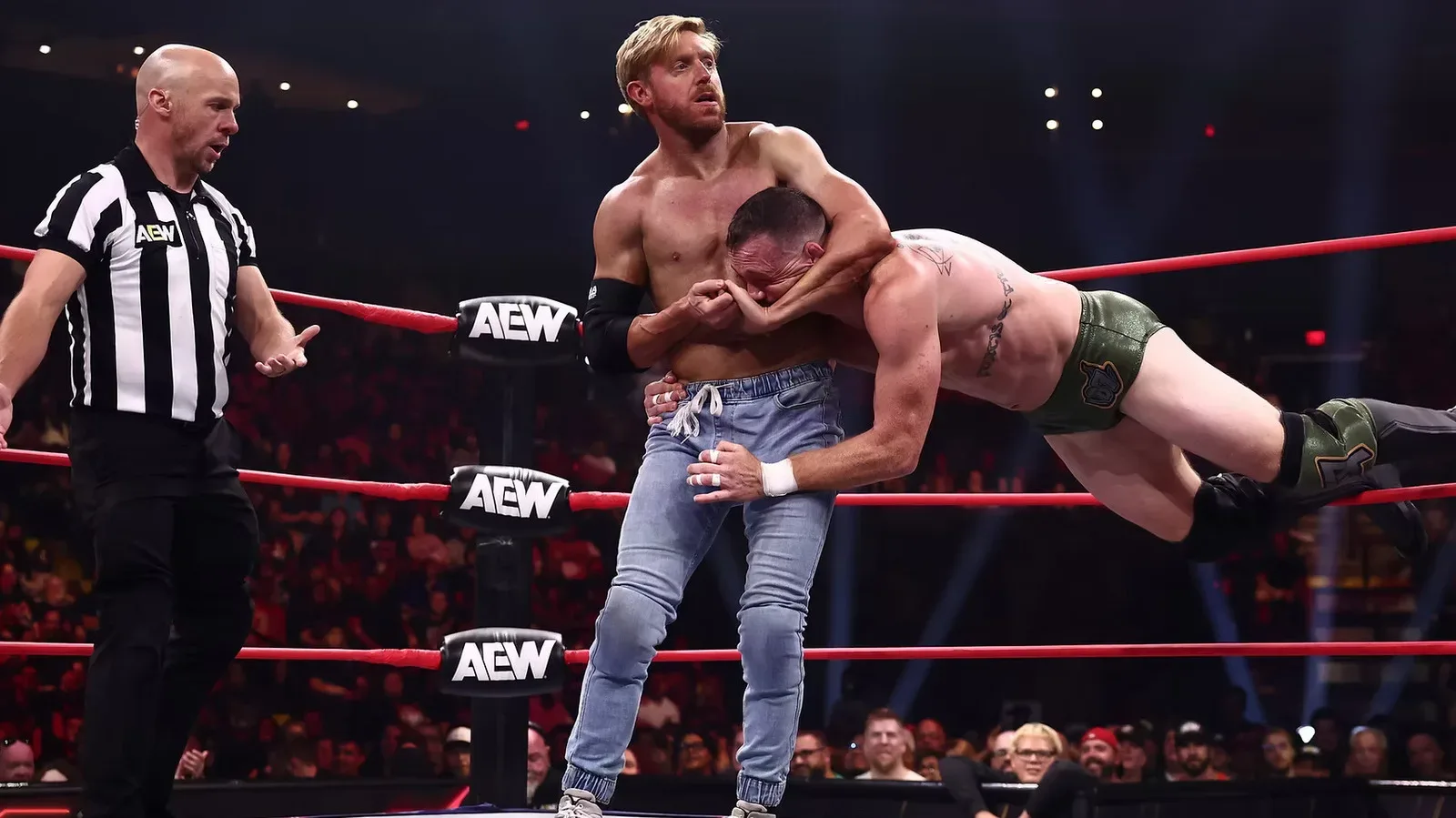
Orange Cassidy believes Tony Khan’s influence on professional wrestling extends beyond the creation of another major company. For the two-time AEW International Champion, Khan’s value lies in the fact that he entered the business as a committed wrestling fan with the resources and willingness to build a platform around the many forms the industry can take.
Speaking with STL Sports Central, Cassidy reflected on his own good fortune in working for AEW’s founder and CEO while also offering a broader assessment of what Khan’s arrival has meant for performers and audiences. Cassidy said the industry has been better served by Khan taking the chance to establish AEW, whether it is viewed as a risk or an opportunity.
“I feel like professional wrestling and everybody overall involved in it, working in it, and all the fans have benefited greatly that this guy is such a huge wrestling fan and took this risk, I would say, maybe like opportunity, whatever it is,” Cassidy said.
That perspective carries particular weight coming from Cassidy. He has become one of AEW’s defining homegrown stars, transforming an initially unconventional presentation into a sustained run near the center of the promotion. His evolution from a wrestler known for deliberate, low-energy comedy and sudden bursts of athleticism into a dependable championship-level performer has happened entirely during AEW’s existence. Cassidy’s success has also come in a company built around the idea that different kinds of wrestlers, matches, and personalities can coexist on one card.
For more background on this topic, read Kevin Knight Leaves Door Open to Mike Bailey Reconciliation After JetSpeed Split.
In Cassidy’s view, that variety is not incidental. It is central to Khan’s vision and to AEW’s identity. He said Khan created an environment that makes room for professional wrestling in its many forms rather than restricting the definition of what belongs on a major American wrestling broadcast.
“But Tony made this place that allows for professional wrestling,” Cassidy said. “And that's all because, to me, professional wrestling is so many different things. It's not just, you know, what you've been seeing on TV for the past, you know, whatever, in America.”
A Platform for Multiple Wrestling Styles
AEW has consistently presented itself as a promotion where stylistic range is a feature, not a complication. Its shows have included technical wrestling, high-flying action, violent stipulation matches, traditional tag team wrestling, comedic character work, hard-hitting bouts, and wrestlers whose reputations were established outside the United States. That mix has been a defining element of the company since its launch.
Cassidy specifically credited Khan with opening a door for international wrestling to reach viewers who might not otherwise have encountered it. The point is not simply that AEW uses talent from different places. Rather, Cassidy sees Khan’s approach as one that recognizes global wrestling traditions as valuable parts of the overall landscape, worthy of being presented to a large American audience.
“He's opened the door to wrestling from around the world for an audience that typically wouldn't have seen it,” Cassidy said.
That philosophy is visible in the range of backgrounds represented across AEW programming. The company has routinely featured talent with experience in promotions and scenes from around the world, while its own in-ring style has often made room for influences beyond a single established television formula. For performers, that can mean more freedom to lean into the strengths that made them stand out before arriving in AEW. For fans, it can mean exposure to forms of wrestling that may once have required going out of their way to find.
Cassidy’s own character is an example of why that flexibility matters. A less conventional act can be difficult to position in a system that demands every wrestler fit a narrow mold. AEW instead allowed Cassidy’s act to develop in front of a national audience. The relaxed demeanor, hands-in-pockets offense, and deadpan humor became familiar features of his matches, but the presentation did not prevent him from being treated as a serious competitor when the moment required it.
Over time, Cassidy’s performances established that the character’s humor and his in-ring ability were not mutually exclusive. His championship work, including his two reigns as AEW International Champion, reinforced that point. He could headline, carry lengthy matches, and work through the physical demands associated with a major title run while remaining recognizably Orange Cassidy.
“The Wrestling Is Always Put First”
For Cassidy, the most important part of Khan’s leadership is that it comes from somebody who loves the medium. He described having a fan as a boss as an advantage because wrestling itself remains the priority.
“And having a fan first and foremost as a boss is the best because the wrestling is always put first. It's always number one,” Cassidy said. “And luckily I can wrestle, and he likes it when I wrestle, so I'm very, very lucky.”
The final line is delivered in Cassidy’s typically understated fashion, but it summarizes a meaningful professional reality. Wrestlers want opportunities to wrestle, to show what they can do, and to build credibility through their performances. Cassidy’s comments suggest he sees Khan as someone receptive to that objective, particularly when it comes to letting performers make their case in the ring.
AEW’s history has included prominent lengthy matches, title defenses, specialty bouts, and major events built around the expectation of high-level ring work. While presentation, character development, and story remain crucial elements of any wrestling product, Cassidy believes Khan’s instincts consistently place the in-ring component at the forefront. In a business where creative preferences can differ sharply from one company to another, that priority has helped AEW attract and retain a roster filled with wrestlers who value the chance to perform at a high level.
Cassidy also said Khan operates on a “different level” when it comes to wrestling knowledge and described the AEW CEO as a very smart man. That assessment fits with Cassidy’s longstanding public praise for Khan. The International Champion has previously spoken positively about AEW’s willingness to accommodate a broad spectrum of wrestling, and his latest comments continue that theme.
His remarks are not framed as a claim that every form of wrestling has to look the same, nor that fans must respond to every style in the same way. The argument is that professional wrestling is broad enough to contain those differences. A company that understands that breadth can create more opportunities for talent and more choices for its audience.
Cassidy’s Place in AEW’s Larger Identity
Cassidy has a unique perspective on the subject because his career trajectory is closely tied to AEW’s own rise. He was not merely inserted into an already established corporate machine with a fixed identity. Instead, he became one of the faces of a young promotion still defining itself in public. As AEW expanded its roster, event schedule, championship picture, and audience, Cassidy’s status grew alongside it.
That shared growth makes his praise especially understandable. AEW gave Cassidy a national stage for a persona that was distinct from the conventional image of a wrestling star. Cassidy, in turn, became a reliable representative of the company’s willingness to take creative chances. His strongest work has often balanced the absurdity of the character with emotional investment, athletic urgency, and the cumulative physical toll of competition.
His two reigns as International Champion helped make that title one of the clearest expressions of AEW’s broad in-ring ambitions. The championship has been positioned as a prize that can be defended frequently and against an array of opponents, a setup well suited to a wrestler such as Cassidy. It allowed him to demonstrate range while also affirming the point he made in the interview: he is grateful to be in a place where the boss appreciates wrestling and gives him the opportunity to do it.
A Positive Public Image, With High Standards Behind It
Khan is frequently described by wrestlers as a passionate supporter of the industry, and Cassidy’s comments add to that picture. At the same time, Khan’s enthusiastic public presence should not be mistaken for an absence of intensity. Brian Cage recently discussed the fact that Khan can become angry while also describing him as an exceptionally positive person.
That combination is not necessarily contradictory. Running a wrestling promotion demands enthusiasm, decisive judgment, and high expectations, particularly when the company’s stated mission is to present wrestling as a major attraction. Cassidy’s focus, however, remains on the positive effect he believes Khan has had: more room for wrestlers, more exposure for varied styles, and a product shaped by someone who places substantial value on the in-ring craft.
For Cassidy, that is the heart of the matter. He does not reduce AEW’s contribution to a single wrestler, match type, or business decision. He sees it in the wider ecosystem created by Khan’s investment in the industry. The company provides a setting where performers with different approaches can work, where fans can see wrestling from beyond their usual frame of reference, and where being able to wrestle remains a meaningful asset.
“Luckily I can wrestle,” Cassidy said. For a performer whose AEW career has been built on proving exactly that, it is a modest conclusion to a far larger point about the kind of company he believes Khan has created.
In pictures

Darryl Polo
Darryl Polo is a passionate wrestling fan covering WWE, AEW, TNA and beyond. He loves great rivalries, breakout stars and the moments that keep fans talking long after the bell. How we work.