
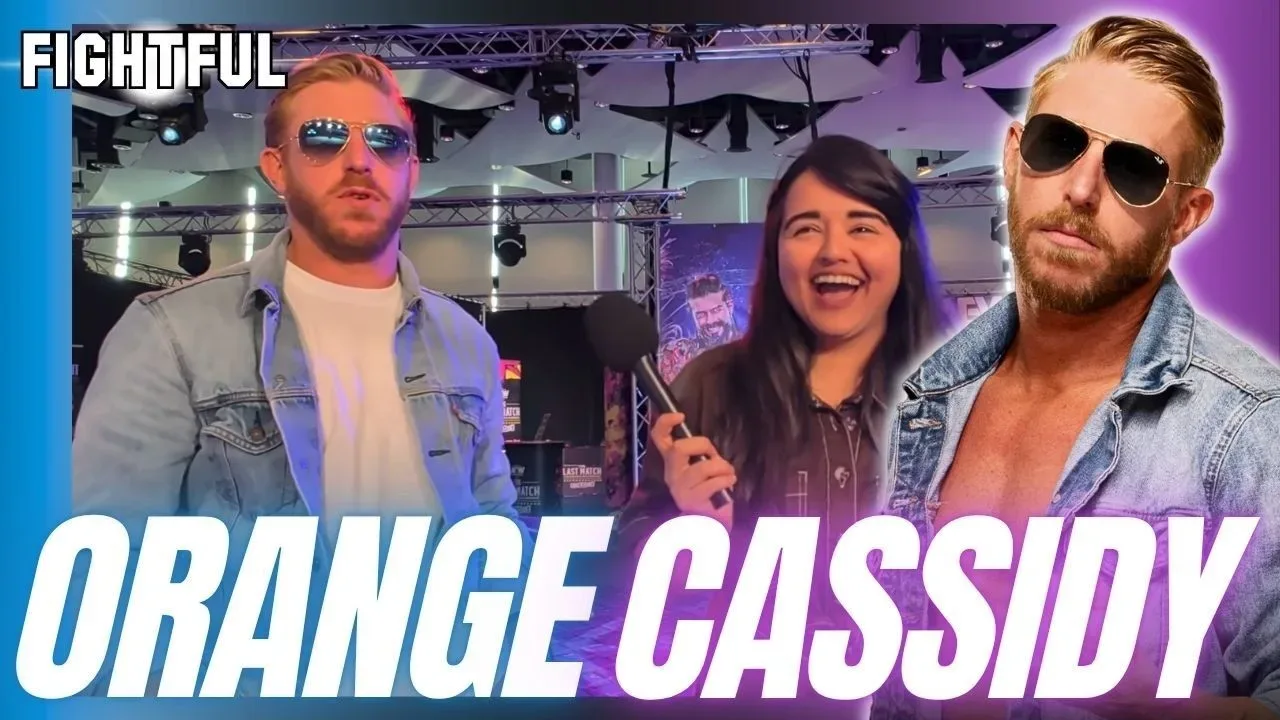
Orange Cassidy has built much of his appeal around doing things differently, so it was fitting that a question about musicals did not lead to a conventional Broadway answer.
During AEW All In weekend, Cassidy reflected on a recent New York City outing and eventually compared himself to two performance institutions that are difficult to place in any single category: Blue Man Group and Stomp. The answer was delivered with the dry, understated humor that has long been central to Cassidy’s on-screen identity, but it also offered an unexpectedly fitting description of a wrestler whose presentation has always stood apart from the usual rules.
Cassidy was asked whether he had attended any concerts recently, following up on his visit to a Taylor Swift performance at Wembley Stadium in 2024. Rather than name another arena tour or music act, the AEW wrestler described attending Masquerade, an immersive New York production built around the world of The Phantom of the Opera.
“Yeah. I don’t think it counts as a concert, but I went to New York City,” Cassidy said. “You don’t call it a musical, you call it an experience. It’s called Masquerade and basically, you dress up in a suit and you go through these room by room by people [doing] a Phantom of the Opera story.”
For more background on this topic, read Nyla Rose Says Tony Khan Has Rejected Her Car-Impact Storyline Pitch for Four Years.
The description immediately matched the unusual nature of the experience. Cassidy explained that attendees are not simply seated in front of a stage and watching the action unfold at a distance. Instead, they are brought through various spaces while performers tell the story around them, putting the audience much closer to the production than in a standard theater setting.
“It’s like right in front of you and you’re kind of involved in it and you go through different rooms, like you end up on the roof at one point, you go all the way down,” Cassidy said. “I highly recommend.”
For Cassidy, the proximity to the actors was evidently one of the major strengths of the show. He recalled standing near enough to the production’s Phantom character to notice the physical effort behind the role, offering a vivid and typically deadpan detail about the experience.
“Somebody as close as you and I are saying it, the Phantom was there singing and I could see the sweat dripping off underneath his hideous face,” Cassidy said before adding, “Spoiler. So it was awesome.”
An Answer That Fits Orange Cassidy
When the conversation turned into a hypothetical question about which musical he would be if he were one, Cassidy initially looked for an answer that matched his well-established aversion to unnecessary exertion. He framed the thought process around finding “the laziest musical” possible, then settled on two performance concepts defined more by rhythm, visual identity, and unconventional staging than by the traditional structure of a book musical.
“If I was a musical… You put me on the spot because what’s the laziest musical you can think of? You know what? Just because, I’d like to say if I was a musical I’d be Stomp because that’s not really a musical. I’d be Blue Man Group.”
The response is a natural fit for Cassidy’s persona. Blue Man Group has long been known for a largely nonverbal, stylized form of performance that combines percussion, comedy, spectacle, and an unmistakable visual look. Stomp, meanwhile, centers on physical rhythm and inventive percussion created from ordinary objects rather than the conventional trappings associated with a musical theater production.
Neither comparison is a literal one, of course, and Cassidy was plainly approaching the question in his own comedic fashion. Still, both choices reflect the qualities that have distinguished him in AEW. Cassidy is a performer whose appeal is not dependent on following expected formulas. His presentation can be quiet, minimal, and deliberately detached, but it is also instantly recognizable. He can create a reaction with a small gesture, a change in posture, or a subtle facial expression before a match ever begins.
That economy is a major part of why Cassidy’s work connects with crowds. His character has often invited audiences to lean in and pay attention rather than simply wait for the biggest or loudest possible action. Much like an unconventional live production, the payoff frequently comes from timing, contrast, and the audience understanding the language of the act.
Immersive Performance and Wrestling Presentation
Cassidy’s comments about Masquerade also underline a connection between immersive performance and professional wrestling. Wrestling is at its best when it creates the sense that the viewer is part of a live event rather than just watching a series of athletic maneuvers. Entrance music, crowd noise, lighting, reactions, camera framing, ring positioning, and character work all help establish that feeling.
An immersive theater production takes that concept further by removing much of the separation between its performers and its audience. Cassidy’s account of moving through rooms, encountering scenes at close range, and ending up on a rooftop illustrates why that format stood out to him. The audience is not merely observing a story; it is moving through the environment in which the story is being staged.
Professional wrestling does not generally operate that way in a literal sense, but the strongest wrestling personalities often make fans feel included in the performance. Cassidy’s relationship with audiences has been built on that shared understanding. Fans recognize the deliberately casual body language, the slow escalation of effort, and the moments when the relaxed exterior gives way to urgency. Those beats work because the crowd knows the character and understands when something has changed.
That is also why Cassidy’s brand of humor has remained effective. His comedy is rarely based on a lengthy explanation. A short response, a shrug, or an unexpectedly specific observation can carry the joke. In this case, he transformed a standard entertainment question into a comparison with Stomp and Blue Man Group, two answers that are amusing precisely because they avoid the obvious route.
Cassidy’s Distinct Place in AEW
AEW has featured a wide range of personalities since its launch, from intense technical wrestlers and larger-than-life villains to athletes whose styles emphasize high-speed action and aerial risk. Cassidy has remained one of the company’s most identifiable figures because he occupies a lane that belongs almost entirely to him.
His character is frequently understated, but understated does not mean insignificant. The effectiveness of Cassidy’s work has often come from contrast. When a wrestler who usually appears unbothered displays emotion or urgency, the shift matters. When someone known for treating movement as optional suddenly accelerates, the audience understands that the stakes have changed.
That dynamic has made Cassidy capable of moving between comedy, competition, and more serious storytelling without abandoning the core of his persona. The details may evolve from match to match, but the foundation remains familiar: the hands-in-pockets attitude, the casual delivery, and the ability to make a minimal choice feel intentional.
His comments about Blue Man Group and Stomp similarly point toward performance styles that do not depend on being traditional in order to be memorable. Blue Man Group’s visual presentation is immediately recognizable. Stomp turns everyday sounds and objects into a structured live experience. Cassidy’s wrestling identity likewise takes elements that might seem simple or even subdued and uses them to create a distinct rhythm.
A Typically Unconventional Recommendation
Beyond the musical comparison, Cassidy was enthusiastic about the New York City production he attended. His recommendation of Masquerade was far more animated than his trademark demeanor might lead some viewers to expect, particularly when describing the closeness of the performers and the scale of the setting.
It was also a reminder that Cassidy’s off-screen comments can carry the same offbeat appeal as his televised work. He does not need to force a punchline; the humor often emerges from the specificity of what he chooses to say. Calling the Phantom’s face “hideous,” then immediately labeling it a spoiler, is the sort of odd but memorable turn that fits his public persona.
For fans of Cassidy, the Blue Man Group and Stomp answer will likely make perfect sense. It is unconventional, economical, a little dismissive of the premise, and somehow still revealing. If Orange Cassidy were a musical, he would not be interested in fitting neatly into the musical category in the first place.
Darryl Polo
Darryl Polo is a passionate wrestling fan covering WWE, AEW, TNA and beyond. He loves great rivalries, breakout stars and the moments that keep fans talking long after the bell. How we work.