
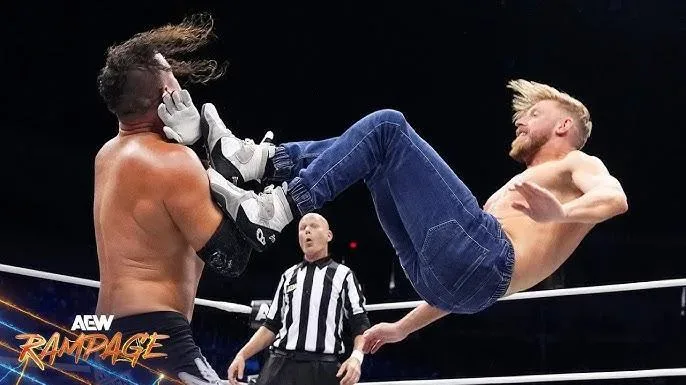
Orange Cassidy’s route into professional wrestling began with an idea that was both simple and remarkably ambitious: after deciding he wanted to try it, he built a ring in his backyard.
The longtime AEW standout reflected on his earliest connection to wrestling during an interview with Show Me St. Louis, explaining that his interest was initially sparked by watching the sport on television. That curiosity became something much more serious after he attended a live event for the first time.
“I saw wrestling on TV, and I was like, wow, that’s cool. I think I can do that,” Cassidy said. “Built a ring in my backyard, and now I’m still doing it. All this time, so. Yeah, it was one of those things. I went to a show in person, and after that, I was hooked.”
For Cassidy, the leap from being a viewer to wanting to participate did not start in a formal training environment. It began at home, with a makeshift ring and a willingness to learn by getting in it with anyone in the neighborhood who was interested.
For more background on this topic, read Sammy Guevara Says He Has Learned ‘Roranese’ to Understand The Beast Mortos.
“My neighborhood friends and, whoever wanted to fight me in a ring built by scraps of wood,” Cassidy said when asked who he wrestled in the backyard.
A Backyard Beginning for an AEW Original
That early DIY approach provides an interesting contrast to the position Cassidy occupies in modern wrestling. He has been active in professional wrestling for more than 22 years and has been a consistent presence in All Elite Wrestling since the company launched in 2019. Over that time, he has become one of the promotion’s most recognizable performers.
Cassidy’s presentation has always stood apart. His deliberately low-energy demeanor, hands-in-pockets mannerisms and “sloth style” have made him unlike almost anyone else on a major wrestling program. The character can appear detached from the moment around him, yet that relaxed exterior has long been central to the reaction he receives from audiences.
His comments about building a backyard ring also underline the straightforward enthusiasm behind that persona. Before becoming known for a uniquely unhurried style, Cassidy was a fan who saw something he wanted to do and found a way to start doing it. The materials may have been scraps of wood, and the opposition may have been neighborhood friends, but the motivation was the same one that has launched many wrestling careers: seeing the spectacle up close and deciding it was worth pursuing.
Live wrestling has often created that kind of turning point for performers. Television can introduce the concept and create an initial fascination, but the atmosphere of an in-person show can make the scale, physicality and connection with the crowd feel immediate. Cassidy’s recollection makes clear that this was the moment that changed his interest from a passing thought into a personal goal.
From Watching Wrestling to Doing It
The appeal of Cassidy’s story is in how direct it is. He did not describe a long period of uncertainty after first seeing wrestling. He watched it, thought he could try it, attended a show, and then acted on the feeling that experience created. The backyard ring became the practical expression of that decision.
It is also a reminder that professional wrestling has always encouraged imagination as much as athletic ambition. Fans frequently recreate the atmosphere of the sport in whatever space is available to them, whether that means practicing promos, staging matches with friends or assembling a place to train. Cassidy’s version went considerably further than most. He and his friends had a ring, however roughly constructed, and he was able to begin testing himself inside it.
Of course, Cassidy’s account does not romanticize the setup as some polished facility. He specifically described it as a ring built from scraps of wood. That detail is central to the story. The point was not that the setting resembled a major arena; it was that it gave him an opportunity to participate.
There is a fitting connection between that resourcefulness and the identity Cassidy later developed as a wrestler. His work has succeeded by defying familiar expectations. Rather than trying to fit neatly into a conventional mold, he has made an unconventional approach work on a major stage. The path began with an unconventional starting point as well: a backyard structure and a group of friends willing to get involved.
More Than Two Decades in Wrestling
Cassidy noted that he is still wrestling all these years after that first decision. With more than 22 years of experience, the backyard ring is now part of a much longer career story. The duration matters because it emphasizes that what began as excitement after a live event was not fleeting. It developed into a lasting commitment to the profession.
Since AEW’s inception in 2019, Cassidy has been one of the promotion’s staples. His presence has helped establish him as a familiar face to viewers, while his distinctive style has ensured that he remains immediately identifiable even in a roster filled with contrasting personalities and in-ring approaches.
That longevity gives added weight to the simplicity of his explanation. Cassidy did not frame his beginning around a grand plan or a complicated origin story. He saw wrestling, liked it, believed he could try it and got started. The years that followed transformed that impulse into a career that has lasted more than two decades.
His answer also reflects the physical, communal side of how wrestling interest can develop. The backyard ring was not something he used alone. He recalled working with neighborhood friends and anyone else who wanted to face him. Even at that early stage, there was an element of performance and participation: wrestling requires opponents, and it requires people willing to share the experience.
The Importance of Seeing It Live
While Cassidy first encountered wrestling on television, he identified attending a live show as the key event in becoming “hooked.” That distinction is notable. Watching on a screen made wrestling seem exciting; seeing it in person made it feel possible.
For a performer whose career has now included more than 22 years in the industry, that first live show occupies an important place in the timeline. It was the experience that pushed him beyond admiration and into action. The backyard ring followed because the idea had become real enough that he wanted to attempt it himself.
Cassidy’s comments offer a concise look at the beginning of a career that has taken him from improvised wrestling with friends to a central role in AEW programming. They also provide a glimpse behind a character that often communicates with minimal effort and even fewer words. The man behind the sunglasses and slow-motion gestures was once simply a prospective wrestler excited enough to build a ring out of whatever wood he could find.
That original enthusiasm remains the clearest takeaway from his story. Cassidy’s early setup was modest, but the decision behind it was significant. One live wrestling show convinced him to give the sport a shot, and more than two decades later, he is still doing it.

Darryl Polo
Darryl Polo is a passionate wrestling fan covering WWE, AEW, TNA and beyond. He loves great rivalries, breakout stars and the moments that keep fans talking long after the bell. How we work.