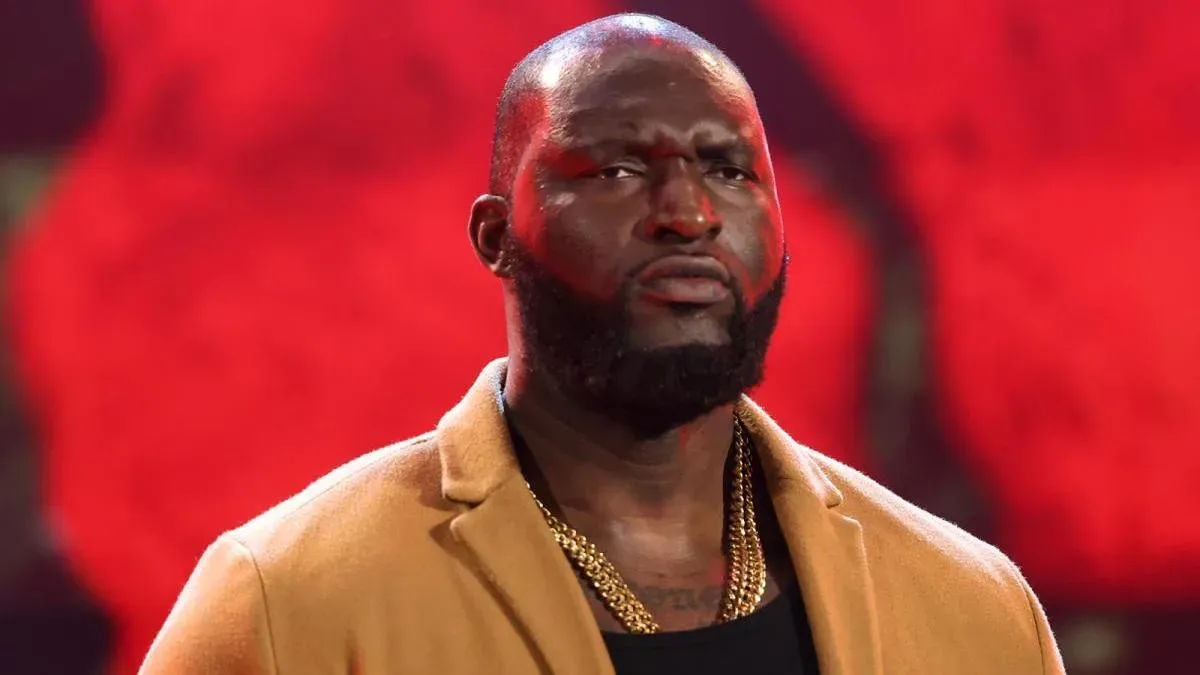
Omos has made his view of his place in professional wrestling unmistakably clear.
During a recent interview with MuscleManMalcolm, the WWE Superstar declared that he considers himself the top active giant in the business. It was a bold assessment from one of the most physically imposing athletes associated with WWE, but it was also consistent with the confidence Omos has projected throughout his career.
“I’m gonna make this statement, I don’t care. I am the greatest working living giant in this business. As it stands.”
The statement puts Omos directly into a longstanding wrestling conversation. The industry has always made room for larger-than-life attractions, especially performers whose extraordinary height and size immediately create a visual contrast with nearly every opponent. From the earliest eras of territorial wrestling through the modern global scene, giants have been presented as unique challenges: difficult to move, difficult to intimidate, and capable of changing the structure of a match with one decisive moment.
For more background on this topic, read Eric Bischoff Questions Financial Value of Heavy Tag Team Focus.
Omos believes he currently occupies the top spot among that group.
A WWE Giant With International Experience
Omos remains best known for his work in WWE, where his size has made him an immediate attraction from the moment he appears on screen. He has been positioned against major names and has regularly been presented as a singular physical presence rather than simply another large wrestler on the roster. In an era populated by elite athletes of many different body types, Omos stands out before a bell even rings.
His profile has not been limited solely to WWE programming. Omos has also worked AAA events over the last year or so and previously appeared in Pro Wrestling NOAH. Those opportunities have given him exposure in promotions with different styles, different audiences, and different expectations for heavyweight wrestling.
That international experience is important to the broader meaning behind his claim. A giant’s reputation is not formed strictly by listed height or weight. It is shaped by how that performer translates in different rings, opposite different opponents, and before crowds who may have very different ideas about what a dominant heavyweight should look like. Working in WWE, AAA, and NOAH places Omos in three distinct wrestling environments.
WWE has traditionally built giant performers around spectacle and major-event scale. AAA brings a different presentation and an established lucha libre culture, while NOAH has long been associated with hard-hitting heavyweight competition and a particularly demanding audience for in-ring credibility. Omos’ appearances across those promotions provide a notable backdrop to his confidence.
What Makes a Modern Wrestling Giant?
Professional wrestling has never had a single definition for what makes a giant great. Raw size is naturally a major element, but it is only part of the equation. A successful giant must maintain the aura that comes with being physically overwhelming while still adapting to the pace, expectations, and storytelling demands of the promotion around them.
For Omos, his argument begins with the visual reality of his presentation. He is one of the rare performers who can make established heavyweights appear significantly smaller in a face-to-face confrontation. That advantage creates immediate stakes. An opponent does not need to explain why overcoming Omos is difficult; the audience can see the challenge immediately.
But modern wrestling places additional demands on larger competitors. Television audiences expect a giant to be more than a stationary obstacle. They want movement, timing, personality, and a clear sense of how the wrestler fits into a match. The most memorable big men have traditionally been the ones who understand when to slow the action down, when to create a burst of power, and when to allow an opponent’s desperation to elevate the story.
Omos’ declaration is therefore not merely a statement about his measurements. It is a claim about his overall standing as an active attraction. By describing himself as the greatest “working living giant,” he is placing value on current performance and presence rather than relying on the history of giants who came before him.
Confidence Is Part of the Role
In wrestling, confidence is often inseparable from presentation. A performer cast as an unbeatable force cannot enter a match looking uncertain about his own status. The character must believe he is superior, and the audience must have a reason to consider whether that belief is justified.
Omos’ words carry that essential element of self-assurance. His phrasing was emphatic, including the point that he did not care if the claim drew disagreement. That attitude suits a wrestler whose role depends heavily on intimidation. A giant who sees himself as one among many loses part of the mystique; a giant who sees himself as the standard gives opponents and fans something concrete to challenge.
There is also a difference between declaring oneself dominant and claiming a place in wrestling history. Omos did not frame the statement as an all-time ranking. Instead, he specifically focused on the current landscape with the phrase “as it stands.” That leaves room for the rich legacy of giant wrestlers while making his position clear regarding the active scene.
The distinction matters because wrestling’s giant lineage is vast. Every generation measures its current super-heavyweight attractions against the lasting images created by larger-than-life predecessors. Modern performers carry that history with them, whether they explicitly invoke it or not. For Omos, claiming the present-day crown is a way of embracing that tradition while asserting that the conversation belongs to him now.
Different Rings, Different Tests
Omos’ WWE status remains central to his identity, but his work beyond WWE adds another layer to his career. Wrestling internationally requires performers to adapt to settings where the audience may not have the same weekly familiarity with their character. A wrestler must make a strong impression quickly, especially when the principal feature of the act is an imposing physical presence.
That is one reason a giant can be effective across promotional boundaries. Size is a universal language in professional wrestling. Regardless of where an event is held, the audience understands the drama of a much smaller opponent trying to survive against someone who towers over the field. The details of match style may differ, but the fundamental story remains recognizable.
At the same time, being a giant in AAA or NOAH is not identical to being one on WWE television. Each promotion has its own rhythm and traditions. The opportunity to work in those environments gives Omos a chance to show that his appeal is not confined to one setting. It also provides fans in multiple markets an opportunity to assess his presence for themselves.
His statement is likely to generate debate, as it is intended to do. Wrestling fans have strong opinions about giants, particularly because the role is so distinctive. Some prioritize agility and in-ring variety. Others emphasize the visual spectacle, aura, and ability to make a match feel extraordinary. Still others judge a giant primarily by the caliber of opponents and events associated with that performer.
Omos has offered his own answer to that debate: he sees no active giant above him.
The Value of Being an Attraction
Not every wrestler needs to be presented in the same way. WWE rosters are built around a range of talents, from technical specialists and high-flyers to powerhouse heavyweights and charismatic talkers. Omos occupies a more specialized space. His value is tied to the fact that he is not easily replicated.
When a performer has Omos’ scale, matchmakers can build stories around problems that conventional offense may not solve. A routine shoulder tackle can become ineffective. A slam becomes a major feat. A wrestler who normally dominates through strength can suddenly be forced to rely on speed, endurance, or strategy. That contrast is the foundation of giant-versus-underdog wrestling, one of the most durable formulas in the industry.
Omos’ declaration also reinforces that he wants to be viewed as more than a novelty. Calling himself the greatest active giant is a demand to be evaluated at the highest level of his particular role. It suggests he sees his international appearances, WWE platform, and physical stature as parts of a larger case for his standing in the business.
Whether fans agree with the claim will remain a matter of personal judgment. That is part of the purpose of a statement like this. It creates discussion, establishes ambition, and gives every future appearance additional context. For Omos, the message is simple: he does not see himself as a contender for the title of wrestling’s premier active giant. He sees himself as the man already holding it.

Darryl Polo
Darryl Polo is a passionate wrestling fan covering WWE, AEW, TNA and beyond. He loves great rivalries, breakout stars and the moments that keep fans talking long after the bell. How we work.