
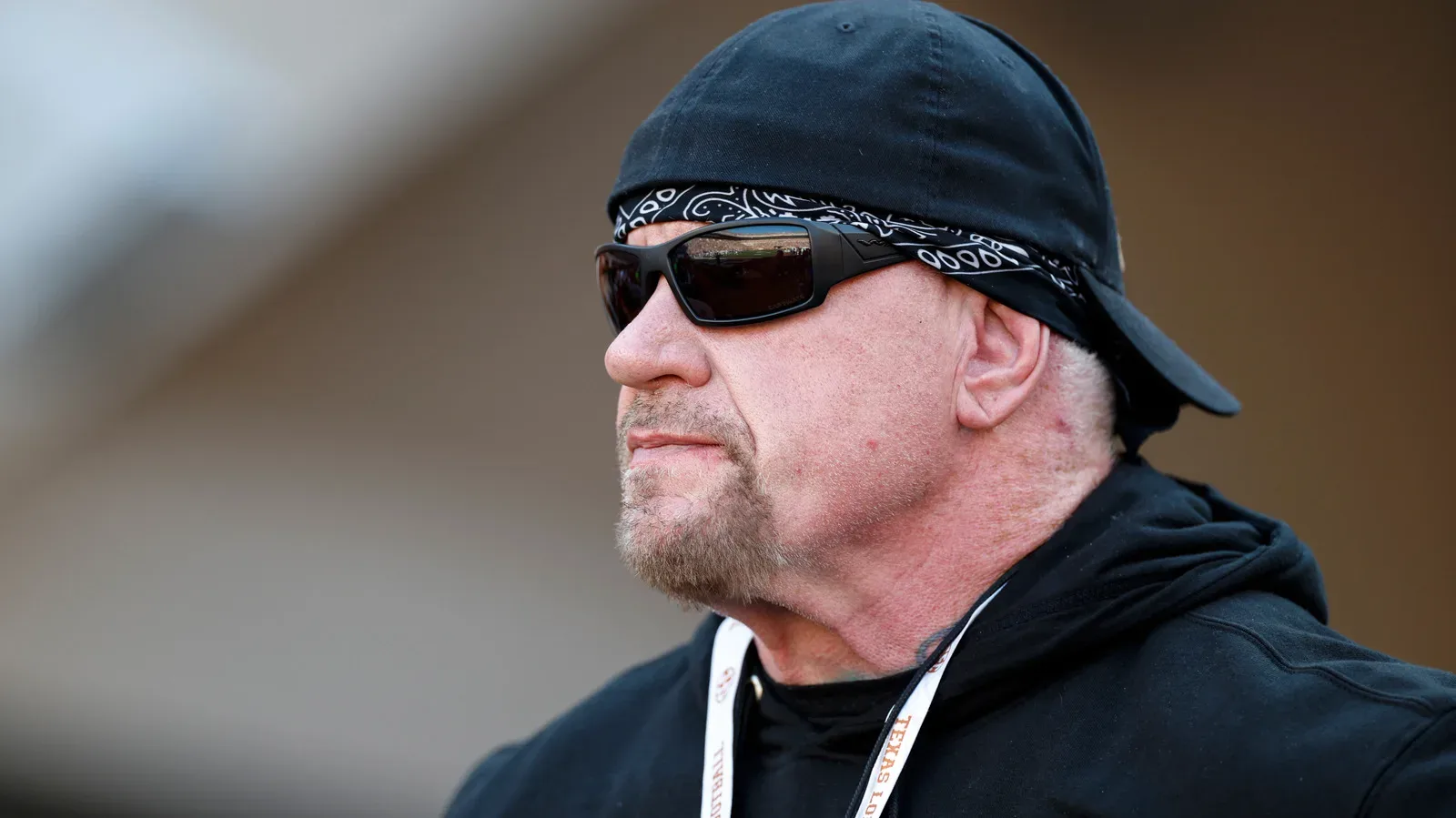
Omos has described his work with Mark “The Undertaker” Calaway in Lucha Libre AAA Worldwide as one of the most meaningful opportunities of his professional wrestling career.
For a performer whose physical stature immediately makes him stand out in any locker room, Omos’ path has included very different environments since arriving in WWE. He has appeared on the biggest stages in the United States, competed in Japan, and now works extensively in Mexico through AAA. That international experience has given the towering WWE star a broader perspective on wrestling, but Omos made clear that learning under Calaway’s guidance has been especially significant.
Speaking with MuscleManMalcolm, Omos said the chance to work with The Undertaker has fulfilled a longstanding ambition. Calaway’s transition into a key creative role in AAA has put Omos in direct contact with one of the most respected minds and performers in modern wrestling history.
“I mean, to work with the Undertaker has been a dream, you know?” Omos told MuscleManMalcolm.
For more background on this topic, read Sunil Singh Says Collapsed Lung Is Healing, Remains on the Path to Recovery.
The statement carries extra weight given the timing of Omos’ entry into WWE. Omos began his career with the company after Calaway’s full-time in-ring run was winding down. As a result, the possibility of sharing a ring with The Undertaker as an active WWE wrestler never materialized. While that particular opportunity was missed, Omos has now found a different way to benefit from Calaway’s experience.
Rather than working opposite The Undertaker in a match, Omos is able to absorb knowledge from a wrestler whose career spanned generations, eras, territories, and the transformation of WWE into a global entertainment force. For someone still seeking to establish the defining identity of his own career, that kind of access can be invaluable.
“The amount of knowledge I’m soaking up from him has been nothing but transformative,” Omos said. “He’s the man. He’s my guy. I am super stoked by the Undertaker. I can speak about him for days, yeah, he’s the man.”
Omos also called working under Calaway’s guidance “a treat,” a concise assessment of a relationship that appears to have helped shape his current presentation in AAA. The Undertaker’s reputation has long extended beyond his in-ring accomplishments. Throughout his WWE career, he was widely recognized as a locker-room leader with a deep understanding of match structure, character work, crowd response, and the responsibility that comes with being a featured attraction.
Those are particularly relevant areas for a performer like Omos. At his size, he is not positioned as an ordinary wrestler. Every entrance, stare-down, exchange, and loss or victory can carry heightened consequences because audiences naturally view him as a special physical presence. Giant wrestlers have historically needed carefully tailored booking and match construction to preserve that aura while still allowing their personalities and athletic abilities to develop.
AAA Has Offered Omos a Different Setting
Omos remains the largest wrestler associated with WWE, but his time on WWE Raw moved through several distinct roles. He first gained major visibility alongside AJ Styles, serving as Styles’ enforcer before eventually becoming a singles attraction. Later, he was aligned with MVP, a pairing designed to provide the giant with a seasoned spokesperson and strategic manager.
Neither association ultimately became the long-term foundation for Omos’ WWE television presence. His run featured shifts between programs and opponents, and he later disappeared from regular WWE programming. His work in AAA has consequently drawn attention as a potentially more consistent platform for the former Raw standout.
The Mexican promotion provides an environment in which spectacle is central to the presentation. Lucha libre is known around the world for its fast-paced style, colorful personalities, mask traditions, passionate fan bases, and dramatic contrasts in size and technique. Omos is an unmistakable contrast to many luchadores, and that contrast can be used to create a unique type of attraction.
A wrestler of Omos’ dimensions does not need to imitate the aerial style that defines much of lucha libre. His value is in forcing opponents and crowds to react differently. Smaller, faster wrestlers can be positioned as daring challengers. Omos can be framed as an obstacle who changes the entire rhythm of a match merely by stepping through the ropes. The key is making those scenarios feel purposeful rather than repetitive, and experienced guidance can help a performer identify where the drama is strongest.
Calaway’s body of work offers obvious lessons in that regard. The Undertaker was able to reinvent elements of his act repeatedly while retaining the core mystique that made him recognizable. He worked as a supernatural figure, a menacing biker persona, a locker-room standard-bearer, and a major-event specialist. He also faced wrestlers of vastly different sizes and styles, from giants and power wrestlers to technicians, high-flyers, and brawlers.
For Omos, learning from a figure with that range could help in developing the details that turn sheer size into a complete character: pacing an entrance, holding a reaction, selling vulnerability without diminishing credibility, choosing when to unleash offense, and understanding how to give an opponent hope before cutting it off. None of those elements are exclusive to a giant, but they are often magnified when a wrestler is presented as physically overwhelming.
Mexico’s Crowds Have Left a Strong Impression
Beyond his appreciation for Calaway, Omos spoke enthusiastically about the audience experience in Mexico. The WWE star has had opportunities to work internationally, including in Japan, and he placed Mexican crowds among the most electric he has encountered.
“I’ve had the privilege of wrestling in Japan and wrestling in Mexico, it’s — the crowd is just electric, I can’t explain it,” Omos told MuscleManMalcolm.
He added that the response is not limited to one market or a select group of major cities. In Omos’ view, the energy has followed AAA from place to place.
That observation speaks to one of the defining strengths of Mexican wrestling. Lucha libre crowds are often intensely engaged with the emotional framework of a match. They react strongly to heroes and villains, celebrate spectacular moments, and create a distinctive atmosphere through chants, noise, and visible investment in the action. The relationship between performer and audience can feel immediate, particularly when a wrestler embraces the role the crowd has assigned them.
For Omos, competing in that atmosphere offers a useful contrast to wrestling on weekly American television. WWE’s production is built around a global broadcast product, precise timing, and the demands of live television. AAA operates within a wrestling culture with its own history, rhythms, and expectations. Working both environments asks a performer to adapt without losing the essential qualities that make them stand out.
International experience can be particularly useful for wrestlers who are still defining their long-term role. A performer may discover different ways to engage an audience, learn which elements of a character travel across language barriers, and gain confidence in front of crowds that respond on their own terms. Omos’ comments suggest that Mexico has been more than simply another destination on his schedule. It has been a setting that has energized him.
A Valuable Stage for Omos’ Next Chapter
Omos’ AAA work also arrives at a notable point in his career. He has already been presented alongside major WWE names and has wrestled in high-profile situations, yet the question surrounding him has often been how fully his enormous potential can be realized over a sustained period. The answer will depend on more than size. It will depend on consistency, character development, adaptability, and the ability to make each appearance feel important.
AAA gives him a chance to continue building those qualities in front of audiences that clearly stand out to him. The presence of The Undertaker as a guiding influence makes the arrangement even more compelling. Calaway understands the pressure of being treated as an attraction rather than simply another member of the roster, and he understands how to make longevity possible in an industry that constantly changes.
Omos’ praise did not come across as casual admiration for a wrestling legend. He specifically emphasized the practical benefit of the knowledge he is receiving and called it transformative. That language suggests he sees the AAA experience as an active period of growth, not a detour from his WWE identity.
Whether Omos’ development in Mexico leads to a larger role on WWE programming, continued prominence in AAA, or both, his current situation has placed him in an unusual and potentially beneficial position. He is working internationally, receiving guidance from one of wrestling’s most accomplished figures, and performing before crowds he describes as electric in every city.
For Omos, the opportunity is simple to describe even if its potential impact could be substantial: a dream chance to learn from The Undertaker while continuing to find his voice as one of wrestling’s most physically imposing stars.
In pictures

Darryl Polo
Darryl Polo is a passionate wrestling fan covering WWE, AEW, TNA and beyond. He loves great rivalries, breakout stars and the moments that keep fans talking long after the bell. How we work.