
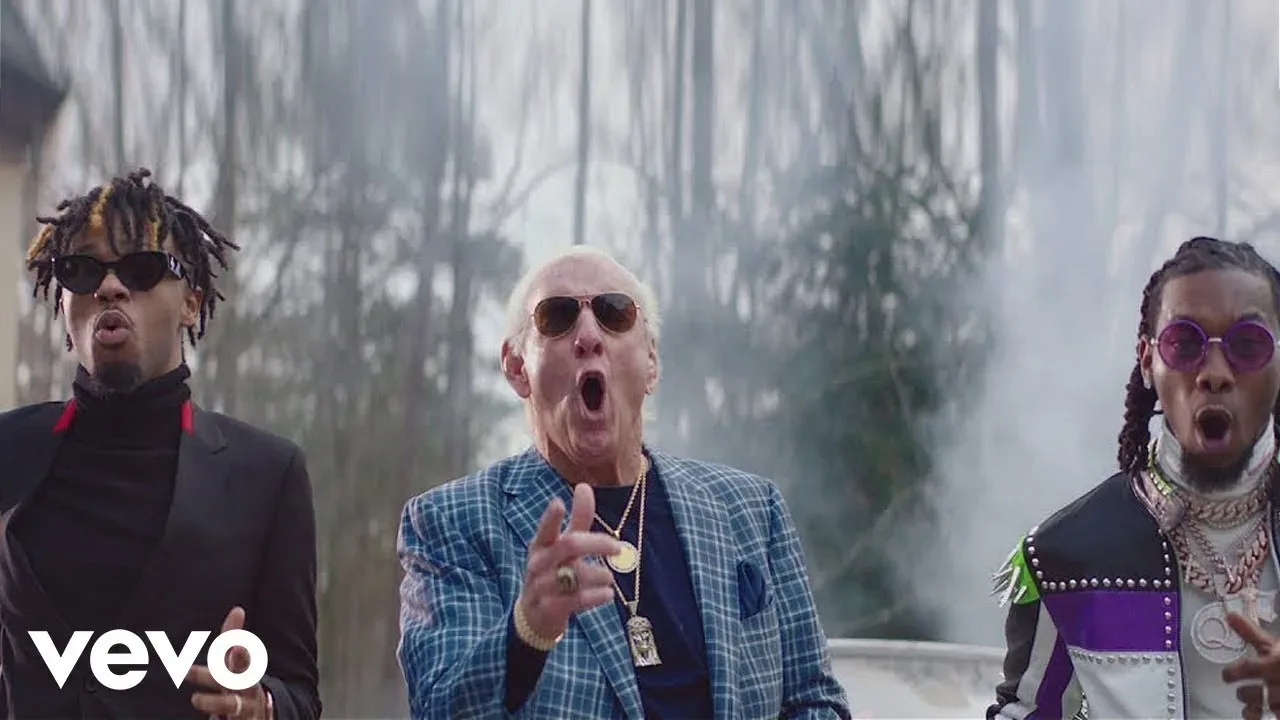
Offset has addressed the lingering financial conversation around “Ric Flair Drip,” saying Ric Flair’s public comments about the record hurt him personally while also making clear that he still considers the WWE Hall of Famer a friend.
The song, released during the height of Offset’s work with Metro Boomin and 21 Savage, became a major crossover moment between hip-hop and professional wrestling culture. Its title, lyrical references and Flair’s larger-than-life persona made it an especially recognizable track for wrestling fans, while the record’s success reached far beyond that audience. “Ric Flair Drip” has been certified six-times platinum.
Flair has embraced his association with the song over the years and appeared alongside Offset in promotional settings, including a memorable appearance on The Tonight Show Starring Jimmy Fallon. However, the relationship became a subject of public discussion in 2024 when Flair said he had received just $39,000 connected to the song. Flair also criticized what he portrayed as a vastly unequal split of the revenue generated by the record.
Speaking in a new interview, Offset said those remarks caught him off guard because his prior experiences with Flair had been positive. He said the comments were painful precisely because he viewed Flair as more than a celebrity collaborator.
For more background on this topic, read Enzo Amore Reflects on Working With John Cena and Backs a Future Presidential Run.
“It’s been a minute. Ric Flair hurt my feelings though, man,” Offset said. “That’s my brother but he hurt my feelings.”
Offset recalled Flair suggesting in an interview that he had made approximately $70 million from “Ric Flair Drip” while Flair received roughly $40,000. Offset disputed the implication that he had left Flair out of the financial side of the project. He stated that he took steps to ensure Flair was paid even though, in Offset’s understanding of the situation, WWE held rights connected to Flair’s name.
“Every time he would talk prior to that, it was always good and positive, it was love,” Offset said. “But I made sure that he got paid because he wasn’t supposed to, like WWE owns the name. So technically, I had to pay them but I made sure to cut in him.”
The exact business arrangements behind the song, including the relevant licensing, ownership and payment structure, have not been publicly detailed in full. Offset did not lay out a specific figure that Flair was paid, nor did he provide documentation regarding the revenue figures that have circulated publicly. His comments instead focused on his belief that Flair had been treated fairly and that Flair had benefited from their work together.
That distinction is important in a situation involving a famous wrestling name, a commercially successful recording and multiple parties who may have had separate interests in its use. The title “Ric Flair Drip” is closely tied to Flair’s well-established identity, but the track was created and released within the music industry, where recording, publishing, distribution, performance and licensing income can all be treated differently. WWE’s ownership interests in elements of Flair’s wrestling presentation further complicate any outside discussion of who was entitled to receive what.
Offset said that he and Flair had shared celebratory moments after the song’s rise. He pointed to their television appearance, which he said has accumulated 12 million views, as one example of how prominently Flair was included in the record’s broader cultural run.
“I did Jimmy Fallon with him, 12 million views,” Offset said. “Even after, he would call me and tell me like, ‘Yo, I just got this bag, you put me back in the game with this song.’”
Offset also said Flair contacted him after acquiring a Rolls-Royce, framing those conversations as evidence that the two men had maintained a warm relationship and that Flair was enjoying a renewed level of visibility and opportunity. For Offset, that history made Flair’s later complaints feel especially disappointing.
“Then I see him, he called me when he got the Rolls Royce,” Offset said. “He’s back in, he’s still styling and profiling.”
“Styling and profiling,” of course, is one of the signature phrases most associated with Flair. It reflects why the song’s title worked so effectively: Flair’s image has long extended beyond the ring. From his robes and championship legacy to his interviews and catchphrases, Flair remains one of the most sampled, referenced and imitated personalities in wrestling history. “Ric Flair Drip” turned that decades-old public character into a modern musical reference point for a new audience.
There is also a human element to Offset’s response that goes beyond money. He did not present his comments as a declaration that he had cut ties with Flair. Instead, he expressed frustration with the way the issue was discussed publicly and suggested that outside voices may have contributed to the tension.
“I love you though Ric, don’t let them bait you into try and like,” Offset said. “It’s love between [us].”
That message leaves the door open for the two to move beyond the disagreement. Offset’s tone was not one of hostility toward Flair, even while he plainly said the remarks had hurt his feelings. He continued to refer to Flair as “my brother” and emphasized the positive history they had built around the song.
A Crossover Hit With Lasting Wrestling Relevance
The discussion has resurfaced because “Ric Flair Drip” remains one of the most prominent examples of a current music act using a wrestling legend’s identity as a central part of a hit record. Wrestlers have appeared in music videos, been named in lyrics and collaborated with artists for decades. Yet few instances have had the sustained mainstream recognition of Offset’s song and its connection to Flair.
For WWE, Flair’s name remains commercially valuable despite the many different chapters of his career. Flair is synonymous with world-title success, charismatic interviews and a persona that has influenced generations of performers inside and outside wrestling. Any use of that identity in a major entertainment property can raise questions about intellectual property rights as well as personal compensation.
Offset’s remarks do not settle those questions. They do, however, offer his side of a dispute that has largely played out through public comments. He maintains that he made an effort to compensate Flair, believes Flair was brought into the record’s success rather than shut out of it, and remains bothered that their relationship was characterized as though he had profited at Flair’s expense.
Flair’s 2024 comments, meanwhile, reflected his own view that the amount he received was dramatically out of proportion to the song’s performance. Both perspectives can coexist as personal accounts of a complicated business arrangement, particularly without a complete public accounting of the relevant deals. What is clear is that the numbers cited publicly have created an enduring point of friction around what had once looked like an uncomplicated crossover success.
Offset’s Continued Connection to WWE
Offset has remained visible in WWE-related settings beyond the legacy of “Ric Flair Drip.” He most recently appeared for WWE on the February 23, 2026 edition of Raw, where he was involved in a segment with Je’Von Evans. That appearance showed that the connection between Offset and wrestling remains active, even as the rapper now addresses a difficult chapter involving one of WWE’s most iconic names.
His latest comments suggest he would prefer not to turn the disagreement with Flair into a prolonged public feud. Rather than escalating his criticism, Offset emphasized affection and respect while asking Flair not to be influenced by people attempting to create division. Whether Flair responds publicly remains to be seen.
For now, the story of “Ric Flair Drip” carries two parallel realities. It remains a six-times-platinum hit that introduced or reintroduced Flair’s unmistakable persona to countless listeners. At the same time, it has become a reminder that successful celebrity crossovers can generate difficult questions about rights, recognition and compensation long after the initial celebration ends.
Offset’s position is clear: he feels wounded by Flair’s comments, but he does not want that hurt to erase the relationship they built. In his view, there is still love between them—even if the financial conversation around one of wrestling culture’s biggest music moments remains unresolved.

Darryl Polo
Darryl Polo is a passionate wrestling fan covering WWE, AEW, TNA and beyond. He loves great rivalries, breakout stars and the moments that keep fans talking long after the bell. How we work.