
Nicolas Cage has drawn a direct comparison between the Marvel Cinematic Universe and WWE while sharing his perspective on the direction of blockbuster filmmaking.
Speaking during a Q&A appearance at FAN EXPO Dallas, Cage discussed the prominence of superhero movies, their elaborate costumes and the increasingly action-centered presentation of their stories. The actor, who has not appeared in the Marvel Cinematic Universe, said the comparison came from a place of affection, but he nonetheless characterized the franchise as becoming a “well-funded and glorified WWE.”
“The MCU is becoming a… I do say this with love. When I see these 50-plus otherwise intelligent, remarkably gifted thespians putting on these ridiculous outfits and getting ready for the fight, and let’s face it, it is cutting all to the fight, it’s hard for me not to be reminded that the MCU is becoming a well-funded and glorified WWE.”
Cage’s remark puts WWE at the center of a larger conversation about spectacle in modern entertainment. His wording focused on a number of qualities often associated with both superhero blockbusters and professional wrestling: highly recognizable visual identities, larger-than-life characters, physical conflict as a central attraction and an audience expectation that the presentation will continually escalate.
For more background on this topic, read WrestleMania 43 Date Could Be Announced Around WWE Crown Jewel in Riyadh.
The comparison was not framed as a dismissal of WWE. Cage explicitly prefaced the thought by saying he made it “with love,” while also voicing concern about how much attention superhero stories place on building toward the next fight sequence. The actor’s point was directed at the structure and visual scale of the MCU, particularly when acclaimed performers are placed in heightened costumes and stories built around confrontation.
Why WWE Is an Easy Comparison for Major Franchise Entertainment
WWE has long operated with an entertainment model that makes its stars instantly identifiable. Ring gear, entrance music, catchphrases, signature moves and carefully constructed personas all help turn wrestlers into characters an audience can understand within seconds. A WWE presentation can introduce a conflict quickly, establish emotional stakes and eventually bring that issue to the ring for a physical resolution.
That basic approach has obvious overlap with superhero storytelling. Comic-book characters are built around distinct costumes, powers, moral alignments and rivalries. Their biggest confrontations are often saved for climactic battles. In WWE, rivalries likewise commonly culminate in matches designed to settle a dispute, advance a character’s story or create a defining visual moment for a performer.
Cage’s observation, however, was specifically about emphasis. He described seeing accomplished actors in “ridiculous outfits” preparing for combat, then noted that the films are “cutting all to the fight.” In that formulation, WWE becomes shorthand for a polished, high-investment form of entertainment where physical conflict is not simply one component of the experience but a crucial engine for the overall presentation.
There is also a notable difference between the two mediums. WWE’s fight sequences are the foundation of the product rather than a detour from it. Matches are where wrestlers communicate character, progress rivalries and seek to deliver the most memorable part of a show. A superhero film may devote major resources to its action set pieces, but it still has to balance those scenes with its dramatic story, dialogue and world-building. Cage’s critique appears to be that the balance in the MCU has increasingly tilted toward the physical spectacle.
A Comparison That Reflects WWE’s Mainstream Reach
Professional wrestling comparisons have become increasingly common in discussions of mainstream pop culture because WWE’s language is so widely understood. Even people who do not follow every weekly show can recognize the broad framework: heroes and villains, entrances, alliances, betrayals, dramatic promos and a major showdown. The company’s presentation has made those elements accessible far beyond the core wrestling audience.
For that reason, calling something “WWE” can mean different things depending on the speaker and context. It can refer to pageantry, theatricality, athletic performance, melodrama or the way a story builds anticipation for a clash. Cage’s comments touched most directly on spectacle and combat, with his phrase “well-funded” also highlighting the enormous resources available to a franchise such as the MCU.
His mention of “otherwise intelligent, remarkably gifted thespians” further underscored that he was not questioning the ability of the performers involved. Instead, he was pointing to the contrast between the reputations of the actors and the stylized material they are asked to perform. Wrestling has always embraced that same contrast in its own way. Performers can be elite athletes, persuasive talkers and serious students of their craft while portraying characters designed to be visually bold and immediately legible to a live crowd.
That mixture of skill and theatrical excess is part of WWE’s identity. The costumes and characters may be heightened, but the demands on the talent are substantial. Wrestlers must perform in front of large audiences, execute physically demanding matches and sustain emotional reactions over the course of lengthy storylines. The fact that Cage reached for WWE as his comparison reflects how firmly that style of larger-than-life performance has become embedded in the entertainment landscape.
Cage’s History With Comic-Book Material
Although Cage has not been part of the MCU, he has a lengthy association with comic-book-inspired projects and characters. That makes his comments especially notable, as they do not come from someone completely detached from the genre’s appeal. He has played Johnny Blaze in the Ghost Rider films and has also voiced Spider-Man Noir in Spider-Man: Into the Spider-Verse.
His remarks at FAN EXPO Dallas did not reject superhero entertainment as a concept. Rather, they raised a question about the creative priorities behind some of its most prominent modern examples. Cage’s use of the phrase “with love” is important in that respect. The statement was a colorful criticism of what he sees as a fight-first tendency, not a suggestion that spectacle or stylized performance have no value.
WWE viewers are particularly familiar with the challenge of blending those ingredients. The company must give fans the major matches and physical moments they expect, while also making sure the matches are supported by enough character motivation and narrative clarity to matter. When the build to a showdown is strong, the eventual bell-to-bell action gains meaning. When the story around it does not connect, even a technically impressive contest can struggle to carry the same emotional weight.
That is a dynamic that extends well beyond wrestling. The most successful franchise stories often make viewers care about the people involved before asking them to invest in the next large-scale battle. Cage’s comments speak to that tension, using WWE as the most vivid available comparison for entertainment built around visual identity and conflict.
WWE and Marvel Continue to Occupy Similar Pop-Culture Space
The overlap between WWE and Marvel as global brands is not limited to Cage’s analogy. Both operate in spaces where iconography is essential. A silhouette, color scheme, logo or signature gesture can carry meaning before a character speaks. Both also rely on audiences developing attachments to personalities and returning to see the next chapter in an ongoing narrative.
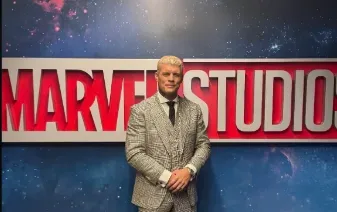
In August, Cody Rhodes shared a photo from a visit to Marvel Studios, another sign of the natural interest that can exist between two major entertainment worlds built around character-driven spectacle. Rhodes is one of WWE’s most recognizable current stars, and the image prompted attention because of the shared cultural territory occupied by WWE and superhero entertainment.
Cage’s comment is unlikely to end discussion about the MCU’s creative direction, particularly among viewers who have debated the role of visual effects, physical sets and action sequences in modern franchise filmmaking. But it also gives WWE a striking place in that discussion. His description recognizes the scale, polish and instantly recognizable theatrical presentation associated with the wrestling giant.
For WWE, being invoked as the comparison for a massive superhero universe says something about the company’s enduring cultural footprint. Its brand of athletic theater has become a reference point for how modern entertainment presents conflict, costumes and crowd-pleasing spectacle. Cage may have been critiquing the direction of superhero films, but his words also acknowledged WWE as a defining model for big, bold and deliberately larger-than-life performance.

Darryl Polo
Darryl Polo is a passionate wrestling fan covering WWE, AEW, TNA and beyond. He loves great rivalries, breakout stars and the moments that keep fans talking long after the bell. How we work.