
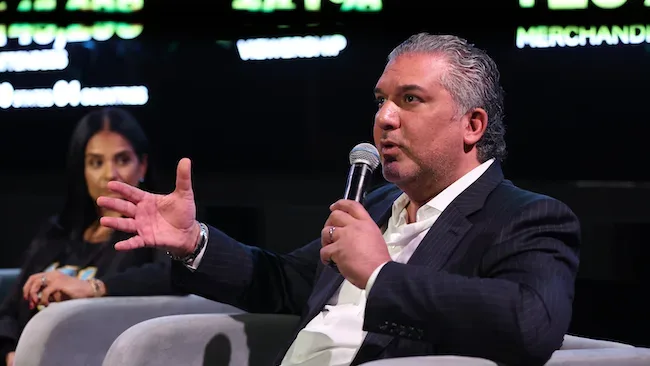
WWE President Nick Khan says the company pays attention when fans raise legitimate concerns, but he does not believe a major sports and entertainment business can make decisions by reacting to every wave of social media criticism.
Speaking on The Varsity with John Ourand, Khan addressed the increasingly visible relationship between WWE, its audience, and online conversation. The discussion began with fan complaints surrounding access to premium live events after WWE’s ESPN arrangement launched last summer. At the time, ESPN Unlimited was not available through every provider, creating a point of frustration for viewers who expected to be able to watch WWE’s biggest events through their existing television packages.
Khan said that availability has since expanded, specifically noting that ESPN Unlimited is now offered through YouTube TV and Comcast. The executive acknowledged that access issues were an example of the kind of feedback WWE will examine and, when appropriate, address.
“Those complaints, some of them we look at and say, ‘There is some truth to this. Let’s make a little adjustment to this or that,’” Khan said.
For more background on this topic, read Bronson Reed Targets Oba Femi, Says He Beats ‘Unbeatable’ WWE Stars.
That distinction was central to Khan’s comments. He did not dismiss fan reaction outright. Instead, he argued that there is a difference between identifying a practical issue affecting consumers and allowing the constant churn of online opinion to dictate company strategy.
For WWE, the ESPN Unlimited availability issue was tangible. Fans were asking whether they could access premium live events through particular providers, and the expansion to YouTube TV and Comcast directly addressed that concern. In Khan’s view, companies should be willing to recognize those types of problems. But he said an organization loses direction if it treats every complaint, trending topic, or viral response as a mandate to change course.
WWE’s Approach to Online Fan Reaction
Social media has become an unavoidable part of professional wrestling. Fans can react to a match, a storyline development, a talent’s booking, a production choice, a ticketing issue, or a streaming problem in real time. That immediacy gives audiences a direct avenue to voice praise and frustration, while WWE and every other major promotion can track public sentiment more closely than ever before.
However, Khan said that being aware of the conversation is not the same as being governed by it.
“But you cannot cater. For companies that read it, believe it, and react to it, it never ever works,” Khan said.
Khan framed the issue as one that goes beyond wrestling. He noted that sports fans, generally, are highly vocal and suggested that complaining is a routine part of being invested in a team, league, or entertainment property. He also pointed to online predictions about the Michigan Senate Primary as an example of why social media reactions and perceived consensus should not automatically be treated as a reliable reflection of the broader public.
His larger point was that companies must avoid making short-term reactive decisions based on loud segments of online discussion. WWE has one of the largest and most active digital fan bases in wrestling, meaning every major creative development can instantly produce competing responses. Some viewers may want a story accelerated, others may want it abandoned, and still others may have entirely different ideas about which performers should be prioritized.
Those debates are part of the wrestling experience, particularly around WWE’s weekly programming and premium live events. Khan’s comments indicate that WWE sees value in monitoring feedback without surrendering its longer-term plans to it.
That approach does not mean the company will never pivot. Wrestling creative has always required adjustments due to audience response, business considerations, scheduling, and changing circumstances. Rather, Khan stressed that WWE must trust its internal leadership to distinguish between meaningful feedback and the kind of moment-to-moment reaction that can pull a product in too many directions.
Khan Calls Triple H the Best Creative Leader in Wrestling
In explaining why WWE should trust its decision-makers, Khan offered emphatic praise for Paul “Triple H” Levesque, WWE’s Chief Content Officer and the man responsible for overseeing the company’s creative direction.
“You have to rely on your team to know we have the best creative in terms of all of wrestling in Triple H, real name Paul Levesque, the best live events team, and the best merchandise and consumer products team,” Khan said.
The endorsement from Khan is notable because it places Levesque’s creative work within WWE’s broader corporate strategy. WWE’s programming is not only designed to serve weekly television viewers. Its stories and star presentation also feed into ticket sales, premium live events, merchandise, sponsorships, licensing, and other major business areas.
Levesque’s creative leadership has been a major focus for WWE since he assumed the Chief Content Officer role. Under his direction, WWE has emphasized longer-form storytelling, expanded attention to talent across the roster, and continued to treat premium live events as major destinations on the company calendar. The exact creative choices may generate differing opinions among fans, but Khan made clear that WWE’s leadership remains confident in Levesque and the team around him.
For a company at WWE’s scale, the creative process is larger than a response to a single audience poll or social media trend. It involves judging how stories will develop over weeks and months, how talent can be positioned for growth, how live crowds are responding, and how programming supports the company’s major events and commercial objectives.
Khan’s remarks suggest WWE believes consistency in that process is vital. Fans can voice their opinions and the company can recognize when criticism reveals a real issue, but the ultimate responsibility for shaping the product remains with Levesque’s creative group.
Business Growth Remains Part of the Conversation
Khan also connected WWE’s operating philosophy to the larger growth of TKO and its collection of businesses. WWE and UFC are the two best-known brands under the TKO umbrella, alongside operations including On Location, IMG, and PBR. Khan said those businesses have continued to grow each year and emphasized the importance of having the right people in place to make decisions.
“They’re able to monetize it. If you’ve seen the growth in TKO with UFC, WWE, on location, IMG, and PBR, each of these continues to grow every year,” Khan said. “It’s not easy, but it’s not supposed to be easy. We have to continue to develop and redevelop what we do and make sure we have the right team in place to help make the right decision.”
The reference to monetization underscores the scope of WWE’s modern business model. A successful WWE storyline or major attraction can have effects well beyond television ratings. It can create demand for live event tickets, drive merchandise sales, strengthen media-rights partnerships, and increase interest in destination events. That is why WWE executives often discuss creative and fan engagement alongside distribution, consumer products, and the live-event business.
With premium live events now connected to ESPN Unlimited, the viewing experience itself has become another crucial part of that equation. A creative decision can only have its full intended impact if the audience can access the event where the story reaches its climax. Khan’s acknowledgement of the early provider concerns, and his update regarding YouTube TV and Comcast availability, showed how WWE is addressing the practical side of its evolving media presentation.
Listening Without Losing Direction
Khan’s comments reflect a balancing act that applies to virtually every major wrestling company, though the stakes are especially high for WWE because of its scale. Fans expect to be heard, and in some cases their concerns can expose genuine obstacles in the product or its distribution. At the same time, a global company cannot credibly operate through constant public referendums on every storyline, match placement, character direction, or business decision.
The WWE President’s position is that useful feedback should be considered, particularly when it points to an issue that can be concretely improved. But he believes the company must retain confidence in its creative, live events, and consumer products leadership rather than chase every online reaction.
For Khan, that starts with Levesque’s creative stewardship. WWE’s ability to maintain momentum will depend on whether its team can continue developing stars, presenting major events, and adapting to legitimate consumer needs without allowing the loudest digital responses to determine the company’s identity from one day to the next.
Darryl Polo
Darryl Polo is a passionate wrestling fan covering WWE, AEW, TNA and beyond. He loves great rivalries, breakout stars and the moments that keep fans talking long after the bell. How we work.