
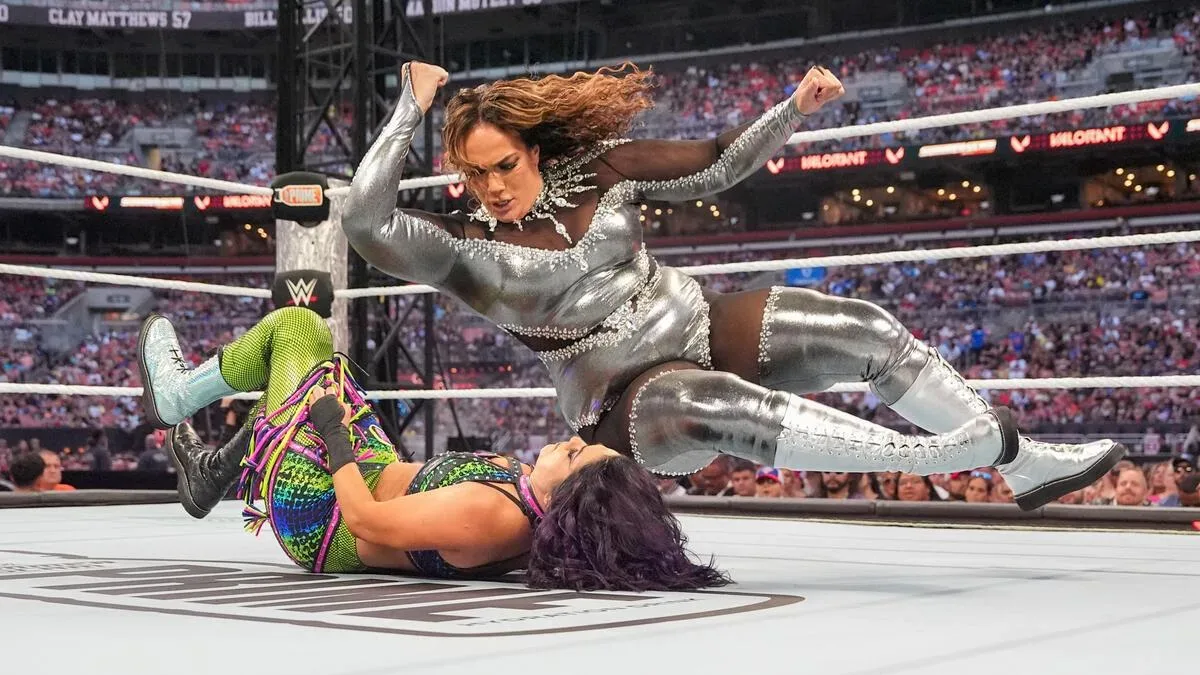
Nia Jax believes WWE’s women’s division has spent the better part of a decade demonstrating that it can occupy the biggest position on a card, both inside the wrestling business and in the wider entertainment landscape.
Jax, who began her WWE run in NXT during the black-and-gold era before becoming a regular presence on the main roster, reflected on the company’s increased emphasis on women’s wrestling in a recent interview. Her comments focused on the period in which WWE increasingly presented women as central attractions rather than simply a separate portion of the show.
That shift has included women receiving prominent championships, longer featured matches, major storyline investment and high-profile main-event opportunities. For Jax, the evolution was not simply a matter of visibility. She framed it as a sustained effort by the performers themselves to establish that women can deliver at the same level as the men in athletic competition and in-ring storytelling.
“I agree because I was there in the black and gold when Hunter was really making the women… kind of just making the show about how good the women are,” Jax said. “He really did invest in us and like prove to like the whole wrestling industry that women are just as good as an athlete as the men, and if not sometimes better and storytelling in the ring.”
For more background on this topic, read Nia Jax Admits Tiffany Stratton’s Money In The Bank Plan Is Difficult To Argue With.
Jax Looks Back on the NXT Foundation
Jax’s perspective comes from having been present during a consequential stretch for WWE’s women’s wrestling. Her developmental tenure took place in NXT, where the women’s division increasingly became one of the brand’s defining attractions. That era helped establish an expectation that women’s matches could receive major time, serious creative stakes and a featured place on the program.
In her remarks, Jax specifically referenced “Hunter,” a clear reference to Paul “Triple H” Levesque, who led NXT during its black-and-gold period and later assumed WWE’s chief content role. Jax credited that environment with putting the emphasis on how good the women were rather than treating their matches as an obligatory segment on the show.
That distinction is central to her point. Being placed on a card is different from being positioned as a reason for viewers to watch. The growth Jax described was rooted in women being trusted to carry rivalries, define major events and make their matches feel like essential parts of WWE programming.
WWE’s presentation of women has changed considerably over the course of Jax’s career. The company has held women’s championship matches in prominent premium live event slots, built entire shows around women’s competition and regularly used women’s title programs as major television stories. In that environment, performers have had more opportunities to demonstrate range beyond the ring, including character work, promo segments and long-form rivalries.
Jax is herself a multi-time Women’s Champion and tag team champion, making her one of the talents who has worked across several stages of that transformation. Her career has included NXT, main-roster championship programs and tag team competition, giving her a firsthand view of how the division’s opportunities have broadened.
A Decade of Women in Major WWE Roles
Jax placed the timeline of the change at roughly a decade, describing that span as a period in which WWE’s women have increasingly taken over major positions on cards.
“So, you know, it’s been about like, I want to say a decade of us women in WWE kind of just like taking over, you know, like being in the main event picture and sometimes being the best match on the card over the men,” Jax said. “So, you know, we have been kind of proving into the entertainment industry that women can hold that top spot.”
The phrase “top spot” carries significance in professional wrestling, where the main event has traditionally been viewed as the clearest measure of a promotion’s confidence in a match, storyline or performer. Main events are asked to close the show, sustain audience attention and deliver a sense of consequence appropriate to the event’s final moments.
Jax’s argument is that WWE’s women have repeatedly met that standard. She did not limit the conversation to athletic performance, either. Her emphasis on storytelling recognizes the broader demands of WWE’s product. A top-level act must connect with an audience through rivalries, personalities and the ability to make the result matter before the bell rings.
That is also why her comments extend beyond wrestling itself. WWE is a global entertainment company, and its most prominent talent are often presented as personalities capable of leading programming, promotional campaigns and major events. Jax sees the women’s division as having made a wider statement: women can be positioned as central attractions and can successfully handle the responsibility that comes with that placement.
More Than a Separate Division
The importance of Jax’s remarks lies in how she describes the women’s roster not as an isolated division but as a group competing for the most meaningful real estate on the overall program. A strong women’s match, in that view, is not noteworthy merely because it is a women’s match. It is judged alongside every other match and segment on the card.
Jax said women have at times been “the best match on the card over the men,” a statement that speaks to the competitive standard she believes has been established. WWE programming contains many moving parts, and a card can feature championship stakes, personal feuds, established stars and emerging names. To stand out in that setting requires far more than a favorable placement.
It requires the performers to create an investment that lasts. The best wrestling stories often combine clear motivations, escalating conflict and a payoff that feels earned. Jax’s praise for women’s storytelling indicates that she considers those elements a major reason the division has been able to thrive in marquee roles.
Her comments also underline the cumulative nature of the progress. The evolution was not the product of one match, one event or one champion. It was built through years of women being given chances to perform in substantial situations and then delivering in those situations. As more talents gained experience at that level, the expectation for women’s matches and stories also rose.
That kind of momentum can change how a roster is viewed internally and externally. When women regularly headline, their rivalries are no longer framed as exceptions to the traditional structure of a wrestling card. They become part of the structure itself.
Jax’s Place in WWE’s Continuing Evolution
Jax remains a notable voice on the subject because she has been a fixture of WWE women’s programming since the mid-2010s. She entered the company during a period of transition, worked in NXT as its women’s division became a major point of focus and later moved into a main-roster landscape where women’s championships and rivalries held increasing importance.
Her own résumé reflects the range of opportunities available across that time. As a multi-time Women’s Champion and tag team champion, Jax has been part of both singles and team-focused title pictures. Those roles put her in the middle of the kind of high-stakes programming she is discussing.
The current generation of WWE women also continues to compete in an environment shaped by those earlier developments. Rising names and established champions alike are expected to deliver not only strong matches but compelling characters and stories capable of commanding major television time. Jax’s comments suggest that this expectation is evidence of progress rather than an added burden: the women are being asked to do more because they have shown they can do more.
There is still a natural competitive element to any WWE roster, and Jax did not suggest that men and women should be evaluated by different standards. Instead, she argued for the opposite. Her message was that the women have proven they belong in the same conversation for top match, top story and top position on any given show.
For Jax, the result of that decade of work is a broader recognition of what women’s wrestling can be within a major entertainment platform. WWE’s women are not merely filling a designated segment. In her view, they have demonstrated the ability to lead the card, close the show and give audiences performances that stand alongside anything else on the program.

Darryl Polo
Darryl Polo is a passionate wrestling fan covering WWE, AEW, TNA and beyond. He loves great rivalries, breakout stars and the moments that keep fans talking long after the bell. How we work.