
Netflix’s on-demand version of the September 28 episode of WWE RAW contains significant visual edits to the show-closing angle involving Jacob Fatu, Jaida Parker, Royce Keys and the 946 group.
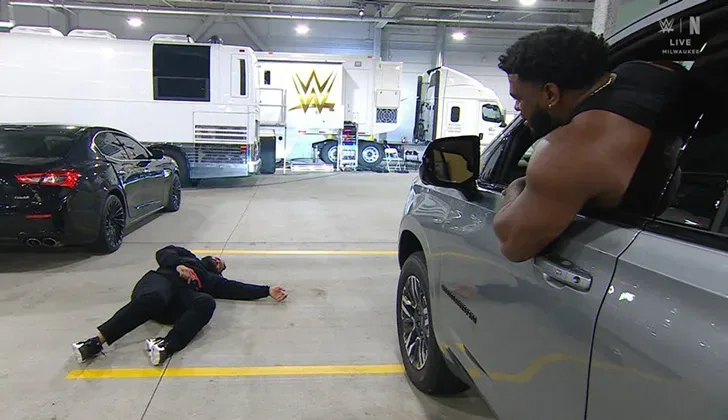
The episode ended with a dramatic confrontation between 946 and The Bloodline that escalated into an automobile attack on Fatu. In the version now available through Netflix, the screen reportedly cuts to black at two of the angle’s most violent moments: when Keys uses a car door against Fatu and when Parker drives another vehicle into the Samoan Werewolf.
The edits do not change the broader storyline outcome. Parker’s alignment with the Royce Keys-led 946 remains a central development from the segment, while Fatu was left as the victim of the group’s closing assault. However, viewers watching the archived RAW broadcast on Netflix do not see the full visual presentation of those key spots as they originally aired.
View the referenced post on X
What happened at the end of WWE RAW
RAW’s closing sequence centered on a brawl between 946 and The Bloodline. The confrontation spilled into a vehicle-related attack on Jacob Fatu, one of WWE’s most physically imposing stars and a major presence within The Bloodline’s orbit.
For more background on this topic, read Lola Vice Says She Feels Ready for WWE Raw After Main Roster Call-Up.
Royce Keys first slammed a car door into Fatu’s face. The angle then intensified when Jaida Parker, using a separate car, ran over Fatu. The attack simultaneously gave 946 a decisive upper hand and established Parker as aligned with Keys’ group.
That development was designed to leave a strong final image for the episode. Parker’s involvement represented more than a surprise appearance in the chaos; it positioned her alongside 946 at the expense of Fatu and The Bloodline. The segment also underscored the willingness of Keys and his allies to use extreme methods in their conflict.
On Netflix, though, the most explicit portions of the car attack have been obscured. The video goes black at the point of the car-door strike and again during the moment Parker runs Fatu over. The result is that the story beats can still be understood from the surrounding footage, but the physical impact of the angle is substantially reduced for on-demand viewers.
A pattern of edits on archived RAW programming
This is not the first time Netflix’s version of WWE RAW has differed from the original presentation in ways that affect controversial or potentially graphic material. Previous replay edits have removed or softened instances involving profanity and blood.
Those adjustments have prompted continued attention from fans comparing the live broadcast presentation with the version that remains available to stream afterward. In some cases, the edits appear to be aimed at language or visuals that a platform may deem unsuitable for its replay library. The September 28 RAW conclusion is especially noticeable because the blackouts occur during the central action of the final storyline segment rather than during a brief isolated shot.
Netflix has also altered camera presentation in another recent RAW example. During the September 14 episode from Mexico City, World Heavyweight Champion Roman Reigns entered ahead of his title defense against Penta. The replay presentation changed camera angles to avoid showing fans making obscene gestures toward Reigns during his entrance.
That prior adjustment and the newest edits illustrate that changes can extend beyond simply muting an isolated word. In the Mexico City instance, the archived version avoided a crowd visual through alternate camera coverage. In the Fatu angle, the September 28 replay instead uses black screens to bypass the impact moments.
The distinction between live storytelling and replay viewing
WWE’s weekly programming increasingly exists in more than one form: the live version experienced as it airs and the archived version watched later through a streaming platform. When an edit involves a major segment, fans who only see the replay can receive a materially different visual experience even if the basic storyline is unchanged.
For this RAW angle, the essential narrative remains intact. Fatu was attacked. Keys was involved. Parker joined forces with 946. The Bloodline was left dealing with the fallout. Yet the execution of the moment matters in professional wrestling, where a major angle often depends on a single shocking visual to establish danger, betrayal or escalation.
The original closing imagery was meant to portray a severe assault on Fatu. By cutting to black at the car-door impact and the vehicle strike, the replay version asks viewers to infer much of that brutality from the audio, reactions and aftermath rather than showing it directly.
That difference could be particularly relevant as WWE follows up on the attack. Any future references to Fatu being run over, or to Parker’s decision to align herself with 946, will stem from an event that some viewers watched in full and others saw in edited form. The storyline implications are the same, but the emotional weight of the segment may land differently depending on which version was viewed.
Jaida Parker’s move changes the situation around 946
Parker’s role in the closing angle is a major piece of the story beyond the streaming edit itself. Her alignment with the Royce Keys-led 946 gives the group another ally and makes the attack on Fatu a statement of intent rather than simply a one-night ambush.
The segment placed Parker directly on the side opposing The Bloodline. By participating in the attack with the car, she made her position unmistakable. It was not a subtle association or an accidental involvement in a crowded brawl; the presentation framed her as an active participant in 946’s assault.
For Fatu, the attack adds another layer to his ongoing issues with the group. The Samoan Werewolf has built a reputation around intensity and resilience, which made him a natural target for an angle designed to show 946 pushing a conflict past ordinary ringside violence. A car attack is a major escalation in WWE storytelling, and the blacked-out replay footage does not lessen the fact that the narrative presented Fatu as being placed in serious jeopardy.
Keys, meanwhile, was shown setting the tone before Parker’s involvement. His use of the car door against Fatu established the dangerous direction of the scene, and Parker’s subsequent action delivered the closing escalation. Together, the sequence gave 946 a defining moment against a group as prominent as The Bloodline.
Why the edits have drawn attention
Professional wrestling television regularly walks a line between spectacle and standards for broad audiences. WWE angles can involve fights, weapons, blood and staged injuries, while streaming services may make separate decisions about what remains in an on-demand catalog. The September 28 RAW edits have drawn attention because they affect a heavily promoted-style climax involving vehicles and a major WWE figure.
Rather than using a different camera shot to lessen the effect, the Netflix replay employs a direct blackout during the two moments in question. That makes the alteration immediately apparent to anyone familiar with the unedited presentation or with discussion of the angle afterward.
The decision also raises the familiar question of continuity for archived wrestling content. Fans returning to an episode to revisit a turning point in a rivalry may not receive the exact same material that was initially broadcast. In this case, the edited version still communicates the result of the attack and Parker’s allegiance, but it does not preserve the complete visual record of how the angle was originally staged.
As RAW moves beyond September 28, attention will turn to Fatu’s condition within the storyline and to the next steps for Parker, Keys and 946. The attack gave the group momentum, Parker’s decision reshaped the sides in the conflict, and The Bloodline now has a clear reason to seek a response.
For viewers revisiting the episode on Netflix, however, the most severe parts of that pivotal finish are no longer shown in full. The archived broadcast retains the storyline consequences of the assault on Jacob Fatu, while blacking out the exact moments that made the ending so startling in the first place.

Darryl Polo
Darryl Polo is a passionate wrestling fan covering WWE, AEW, TNA and beyond. He loves great rivalries, breakout stars and the moments that keep fans talking long after the bell. How we work.