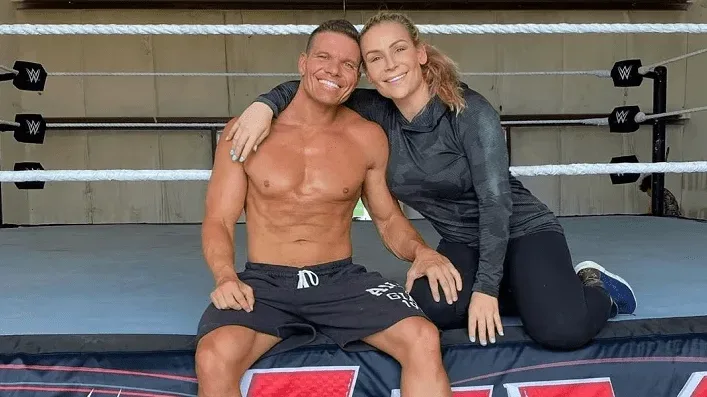
Nattie has offered more insight into her recent work with the National Wrestling Alliance, including the role her husband, WWE producer TJ Wilson, played during the NWA tapings that featured her appearances on Powerrr.
Speaking during her Hart Beat segment on Busted Open, Nattie said Wilson came to NWA to help produce her matches alongside Sal Rinauro. More than simply having an additional trusted voice available for her own bouts, Nattie said she wanted Wilson to work directly with the women at the tapings and introduce them to the detailed learning environment associated with the Hart family’s Dungeon tradition.
The comments give added context to Nattie’s NWA involvement. Her appearances brought a veteran WWE presence to the company’s programming, but she framed the experience as an active in-ring and creative collaboration rather than a straightforward guest role. Nattie wanted to wrestle, sharpen her own craft and provide the talent around her with the kind of match preparation she believes can make a meaningful difference.
“Every single girl that I get the chance to work with, I also wanna give a very deep learning experience of going over stuff,” Nattie said. “I brought T.J. (Wilson) into NWA as well to be my producer there along with a gentleman named Sal (Rinauro), who’s an awesome producer at NWA. But I really wanted T.J. to come too because I wanted him to work with me and work with the women and for everyone to get the experience that we give at The Dungeon.”
For more background on this topic, read Nattie Says TJ Wilson Filmed Episode of Charlotte Flair’s New Podcast.
A Familiar Creative Partner at Ringside and Behind the Scenes
Wilson, who is also known to wrestling fans as Tyson Kidd, has built a reputation as a producer following the end of his active in-ring career. His work in WWE has placed him behind the scenes on major matches and with prominent performers, making his presence at an NWA taping notable even though Nattie made clear that the immediate purpose was tied to the work she was doing there.
For Nattie, the arrangement meant having a collaborator who understands both her wrestling instincts and the level of preparation she expects. That familiarity can be especially useful when working with wrestlers from another locker room, where there may be limited time to establish rhythm, discuss match structure and review the smaller details that can define a finished performance.
She also pointed to Rinauro’s contribution, calling him an “awesome producer” at NWA. Nattie’s description did not present Wilson as replacing NWA’s existing process. Instead, it placed him alongside Rinauro as part of an expanded effort to prepare her matches and help the women involved get more out of the opportunity.
That distinction matters. Producers do much more than map out a list of moves. They can help performers clarify character motivations, build a match around the crowd response, establish a logical escalation and ensure that transitions between key moments feel natural. For wrestlers at different stages of their careers, the chance to receive direct feedback from experienced veterans can be as important as the match itself.
Bringing a Dungeon-Style Learning Experience to NWA
Nattie connected the NWA sessions to the values of The Dungeon, the influential Hart family training environment that has long represented a rigorous, detail-oriented approach to professional wrestling. The Hart legacy is inseparable from Nattie’s career, and she has repeatedly emphasized the importance of preserving that knowledge while continuing to evolve as a performer.
Her stated goal was not merely to tell younger wrestlers what to do. She wanted to create a deeper experience built around going over material, examining what works and helping talent understand the reasoning behind the choices made in a match. That approach reflects the reality that professional wrestling is learned not only through live reps, but also through the discussions before and after those reps.
Nattie said NWA owner Billy Corgan was pleased with the arrangement. The benefit for the promotion is apparent: a group of women working on its tapings had access to Nattie’s experience as a longtime top-level performer and to Wilson’s perspective as an established producer. It also offered Nattie a setting in which she could engage closely with performers outside of WWE’s usual ecosystem.
The NWA has continued to roll out Powerrr episodes featuring Nattie from those tapings. Her comments suggest that viewers are seeing only one part of what took place. The televised matches are the public result, while much of the value Nattie described came from the preparation, discussions and individual work conducted around them.
Nattie Says the Teaching Process Is Also for Her Own Growth
While Nattie spoke enthusiastically about helping other wrestlers, she pushed back on the idea that her role should be viewed entirely as selfless mentorship. She was candid that there is a personal competitive benefit in the process, and she does not see any need to hide that motivation.
“I know Billy Corgan was thrilled with it because we really love giving back but, here’s the thing: I’m not just giving back,” Nattie said. “I have a very selfish interest in what I’m doing as well, and I wanna make that clear because it’s one thing to be like, ‘Oh, she’s so giving. She’s doing this, she’s helping elevate young talent.’ No, no, no, no, no, no, no, no. There’s a reason why somebody like Seth Rollins has a school.”
Nattie used Seth Rollins as an example of a wrestler whose role in coaching and developing others can coexist with his own pursuit of excellence. The point was not that teaching takes away from an active performer’s career; in her view, it can strengthen it. Explaining the craft requires a wrestler to articulate ideas that may otherwise be instinctive, and that process can sharpen their own decision-making.
“Yeah, Seth loves giving back too and I’m sure he’s an amazing coach, and an amazing teacher and has a ton to give, but when you help others, you dial in yourself, and the more I help other people, the sharper I get,” Nattie said.
That perspective is particularly revealing coming from a wrestler with Nattie’s longevity. After years at the highest level of WWE, she is not describing instruction as a ceremonial transition away from active competition. She sees it as part of remaining engaged, disciplined and prepared for her own performances.
It is also a philosophy that fits the history of professional wrestling training. Many of the industry’s most influential performers have simultaneously wrestled, coached, produced or helped shape matches for others. The process demands an understanding of crowd psychology and pacing that can reinforce the fundamentals an experienced wrestler already knows.
What It Means for Nattie’s NWA Appearances
Nattie’s explanation adds another layer to her NWA run. On screen, the focus naturally falls on her matches and interactions within the promotion. Off screen, she was attempting to create an environment where the women working with her could receive more intensive guidance from both her and Wilson.
There is no suggestion in Nattie’s comments that she was taking credit for the work of the NWA roster or its existing staff. In fact, she specifically praised Rinauro’s role. Her message was that she and Wilson brought an additional resource to the tapings, one rooted in their experience and in the training standards Nattie associates with The Dungeon.
For the women involved, the chance to work with Nattie and Wilson could offer a different kind of feedback than they receive in their regular routines. Every promotion has its own rhythms and creative priorities. Exposure to another productive process can give performers new ways to think about preparation, pacing and the choices that connect a match’s opening moments to its finish.
For Nattie herself, the payoff is equally clear. She wants to keep learning through teaching, stay precise by breaking down the craft and continue treating every opportunity as a chance to improve. Her NWA work, as she described it, has allowed her to pursue all of those goals at once.
Wilson Continues to Be Active Beyond WWE Production Work
Wilson’s involvement at the NWA tapings came as he continues his work as a WWE producer. Nattie’s comments spotlighted a specific instance in which his experience was brought into another environment to support her matches and work with the women’s division.
Elsewhere, Wilson has also filmed material for Charlotte Flair’s new podcast. That appearance is separate from the NWA work Nattie discussed, but it further reflects his ongoing visibility within wrestling circles despite no longer competing as an active wrestler.
As additional Powerrr episodes featuring Nattie arrive, her remarks provide a useful lens through which to view the matches. She was not simply passing through NWA for a handful of televised moments. Nattie approached the experience with a producer’s mindset, a trainer’s interest in detail and a competitor’s desire to leave sharper than she arrived.
Darryl Polo
Darryl Polo is a passionate wrestling fan covering WWE, AEW, TNA and beyond. He loves great rivalries, breakout stars and the moments that keep fans talking long after the bell. How we work.