
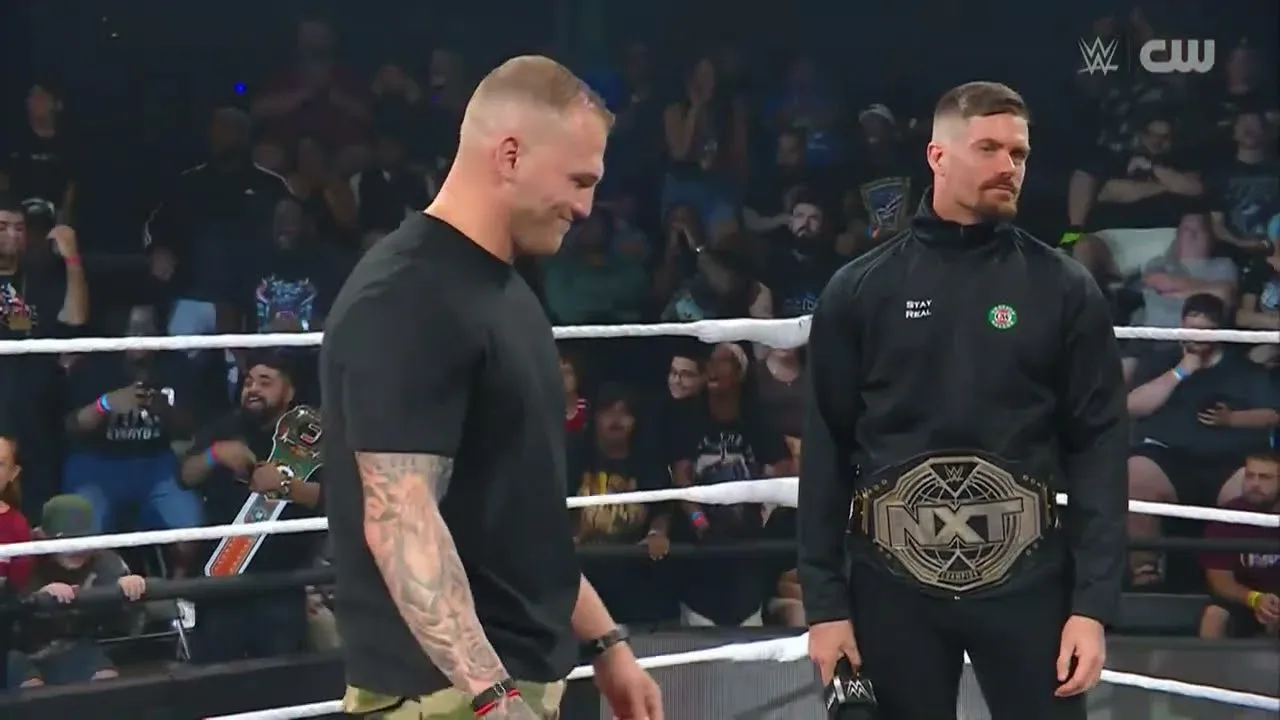
Myles Borne is not giving Grayson Waller the reaction he may have wanted from his Stephanie Vaquer t-shirt stunt.
During a recent episode of WWE NXT, Waller arrived at the WWE Performance Center wearing a Stephanie Vaquer shirt while attempting to get under Borne’s skin. Rather than treating the choice as an effective insult or a meaningful distraction, Borne turned the argument around: Waller bought officially licensed merchandise, which means he financially supported Vaquer.
For Borne, that detail outweighs any intended mind games. He sees Waller’s move as a contribution to Vaquer’s success, not an attack on her or on Borne.
“He literally went out and spent his own hard-earned money on her T-shirt,” Borne said. “All you did was put money on our table. You put food on our table that night. Thank you, I appreciate it.”
For more background on this topic, read Myles Borne Laughs Off ‘What?’ Chants After NXT Promo: ‘You’re Wasting Your Energy’.
The exchange is a familiar kind of conflict in WWE, where wrestlers often look for visual statements that can travel quickly beyond the ring. A t-shirt, a sign, or a strategically chosen piece of gear can become the center of attention if it sends a personal message. Waller has long leaned into that kind of provocative presentation, and wearing Vaquer merchandise gave him a simple way to associate himself with Borne’s situation while inviting a response.
Borne’s answer, however, was to deny Waller the emotional payoff. His position is that a wrestler wearing another performer’s licensed shirt does not diminish that performer. It boosts the performer’s visibility and directly supports the business around the merchandise.
“If you thought you got me, that’s not getting me,” Borne said. “You’re a contributor. You’re a fan at that point.”
Borne says the shirt became the real story
Borne also suggested that Waller’s attempt to control the conversation did not work because viewers focused less on what Waller was saying and more on the shirt itself. That, in Borne’s view, reinforced Vaquer’s star power.
“I hate to say it, but everyone took away the t-shirt,” Borne said. “You wore a T-shirt, and no one cared about what you were saying; they cared about the T-shirt.”
That is an important distinction in Borne’s response. He did not merely say that Waller failed to upset him. He argued that the stunt actively shifted attention away from Waller and toward Vaquer. In a business driven by personality, recognition, and crowd response, being the person people remember after a segment can matter more than being the person who initiated the segment.
Borne went further by declaring that Vaquer remains the more significant attraction in the situation.
“At the end of the day, like it or not, she’s a bigger star,” Borne said. “Wear the T-shirt if you want to; I really don’t care. You can put food on our table. If you thought you got me, you didn’t get me.”
The comment does not leave much room for ambiguity. Borne’s response is built around confidence in Vaquer’s standing and an unwillingness to allow Waller to define the meaning of the moment. Rather than arguing about why Waller wore the shirt, Borne embraced the basic fact that the shirt represented an official product tied to Vaquer.
The merchandise detail changes the framing
Waller’s shirt was officially licensed Vaquer merchandise. That point sits at the center of Borne’s argument. In wrestling storylines, a performer’s merchandise can be used as a taunt, a tribute, or an expression of fandom, depending on the context. Waller clearly used it in an antagonistic setting. But Borne’s response places the emphasis on the purchase itself rather than Waller’s intended attitude.
That framing allows Borne to turn an attempted jab into an endorsement. The shirt may have been worn to provoke, but it also displayed Vaquer’s name and image. It also represented money spent on a product connected to her. Borne’s message is that those realities are impossible to separate from Waller’s attempt to make the moment uncomfortable.
It is also notable that the licensed Vaquer shirt was not the shirt Waller originally wanted to wear. No further details about that intended shirt were provided in Borne’s remarks. Still, the version that did make it onto NXT television became the subject of discussion, and Borne was ready with an answer that focused on what the visible shirt represented.
Waller’s approach meets Borne’s composure
Waller’s on-screen persona has often revolved around confidence, confrontation, and finding ways to unsettle opponents before a match even begins. That approach can be effective when an opponent appears rattled or is pulled into a back-and-forth on Waller’s terms. Borne’s remarks show a different strategy: refuse to grant that the provocation had any impact.
Instead of disputing the visual or pretending it did not draw attention, Borne acknowledged the shirt and claimed it served Vaquer. He thanked Waller for making the purchase. He called him a contributor. And he said that the shirt overshadowed Waller’s own words.
That response does not erase the possibility that Waller’s appearance was designed to generate a reaction from the NXT audience. It does, however, establish Borne’s public position clearly. He is not treating the shirt as a point of embarrassment, jealousy, or vulnerability. He is treating it as merchandise promotion.
In that sense, the t-shirt episode has become a battle over perception. Waller attempted to use Vaquer’s likeness as a tool for disruption. Borne’s answer is that Vaquer’s popularity is precisely why the tactic cannot work as intended. If fans remember the shirt, Borne believes they are remembering Vaquer—not Waller’s insult.
Stephanie Vaquer remains central to the conversation
The strongest part of Borne’s response is his insistence that Vaquer is the central figure in the entire exchange. He did not try to make the conversation exclusively about himself or his conflict with Waller. Instead, he repeatedly stressed that Waller’s actions brought attention and support to Vaquer.
That is why Borne’s “bigger star” line stands out. It is not simply a defense of Vaquer; it is a direct challenge to Waller’s ability to turn a supporting visual into a moment about himself. Borne’s view is that Waller’s stunt unintentionally confirmed Vaquer’s relevance. If the shirt was memorable, then the name on the shirt was memorable too.
For now, Borne has made his stance unmistakable. Waller can wear Vaquer merchandise, but Borne does not see that as leverage. He sees it as proof that Vaquer’s presence carries weight—and as a purchase that benefits her rather than harms her.
Whether Waller responds with another attempt to escalate the situation remains to be seen. What is already clear is that Borne has chosen not to meet the provocation with visible frustration. His answer is simple: Waller bought the shirt, the shirt drew attention to Vaquer, and the supposed mind game did not land.

Darryl Polo
Darryl Polo is a passionate wrestling fan covering WWE, AEW, TNA and beyond. He loves great rivalries, breakout stars and the moments that keep fans talking long after the bell. How we work.