
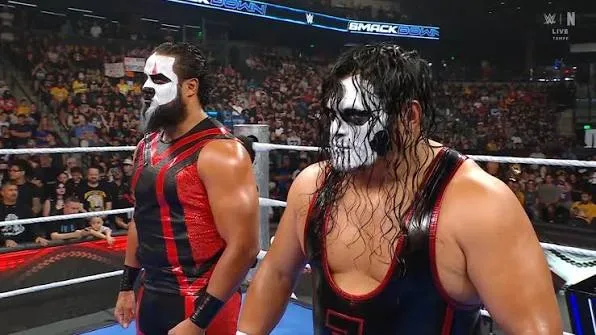
Jeff Cobb has reflected on one of the more unusual adjustments from his WWE tenure, explaining why the face paint he wore as JC Mateo was more difficult to manage than wrestling under a mask earlier in his career.
Cobb was part of WWE’s MFT faction alongside Tama Tonga, Talla Tonga and other members of the group. During that run, the faction’s presentation included face paint, giving Cobb a visual look that stood apart from much of his previous work. Although paint may appear less restrictive than a full mask from the outside, Cobb said the reality of preparing for and recovering from a match made it the more frustrating option.
Speaking with SOTO619, Cobb was asked to compare the challenges of wearing face paint with those of competing in a mask during his time in Lucha Underground. His answer was direct: the paint was the tougher of the two, even though both looks came with their own complications.
“Paint. Because I’ve never done that before. Although, to be fair, I’ve never done the mask thing before. But the paint was truly different. Because I was told, you’re going to wear the paint like you did in Japan, and I never wore paint in Japan. I think they got me confused with somebody else.”
For more background on this topic, read Sol Ruca Says WWE Has Told Her a Heel Turn May Never Be in the Cards.
A New Look for JC Mateo
The detail about being told he would wear paint “like” he supposedly had in Japan added another layer to Cobb’s experience. He made clear that he had not actually used face paint during his time there, suggesting there was some confusion over his prior presentation before the WWE look was put together.
For performers, a change in appearance can be as important as a change in ring name, alignment or faction. Gear and visual branding help establish a wrestler’s role quickly, particularly within a group presentation. In Cobb’s case, the face paint became part of the MFT identity. But it also required him to take on a routine with which he had no established familiarity.
That distinction mattered. Cobb was not merely returning to a look that had been associated with him elsewhere; he was learning how to work with it in real time. A wrestler has to account for how any addition to their presentation holds up through a match, under bright lights and through the physical demands of performing. Paint also creates a separate logistical issue once the bell rings for the final time.
Cobb described the removal process as the central reason the paint was more difficult than the mask. While a mask could create issues with breathing, it could be put on before a match and taken off afterward without the same extended cleanup.
“But yeah, paint was hard because I had to find paint. But, yeah, the paint was definitely the hardest just for the fact that, like, with the mask, I could put it on. I couldn’t breathe, but I could put it on, and then when I’m done, I could take it off. But the paint took forever to get off. I had to use the wipes. Then I found out the wipes that I used got recalled.”
The Practical Problem With Face Paint
Cobb’s comments underline a side of wrestling presentation that is often easy to overlook. Fans see the finished entrance and the completed ring gear, but the work involved before and after a match can be substantial. Face paint does not simply function as an accessory. It has to be acquired, applied and removed, all while a wrestler is preparing for the demands of the show itself.
For Cobb, the paint’s difficulty was not framed as an issue of in-ring movement alone. He specifically contrasted it with the mask, noting that the mask presented a breathing challenge but offered a much simpler process once he was finished competing. Paint, on the other hand, remained a problem after the performance had ended.
The need to find suitable paint and removal wipes turned an on-screen aesthetic into an off-screen obligation. Cobb’s note that the wipes he used were later recalled made the situation even more inconvenient. It was a small but telling example of how a performer’s day can be affected by details that have little to do with executing a move or telling a story in the ring.
His answer also provides a useful contrast between two forms of wrestling attire that are regularly treated as comparable visual devices. Masks can alter a wrestler’s identity, expression and comfort level. Face paint can do much of the same from a visual standpoint, but it has a different physical and practical impact. Cobb’s experience was that the mask was more immediately restrictive because he could not breathe as easily, while the paint created the longer-lasting headache.
From Lucha Underground to WWE
Cobb’s career has placed him in a range of wrestling environments, and his comments focused on two distinct forms of presentation from different periods. His Lucha Underground mask was one challenge, while the face paint used during his WWE run as JC Mateo was another. He emphasized that neither was something he had extensive prior experience using before those respective situations.
That is significant because it avoids a simple comparison between a veteran mask wearer and a newcomer to face paint. Cobb said he had “never done the mask thing before” as well. In other words, both looks required an adjustment, but the face paint ultimately left the stronger negative impression because of all the work surrounding it.
The conversation also shows how much a wrestler’s identity can shift when joining a faction. As a member of MFT, Cobb’s presentation was connected to the larger unit rather than standing entirely on its own. The paint helped reinforce that group association, even if it was not something he had previously worn in Japan, as he was initially told.
Faction aesthetics have long been a key part of WWE presentation. Matching or complementary attire, coordinated entrances and shared visual elements can immediately communicate unity. Face paint is especially noticeable because it transforms a wrestler’s appearance in a way that viewers can recognize instantly. For Cobb, however, the visual benefit came with a notably less glamorous backstage process.
Cobb’s Candid Assessment
There was humor in Cobb’s recollection, especially when he explained that he believed he had been confused with somebody else over the idea that he had worn paint in Japan. Still, the broader point was clear: the WWE face paint was not an easy addition to his routine.
His assessment was not that a mask was effortless. He plainly said breathing in the mask was difficult. But after a match, he could remove it. The paint lingered, had to be cleaned off with wipes and took considerably more time to deal with. That practical difference decided the comparison for him.
For fans who remember Cobb’s WWE presentation as JC Mateo within MFT, the comments offer context for a look that was designed to make an immediate visual statement. The face paint may have served the faction’s image, but it also gave Cobb a new set of responsibilities that continued well beyond his entrance and match.
Ultimately, Cobb’s answer is a reminder that wrestling gear is never just gear. The most memorable visual choices can require the most work, and in this case, he found that painted face to be more difficult than wrestling behind a mask.

Darryl Polo
Darryl Polo is a passionate wrestling fan covering WWE, AEW, TNA and beyond. He loves great rivalries, breakout stars and the moments that keep fans talking long after the bell. How we work.