
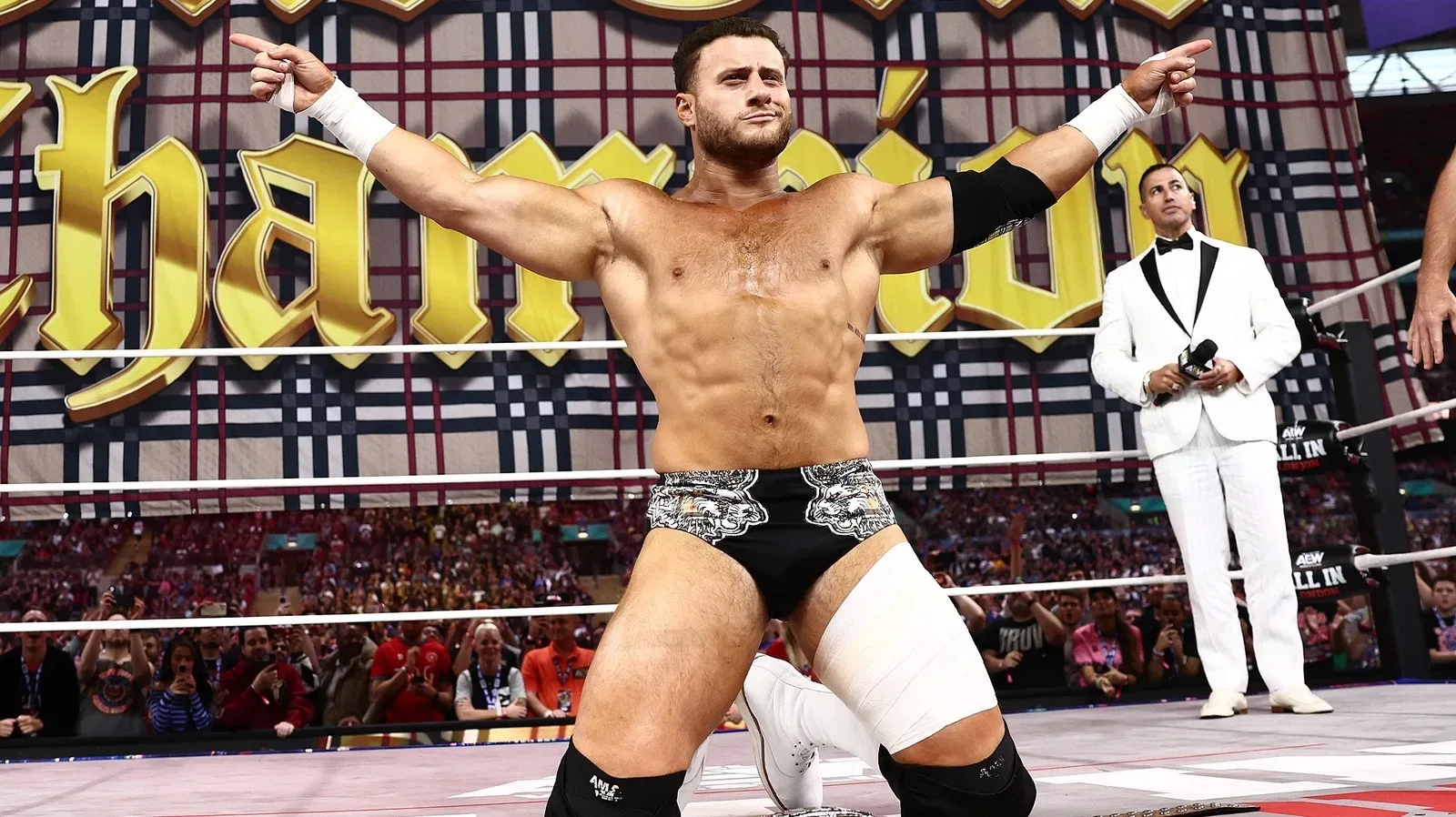
Maxwell Jacob Friedman has made a career out of presenting certainty, whether he is proclaiming himself better than the competition, dismissing doubters, or insisting that every major moment in AEW eventually runs through him. But while MJF remains unwavering in his public confidence, he has acknowledged that his first AEW World Championship reign taught him lessons that changed the way he approaches the wrestling business.
The three-time former AEW World Champion spoke with Pro Wrestling Illustrated about the significance of that initial run at the top of the company. Friedman held the championship for 406 consecutive days, a stretch he identified as AEW's longest unbroken single reign with the title. Looking back, he said the reign contained some of the strongest business the company had ever done, while also exposing him to the costs of putting faith in other people.
“I learned so many lessons in my first world title reign,” Friedman said. “I think it’s safe to say that a brunt of those 406 days is some of the best business our company had ever done.”
That championship run was defined by more than just its length. MJF's reign placed him at the center of AEW's biggest stories and gave fans a notably different side of a performer who had long built his reputation through cruelty, manipulation and self-interest. His partnership with Adam Cole became one of the period's central narratives, turning two rivals into an unlikely team and allowing Friedman to show vulnerability in a way that had rarely been associated with his on-screen character.
For more background on this topic, read Rohan Raja Vows To Shock Andrade And Take AEW National Championship At MLP Northern Rising.
For Friedman, however, that emotional evolution is inseparable from the eventual collapse of the relationship. He described Cole as a “wolf in sheep’s clothing” and pointed to the final two months of his championship reign as a particularly lonely period. The experience of being isolated after Cole's betrayal, in Friedman's view, became the part of the reign that offered its most important education.
The final stretch of a record-setting reign
A 406-day title run naturally brings major expectations. A champion must carry marquee programs, navigate changing challengers, remain a consistent television presence and keep the audience invested in the championship itself. Friedman believes his first reign achieved a great deal on that front, but his reflection was not framed as a victory lap. Instead, he focused on the mistakes he believes were made during the personal side of his time as champion.
“I wanted to stay away from those mistakes that were made and never make them again, and I feel I did do just that,” Friedman said. “I think the biggest lesson that I learned was trusting people has never benefitted anyone in this profession.”
It is an outlook that fits the MJF audiences have often known. Long before his partnership with Cole, Friedman operated with an assumption that loyalty was temporary and that alliances existed only until they stopped being useful. Yet the first AEW World Title reign complicated that image. By allowing Cole, and eventually the audience, closer to him, MJF opened himself to a kind of disappointment that he now says confirmed his oldest instincts.
Friedman argued that betrayal is not an isolated occurrence in professional wrestling. He pointed to the history of tag teams, where friendship and cooperation frequently give way to conflict, jealousy or outright treachery. In that context, his conclusion is not simply that Adam Cole cannot be trusted. It is that trust itself is a dangerous decision in an industry where partnerships often come with an expiration date.
That perspective also extends beyond the locker room. Friedman said he believes he made a similar error by allowing fans to see him in a more open and personal light. The connection he developed with the audience was a major element of his title reign, especially as his relationship with Cole shifted from antagonism to friendship. But MJF now views that decision as one he does not intend to repeat.
“I let them in, if you will. I think that was a massive mistake and a mistake I’m never going to make again,” Friedman said. “I don’t think wrestling fans deserve having me open up to them at that level again.”
Whether fans agree with that assessment is another question. The willingness to show emotion and uncertainty added fresh dimensions to Friedman as a performer, and it helped make the eventual betrayal angle land with greater force. Still, the current MJF is presenting that chapter as a warning rather than a turning point to be celebrated. From his standpoint, being emotionally available did not make him stronger. It gave others an opening.
MJF draws a line between criticism and bad faith
Friedman's comments were not limited to the people closest to him in AEW storylines. He also discussed the constant scrutiny that comes with being one of the company's most prominent names. MJF has never appeared especially concerned with being universally liked, and he maintained that stance while explaining how he evaluates criticism from fans online.
“I don’t care if people like me. That s**t’s for the birds. I’m good on that,” Friedman said.
Still, he did not say that all criticism is meaningless. Friedman made a distinction between messages he sees as hostile attempts to disparage AEW and criticism that comes from people who have a real connection to the promotion and want it to improve. He said he can identify what he considers good-faith criticism versus bad-faith criticism, and that he is willing to listen when a supporter is sincerely invested in AEW's success.
His example was aimed at social media accounts that, in his opinion, signal their intention through a constant stream of negativity toward AEW. Friedman said he dismisses those opinions. Conversely, he said feedback from genuine grassroots AEW fans is worth hearing, even if he does not automatically accept their conclusions.
That distinction is important because it reveals a more measured side to Friedman's typically combative public persona. He may insist that he is right more often than anyone else, but he also recognizes that a performer and a promotion can benefit from understanding what committed viewers are saying. Listening, though, is not the same thing as agreeing.
“I’m always right, and most people are always wrong,” Friedman said.
The statement is classic MJF bravado, but it also underscores the larger philosophy behind his response to criticism. He does not present online feedback as something that can weaken him. Instead, he sees negativity as material he can use. Friedman said that when he encounters a negative post, he may read it while training and convert that reaction into motivation.
“If you find yourself being upset with the way I am on television, and you post about it, just know all you’re doing is feeding the monster!” Friedman said.
For an act built on provoking strong responses, that mindset is not surprising. MJF has spent much of his AEW career making audiences react, whether through outrage, admiration, laughter or emotional investment. His latest comments suggest that he views every one of those responses as evidence of influence. Praise may be welcomed selectively, and criticism may be categorized by intent, but either can keep attention focused on him.
A changed champion with familiar confidence
Friedman's first AEW World Championship reign remains a defining piece of his legacy. The duration alone places it prominently in the history of the title, while the stories surrounding it gave him opportunities to work outside the boundaries of the character fans initially came to know. He was still arrogant and ruthless, but he was also allowed to become attached to another person and to a wider audience.
His present-day interpretation of that run is far more guarded. MJF sees the accomplishments, including the business he says AEW generated during the 406 days, but he also sees a period when lowered defenses left him exposed. The betrayal by Cole and the isolation of the reign's closing months appear to have reinforced a version of Friedman that is determined not to make the same emotional gamble again.
That does not mean MJF has stopped engaging with the audience or stopped using their reactions to fuel his performances. If anything, he has made clear that attention remains valuable, including negative attention. What has changed is the boundary he says he will maintain. The MJF who learned from his first world title reign is still eager to be seen, still eager to be discussed and still certain of his own importance. He simply no longer intends to let anyone mistake access for trust.
In pictures

Darryl Polo
Darryl Polo is a passionate wrestling fan covering WWE, AEW, TNA and beyond. He loves great rivalries, breakout stars and the moments that keep fans talking long after the bell. How we work.