
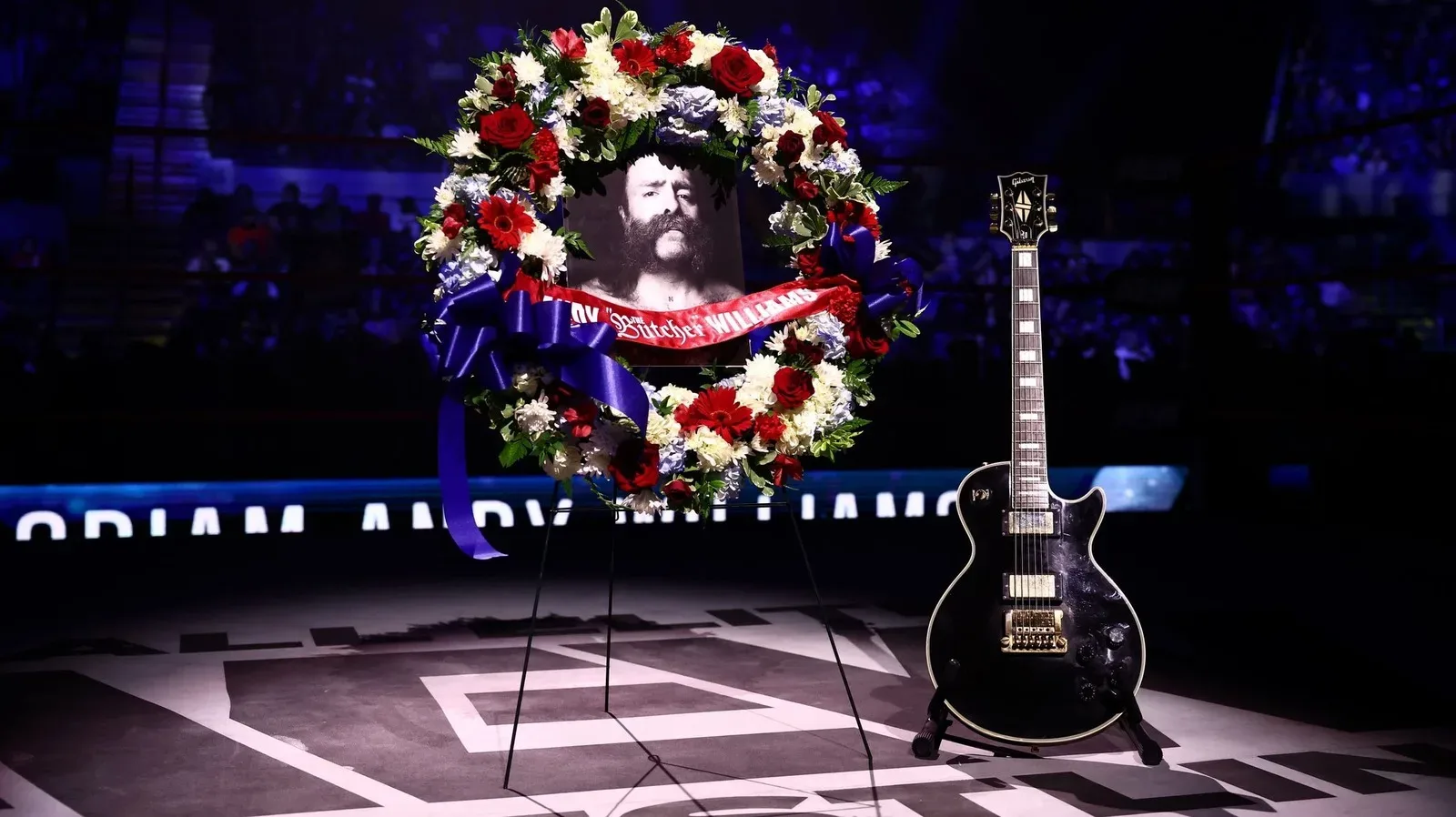
“Speedball” Mike Bailey has reflected on the emotional closing moments of the September 12, 2026 edition of AEW Collision, which was dedicated to the late Andy “The Butcher” Williams.
Williams died on September 5 at the age of 48 after suffering a medical emergency at an Enjoy Wrestling event in Pennsylvania. The loss was felt throughout professional wrestling and music, two worlds Williams had long represented through his work as a wrestler and as a musician.
One week after Williams’ passing, AEW closed Collision with a tribute presentation celebrating his life. The segment included a music video, while members of the AEW roster assembled on the entrance stage and embraced one another as the show came to an end.
Bailey was part of that episode, competing against Jon Moxley in the opening match. In a recent entry on his YouTube vlog, Bailey discussed what it meant to join his colleagues on the stage for the tribute and why the moment resonated even with wrestlers who had not known Williams closely.
For more background on this topic, read Wheeler Yuta Embraces Muta Scale Comparisons After Jon Moxley Blood Battle.
“At the end of Collision, everyone went out on the stage as they played a tribute to Andy Williams, and it was such a great moment for all of us to be going through this together.”
For Bailey, the value of the gathering was not in trying to lessen the sadness surrounding Williams’ death. Instead, it was in the ability of the locker room to be present for one another in a moment of shared grief.
“It has been a very, very difficult week for all of us, and you know, I say this as someone who did not spend a lot of time with Andy. I only met him here and there, but I say this very often, the professional wrestling world is a community, right?”
Bailey’s comments speak to the wider sense of connection that often exists within wrestling, where performers, production staff, and other people around the industry can be affected by a loss regardless of how frequently they worked with the person involved. Williams had been associated with AEW for nearly seven years, making his presence familiar to many members of the company even as he maintained a career and identity that extended beyond the promotion.
The September 12 tribute brought that community together in a highly visible way. Rather than ending the program solely on the night’s in-ring action, AEW concluded with its roster standing shoulder to shoulder as the video played. Bailey described the scene as a reminder that tragedy can be collective, and that support can be collective as well.
“So anytime there is any kind of tragedy that happens, we all feel it, and we all have to and want to be there for each other, and everyone being together on that stage felt really good.”
Williams was known in AEW as The Butcher, a physically imposing competitor whose presentation was closely tied to his background in music. His work in wrestling and music gave him a distinctive place in both communities, and the tribute on Collision leaned into the full scope of that legacy by using a music video to honor him.
While Bailey noted that the emotion of the week remained unavoidable, he viewed the roster’s time together on the stage as something positive amid the loss.
“Even though we’re all experiencing very, very big sadness because of this, this felt like a nice moment of togetherness.”
The placement of the tribute at the end of Collision allowed the entire episode to lead into a final, unified acknowledgment of Williams. Bailey’s opening match against Moxley meant he was present from the start of the broadcast through its closing moments, experiencing a show that carried the normal demands of live wrestling while also serving as a memorial for a fellow performer.
Williams’ AEW contract had technically expired in June 2026. However, AEW President Tony Khan stated that Williams had recently discussed several ideas for connecting the wrestling and music worlds before his death. Those plans underlined how central both fields remained to Williams and how he continued to envision projects that could bring his two professional passions together.
That detail also gives added meaning to AEW’s decision to close the tribute with music. Williams’ identity was never confined to one role. He was The Butcher to wrestling audiences, but his influence and interests reached beyond the ring, and AEW’s memorial presentation recognized that broader creative life.
A Moment That Extended Beyond The Ring
Professional wrestling is built around individual personalities and competition, but it also depends on close working relationships formed through travel, training, live events, and the shared pressure of performing. Bailey’s remarks did not suggest that every person on the stage had the same relationship with Williams. Instead, he emphasized that a community can grieve together even when the connections are different from person to person.
That distinction is important in understanding why the image of the AEW roster gathered on the ramp carried such weight. The tribute was not presented as a routine television closing. It was a moment for people affected by Williams’ death to stand alongside colleagues, acknowledge the loss, and offer support through their presence.
Bailey’s comments also reflect the difficult balance wrestlers and other professionals face after a loss in their industry. Shows continue, matches still take place, and performers must fulfill the responsibilities of live television. Yet the people involved may be grieving at the same time. The September 12 Collision addressed both realities: AEW staged a full episode of wrestling, then made space at its conclusion to honor Williams.
Bailey and Moxley opened that broadcast, placing Bailey in one of the night’s most prominent in-ring positions. But when Bailey later spoke about the episode, his focus was not on the match. His attention was on the closing tribute, the assembled roster, and the comfort he found in sharing that space with others.
Williams’ death remains a profound loss for those who knew him, worked with him, or encountered his work in wrestling and music. Bailey made clear that his own direct time with Williams was limited, but he also made clear that limited personal interaction does not prevent a person from feeling the impact of a tragedy within a close professional community.
AEW Honors The Butcher’s Legacy
AEW’s September 12 broadcast served as a public remembrance of Williams after a painful week for the company and the wider wrestling world. The music video and roster gathering provided the show with a final statement of respect, while Bailey’s recollection offers a personal view from inside the group that stood on the stage.
His description was simple: the sadness was real, the week had been hard, and being together helped. In an environment where performers are frequently expected to project confidence and intensity, the sight of the roster embracing during the tribute offered a different kind of statement—one rooted in solidarity.
For Bailey, that solidarity was the defining part of the moment. The AEW roster could not change the loss, but it could come together to recognize Williams and support one another. As the company continues to mourn Andy “The Butcher” Williams, the final image from that edition of Collision stands as a tribute to both his legacy and the community Bailey described.
In pictures

Darryl Polo
Darryl Polo is a passionate wrestling fan covering WWE, AEW, TNA and beyond. He loves great rivalries, breakout stars and the moments that keep fans talking long after the bell. How we work.