
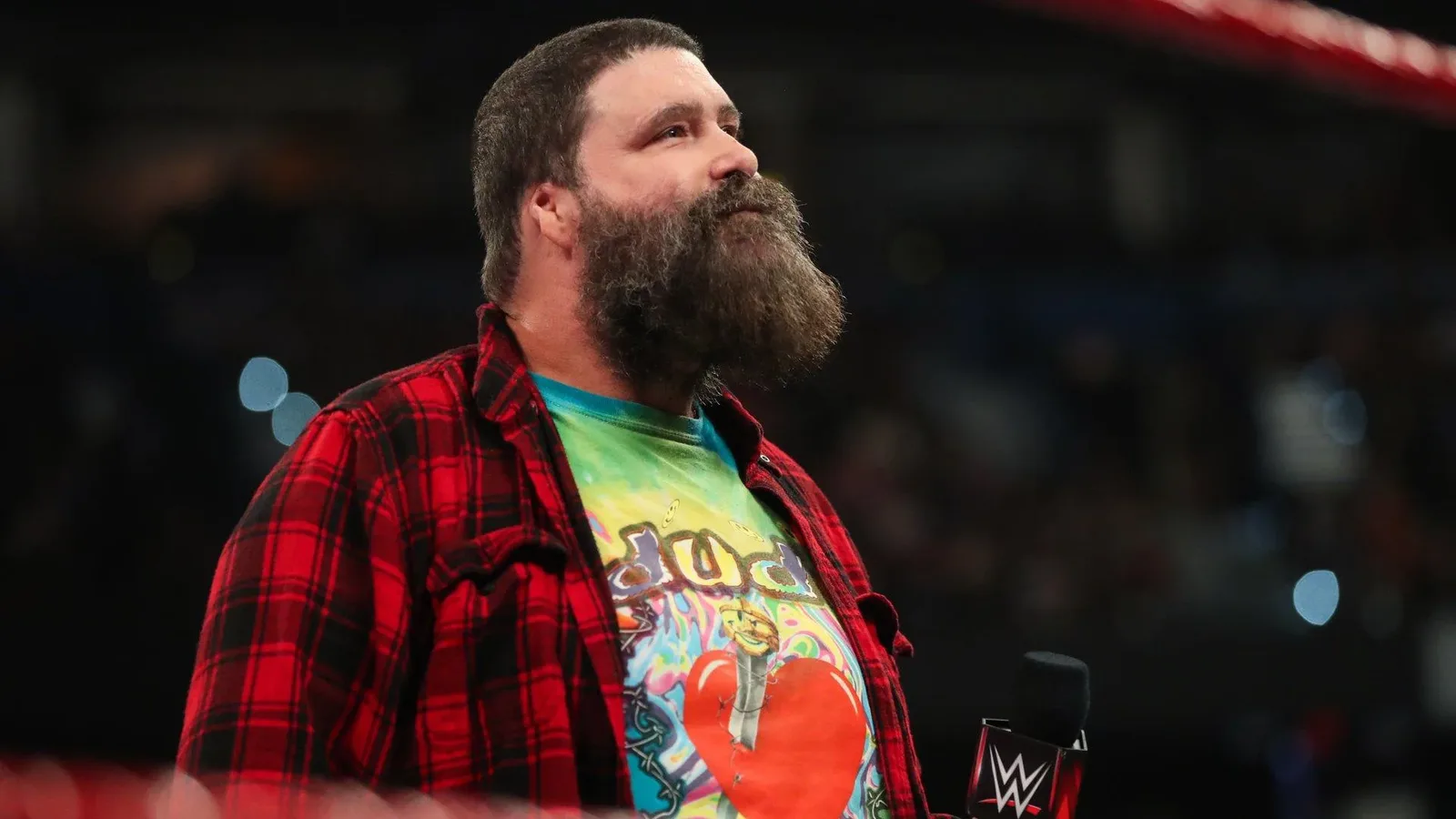
Mick Foley has detailed the substantial financial sacrifice involved in allowing his WWE Legends deal to expire, revealing that the arrangement had accounted for 25% of his income.
The WWE Hall of Famer had previously made clear that he would not continue the deal once it reached its end in 2026. Foley’s decision followed public comments he made near the end of 2025, when he said he would no longer appear on WWE programming or renew his Legends agreement because of WWE’s relationship with the Donald Trump administration.
Foley has followed through on that position. His agreement with WWE expired earlier in 2026, a development he confirmed in July, and he has since signed with All Elite Wrestling. Speaking during an appearance on Wrestling On The Spectrum, Foley explained that the decision came with a real and measurable cost.
“I’m taking a considerable loss. 25% of my income came from the Legends deal. But there are people who talk the talk and people who walk the walk, and I try to walk the walk and have not had a single regret. I miss the money, but I don’t miss the ability to look at myself in the mirror every night.”
For more background on this topic, read Drake Maverick Opens Up On Unexpected Rockstar Spud Return For PROGRESS Wrestling.
A Major Financial Commitment
Foley’s comments offer a rare look at how consequential a Legends contract can be for a retired WWE name. Such agreements can cover WWE’s continued use of a performer’s likeness and name across various licensed products, archival content, promotional material, collectibles, video games, and other projects. The exact terms differ from talent to talent, and Foley did not outline the specific provisions of his former deal.
What he did establish is that the income was not incidental. One quarter of his earnings represented a considerable amount, particularly for someone who has remained active for decades through public appearances, speaking engagements, writing, charitable work, conventions, and professional wrestling-related opportunities.
Foley did not present the decision as painless. In fact, his acknowledgment that he misses the money makes the choice more direct: he understood the financial consequences before the agreement expired and accepted them anyway. His emphasis was not on minimizing that impact, but on explaining why he felt it was worthwhile.
The phrase “walk the walk” has long been associated with Foley’s public persona. Throughout his career, he has often spoken candidly about subjects beyond wrestling and has not generally avoided taking positions that may draw disagreement. In this case, he has said that maintaining his personal convictions mattered more than preserving an agreement that had become a major part of his income.
Foley Did Not Renew With WWE
At the end of 2025, Foley publicly stated that he would not be appearing on WWE television and would not sign a new Legends deal after his existing agreement ended in 2026. The reason he gave centered on WWE’s relationship with the Donald Trump administration.
That position was notable because Foley has had an enduring association with WWE. His legacy includes some of the most memorable characters, matches, and moments of the company’s modern history. Competing as Mankind, Cactus Jack, and Dude Love, Foley became a defining figure of the late 1990s and early 2000s, earning a reputation for unusual versatility as well as extraordinary physical punishment inside the ring.
His WWE résumé includes multiple world championship reigns, the WWE Championship, tag team success, landmark Hardcore Championship moments, and a central place in the company’s Attitude Era history. He was inducted into the WWE Hall of Fame in 2013. Even after his full-time in-ring career ended, Foley continued to make occasional WWE appearances and remained prominently represented through the company’s historical library and merchandise ecosystem.
That history makes the expiration of the Legends deal significant. Foley is not a wrestler whose WWE connection was limited to one short run or a single character. His body of work is deeply interwoven with WWE’s history, from the Hell in a Cell match at King of the Ring 1998 through his WWE title victory on the January 4, 1999 episode of Raw, a moment that remains among the most celebrated in the company’s television history.
Still, Foley’s recent remarks make clear that professional history and present-day business ties are separate considerations. He has not suggested that his accomplishments disappear or that his contribution to WWE is less meaningful. Rather, he has chosen not to continue a commercial relationship under the circumstances he previously described.
No Regrets Despite the Lost Income
The most striking part of Foley’s latest statement is his insistence that he has not had “a single regret.” That does not mean he is unaffected by the loss of revenue. He plainly said otherwise. But Foley drew a distinction between missing the money and regretting the decision that caused him to lose it.
For performers whose careers extend far beyond their active wrestling years, Legends arrangements can provide a degree of stability while allowing promotions to continue marketing well-known names. The financial value can be especially meaningful for stars who built their fame during earlier eras and whose images remain valuable to fans and collectors decades later.
Foley’s account underscores that departing from such an agreement can be a serious professional choice rather than simply a symbolic gesture. By placing the figure at 25% of his income, he has put a clear number on the stakes without disclosing the overall dollar amount involved.
His framing also places the decision in personal terms. Foley said he values being able to look at himself in the mirror each night, indicating that the issue, for him, is rooted in conscience rather than an attempt to generate attention or reshape his wrestling legacy. His comments leave little ambiguity about how he views the trade-off: the financial loss is substantial, but the personal cost of renewing would have been greater in his view.
A New Chapter With AEW
Since his WWE Legends deal expired, Foley has signed with AEW. The signing represents a new formal association for a wrestler who remains one of the industry’s most recognizable and respected veterans.
Foley’s connection to AEW does not change the significance of his WWE career, nor does it erase the lengthy relationship he had with WWE after retirement. It does, however, mean that his current professional alignment is no longer with the company that played the largest role in establishing him as a mainstream wrestling icon.
There has been no indication in Foley’s comments that his move should be viewed solely through a financial lens. Given his disclosure about the money tied to the expiring WWE agreement, it would be inaccurate to assume that signing with AEW fully replaces that lost income or that it was designed to do so. Foley has not provided details about the terms of his AEW arrangement, and no such details should be presumed.
What is clear is that Foley remains engaged with professional wrestling. His presence continues to carry weight because of both his accomplishments and the credibility he earned through a career defined by risk, creativity, and a deep connection with audiences. Whether he is discussing wrestling, appearing in a new environment, or addressing his own business decisions, Foley has retained a willingness to speak plainly.
Foley’s WWE Legacy Remains Intact
The expiration of a Legends deal does not diminish Foley’s standing as one of WWE’s most important figures. Few performers successfully established three distinctly memorable personas at the national level, and fewer still did so while becoming a world champion and delivering several of the era’s most enduring matches.
Mankind’s evolution from an unsettling outsider into a beloved hero remains one of WWE’s best-known character arcs. Cactus Jack embodied a more chaotic and violent edge, while Dude Love showcased Foley’s comedic and flamboyant range. Together, those identities helped make Foley uniquely adaptable during a period when WWE was rapidly changing.
His decision to step away from a lucrative agreement therefore stands as a current business and personal development, not a revision of that legacy. Foley’s achievements remain part of WWE history, and his comments indicate that he recognizes the financial value attached to his name and body of work.
At the same time, he has been unequivocal that he is comfortable with his choice. The former Legends deal represented 25% of his income, and Foley says he misses that money. Yet he has also said he has no regrets, choosing personal conviction over a renewal that would have preserved a meaningful revenue stream.
For Foley, that is the central point. The loss is real, the decision was consequential, and he believes it was the right one.

Darryl Polo
Darryl Polo is a passionate wrestling fan covering WWE, AEW, TNA and beyond. He loves great rivalries, breakout stars and the moments that keep fans talking long after the bell. How we work.