
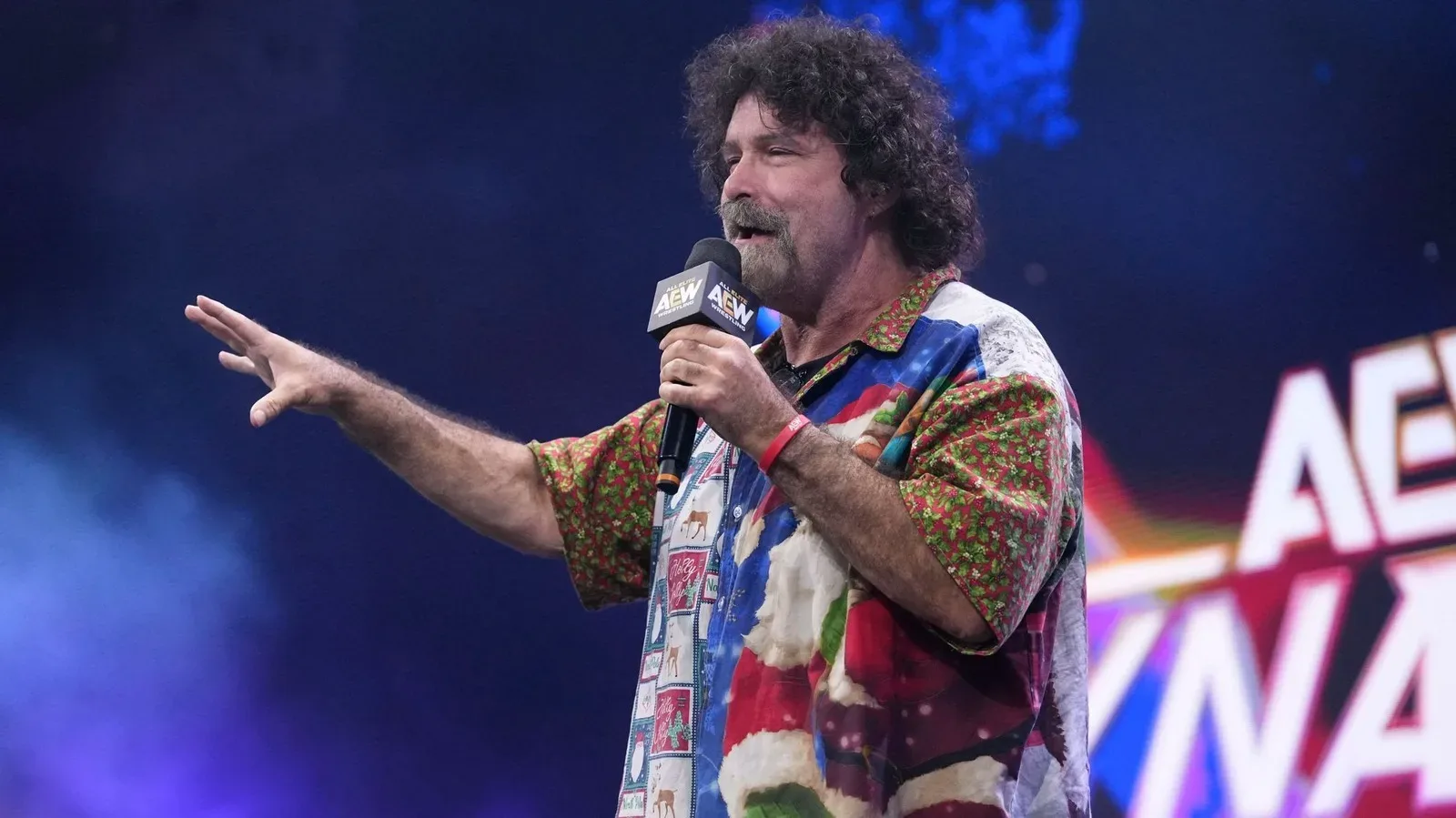
Mick Foley has made clear that he is enjoying his association with AEW, and the WWE Hall of Famer believes Tony Khan’s approach to running the company is a major reason why.
Foley, whose career is most closely associated with WWE despite notable runs across multiple promotions, has appeared intermittently in AEW in recent months. His involvement has included television segments as well as work on pre-show panels ahead of several AEW pay-per-views. While those appearances have not represented a full-time in-ring return, they have kept one of wrestling’s most distinctive voices connected to the promotion.
Speaking on Battleground Podcast, Foley described AEW as a place where he feels valued and said Khan’s management style is one that suits him personally. He contrasted it with WWE’s long-established and highly successful model without dismissing what WWE has accomplished.
“Oh, I love it [in AEW]. I love it, you know, Tony Khan makes it clear that he really appreciates his talent. He’s got a great board, and it’s just — it’s a different management style. And it’s one that I take to, you know, better,” Foley said.
For more background on this topic, read Jamie Hayter Injury Forces AEW WrestleDream Women’s Tag Title Match Postponement.
Foley’s comments do not frame one company’s internal approach as the only valid way to operate. Instead, he emphasized that different leadership structures can reach the same goal, while noting that he is especially comfortable with AEW’s culture and Khan’s stated appreciation for the people working under the company banner.
“Of course, you know, WWE’s obviously, you know, an incredible success at doing things their way, but there’s no one way to cross the finish line, and I’m really happy where I am,” Foley added.
Foley Finds a Different Fit in AEW
The comments offer further context to Foley’s present relationship with AEW. He has never been a conventional fit for any single corporate wrestling identity. Long before becoming one of WWE’s most beloved performers, Foley made his name through a journey that included wrestling in different environments, adapting his style, and building an audience through characters including Mankind, Cactus Jack, and Dude Love.
That background makes his remarks about different routes to success especially fitting. Foley’s career was built on persistence as much as opportunity. He became a major star in WWE, delivered some of the most memorable matches and promos of his generation, and eventually entered the WWE Hall of Fame. Yet his career also gave him direct experience with the ways that wrestling can operate outside one central system.
AEW’s presentation has offered a different setting for Foley’s recent appearances. The company has utilized established legends and wrestling history as part of its programming while also placing significant focus on its active roster. Foley’s participation on pay-per-view pre-shows and in selected segments has allowed him to contribute without requiring the company to position him as a weekly fixture.
For Foley, the appeal appears to go beyond simply being invited to appear on screen. His praise focused on a belief that AEW leadership openly values its talent. In a business where performers often work under intense physical and public pressure, acknowledgment from management can carry considerable weight. Foley’s words suggest that he sees a clearer personal connection with that atmosphere than he did with the management structure he knew in WWE.
He has previously spoken positively about parts of his WWE career, so his satisfaction in AEW should not be interpreted as an attempt to erase that history. Foley became a defining figure for WWE during the Attitude Era and remained connected to the company in varying capacities well after his full-time wrestling days ended. His legacy there is secure. His current stance is instead rooted in where he feels he belongs now.
Competition Remains Central to Foley’s View
Foley also used the discussion to highlight what he sees as AEW’s broader importance to the wrestling business. In his view, the existence of a viable alternative has created meaningful leverage for wrestlers, particularly when it comes to compensation and career options.
“You know, without AEW, WWE wrestlers would not be doing nearly as well. I hear they’re now cutting way back on salaries, and it’s great to know there’s somewhere else to go,” Foley said.
The statement reflects a longstanding argument within professional wrestling: competition changes the balance of power. When more than one major company can offer visibility, money, and meaningful opportunities, talent has more choices. That can affect negotiations, creative possibilities, scheduling considerations, and the ability of wrestlers to determine the next step in their careers.
Foley did not provide specific details regarding the salary reductions he referenced, and his remarks were framed as something he had heard rather than a detailed report of contractual terms. Still, the larger point was unmistakable. He believes AEW’s presence has benefited wrestlers beyond those currently signed to the company.
That perspective is particularly notable coming from a performer whose greatest mainstream success came under the WWE umbrella. Foley understands the scale and reach WWE has maintained over decades, and he explicitly called the company “an incredible success.” At the same time, he sees value in there being another destination capable of giving wrestlers options.
AEW was founded in an environment where fans and wrestlers had spent years discussing the need for greater major-league competition in North American wrestling. Its arrival created another prominent platform for established names, rising prospects, independent standouts, and international performers. The company’s role in the marketplace has remained a subject of regular debate, but Foley’s position is clear: he considers the alternative valuable for the people doing the work.
A Departure Without Regret
Foley spent the bulk of his wrestling career connected to WWE, but he ultimately chose to move on after becoming unhappy with the promotion’s close association with Donald Trump. He has since said that he enjoyed his time with WWE while also recognizing that the moment had come to leave.
More recently, Foley stated that he has no regrets about ending that relationship with the TKO-owned promotion. His latest comments reinforce that outlook. He is not presenting himself as someone reluctantly looking back at a former role. He is speaking as someone comfortable with the decision he made and content with his present place in AEW.
That distinction matters because Foley’s status gives his words additional context. He is not a young wrestler attempting to gain attention by criticizing an industry leader, nor is he someone whose career depends on turning a single interview into a storyline. He has already achieved the rare level of fame where his place in wrestling history is unquestioned. As a result, his comments are best understood as a personal assessment of workplace culture, professional freedom, and the value of having alternatives.
Foley’s relationship with wrestling has always been marked by candor. Whether discussing the physical toll of his career, the creative process behind his iconic characters, or the larger direction of the industry, he has generally been willing to explain his thinking plainly. His assessment of AEW and Khan follows that pattern. He likes the environment, feels that talent is appreciated, and considers competition beneficial for wrestlers.
What Foley’s AEW Presence Represents
For AEW, Foley’s continued association carries symbolic value even when he is not central to weekly programming. He represents a generation of wrestling that connected intense physical storytelling with emotional character work. His career also demonstrates that a performer can build a lasting legacy without following a perfectly conventional path.
His appearances can offer AEW a recognizable bridge to wrestling history, while his public support provides a vote of confidence in Khan’s management approach. That does not mean Foley’s endorsement alone settles discussions about AEW’s direction or the state of the business. It does, however, underscore that a veteran with deep experience across wrestling’s many eras sees merit in the company’s approach.
Foley’s remarks ultimately come back to choice. WWE has found enormous success through its own structure, as he acknowledged. AEW, in his view, has established a different kind of environment and an important additional option for talent. For Foley personally, that environment has proven to be a better fit.
As he continues to make sporadic AEW appearances, the Hall of Famer appears settled in that view. He is happy in the company, appreciative of the way Khan treats talent, and convinced that AEW’s presence has made the professional wrestling landscape stronger for the people who perform in it.
In pictures

Darryl Polo
Darryl Polo is a passionate wrestling fan covering WWE, AEW, TNA and beyond. He loves great rivalries, breakout stars and the moments that keep fans talking long after the bell. How we work.