
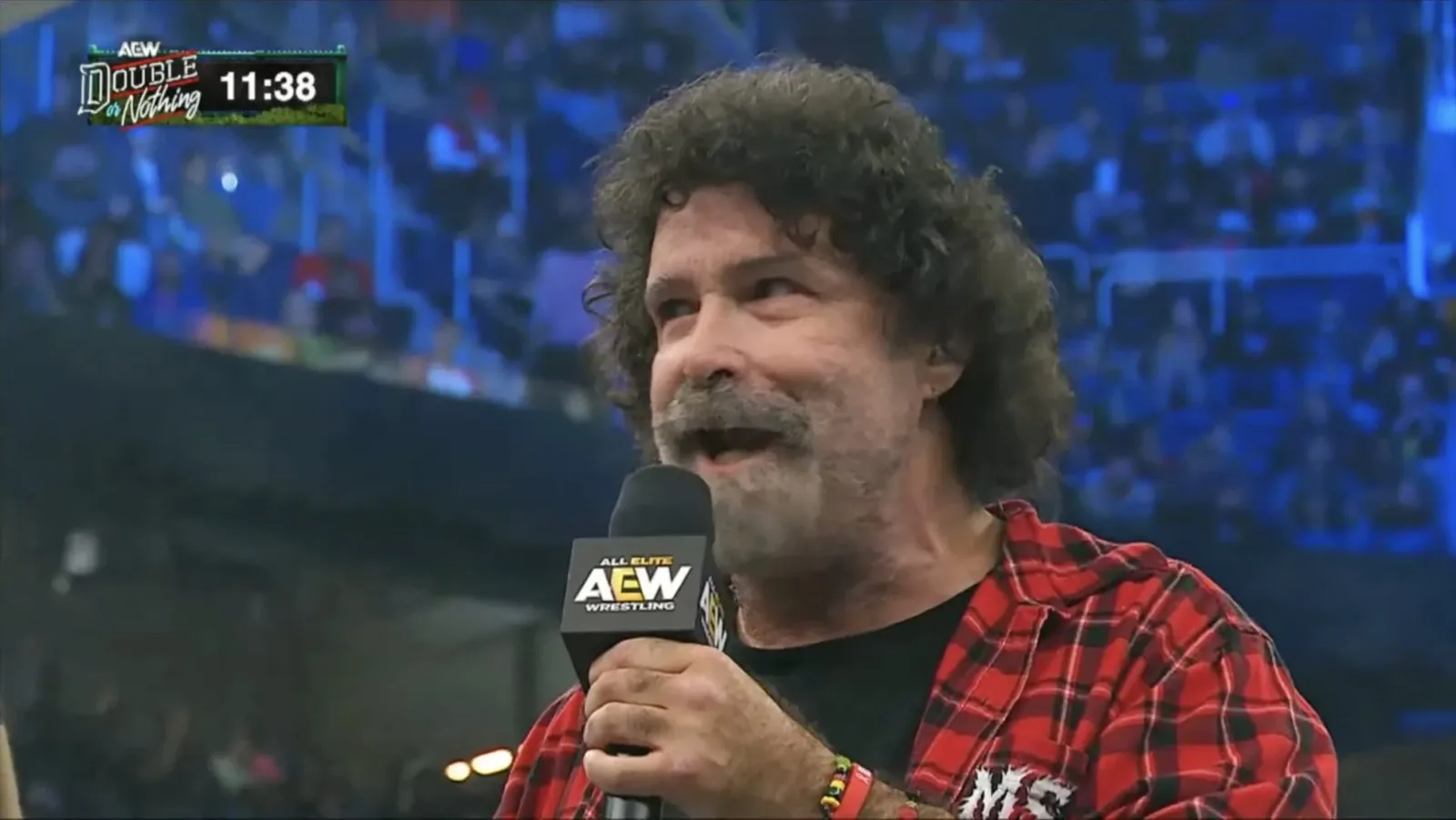
Mick Foley believes the emotional honesty he sees in women’s wrestling is the biggest reason the division has resonated so strongly with him over the past decade.
Speaking on The Mick And Kenny Show, the WWE Hall of Famer looked back on the period beginning in 2015 when his children called him in to watch Paige compete in NXT. Foley said that moment immediately stood out to him, describing his reaction as, “This is different.”
Foley’s comments arrive in the context of a major evolution for women’s wrestling across the Western wrestling landscape. Over the last decade, women performers have increasingly been presented as central attractions, with major rivalries, championship programs and featured match time becoming a more consistent part of the industry. Foley did not frame his perspective as a scientific conclusion or a criticism of every male performer, but rather as a personal explanation for why he has found himself gravitating toward women’s matches.
For Foley, the key is not simply athleticism, physicality or the scale of the matches. It is the willingness to let viewers see what the moment means.
For more background on this topic, read Josh Alexander Says PAC Was ‘The Best Wrestler In AEW’ in Emotional Reflection.
Foley Sees Greater Emotional Openness
Foley said he has long felt that wrestling is, at its core, an emotional business. In his view, women wrestlers often make that emotion more visible, whether the story calls for pride, frustration, vulnerability, joy or anger. He contrasted that approach with a familiar wrestling convention in which male wrestlers absorb hard strikes and project no outward reaction in order to preserve an image of toughness.
“The women wear their heart on their sleeve,” Foley said while explaining his connection to the division.
He argued that there can still be an outdated stoicism in men’s wrestling, even when the physical action is intense. Foley described the idea of wrestlers hitting one another hard while acting as though they have not been affected as something that can feel counterproductive. Wrestling, after all, asks audiences to invest in pain, conflict and personal stakes. If a wrestler refuses to show the consequences of what is happening, the audience may have less reason to feel them too.
That distinction speaks directly to Foley’s own legacy. Throughout his career as Cactus Jack, Mankind and Dude Love, Foley was never defined by a detached, invulnerable persona. He became one of wrestling’s most distinctive performers because he could make violence, fear, desperation and resilience feel meaningful. His work regularly asked viewers to understand the emotional cost behind the punishment, not merely admire the punishment itself.
In that sense, Foley’s praise is rooted in a storytelling principle rather than a simple preference for one division over another. He is drawn to performances that communicate clearly and make the audience feel the stakes. To him, emotional expression does not diminish toughness. It can make toughness more believable.
Terry Funk Remains Foley’s Measuring Stick
To illustrate that point, Foley recalled watching Terry Funk in Japan during the late 1970s and early 1980s. Funk is widely remembered as one of professional wrestling’s most fearless and influential figures, but Foley focused on another side of his mentor’s presentation: the willingness to cry during interviews.
Foley noted that Japan could be a highly macho and stoic environment, which made Funk’s emotional displays all the more striking. Rather than seeing tears as a contradiction to Funk’s credibility, Foley viewed them as an extension of it. He said that watching Funk weep did not make him appear less tough; it made him appear tougher because the emotion underscored how deeply the struggle mattered.
“This is an emotional business,” Foley said, explaining that Funk’s tears, sweat and blood combined to create something “very compelling.”
The point is especially notable coming from Foley, whose professional connection to Funk helped shape both his approach to in-ring violence and his understanding of character work. Foley has consistently spoken about the importance of making audiences care, and his comments on women’s wrestling fit within that same philosophy. Physical risk, by itself, is not necessarily enough. The strongest wrestling performances give the audience an emotional reason to respond to that risk.
Funk’s example also challenges a narrow definition of toughness. A wrestler can be physically durable, aggressive and fearless, but still reveal grief, exhaustion or pain. For Foley, that openness is not a weakness to be hidden. It is often the thing that gives the match or interview its lasting power.
The Paige Match That Changed Foley’s Perspective
Foley traced his more focused interest in women’s wrestling to 2015, when his children urged him to watch Paige in NXT. He did not identify the specific match in his remarks, but he was clear about the impression it left. The presentation felt different enough that it caused him to take a closer look at what was happening in the women’s division.
That period was significant for NXT’s women’s roster, which was building a reputation for competitive matches and character-driven rivalries. Foley’s recollection does not attempt to reduce that era to a single performer or one turning point. Instead, Paige became the entry point for him to recognize a broader quality he felt was present in women’s wrestling.
His comments also underline the role younger fans can play in changing how established wrestling figures view the product. Foley’s children were the ones who called him over to the television. A performer who had already experienced virtually every level of the business, from independent wrestling to major-event stardom, found himself being introduced to a new perspective through his family’s enthusiasm.
That is part of what makes the story resonate. Foley was not approaching the division as a detached observer attempting to offer approval from a distance. He was reacting as a fan who was surprised by what he saw and then tried to understand why it affected him.
Emotion Is Not Limited By Promotion or Gender
Foley was careful not to make a blanket statement that men’s wrestling lacks emotion or that women’s wrestling has a monopoly on it. He acknowledged that there are performers in AEW who provide “the best of everything.” His larger point was about a tendency he has noticed and the kind of work that consistently reaches him as a viewer.
There have always been men in wrestling who built their reputations on emotional transparency, just as there are women whose characters are deliberately restrained or cold. Foley’s observation is instead about presentation and permission. He feels women are often more willing to show the internal response to a conflict, and that choice can create a stronger bond with the audience.
That is an important distinction in a business where selling is frequently discussed only in physical terms. A wrestler selling a strike, a hold or an injury is fundamental to the match. But emotional selling can be equally essential. It is the look after a near fall, the anger after being betrayed, the disbelief following a loss or the relief after a hard-fought win. Those reactions tell audiences why a match should matter beyond the moves themselves.
Foley’s remarks suggest that this is the dimension he sees most consistently in women’s wrestling. The performers may be competing at the highest physical level, but the emotional communication is what keeps him engaged.
A Perspective Shaped By a Career of Feeling
Foley has always been an unusual voice when it comes to wrestling’s ideas about masculinity, pain and vulnerability. His greatest performances often balanced brutality with humanity. Whether he was portraying a tortured underdog, an unhinged brawler or an eccentric romantic, Foley understood that audiences remember feelings as much as they remember spots.
His latest comments are therefore less a surprising departure than a continuation of that outlook. He is drawn to wrestlers who allow the audience to see the struggle underneath the performance. In his view, the visible emotion in women’s wrestling creates a directness that can be difficult to ignore.
Elsewhere during the same conversation, Foley and AEW’s Willow Nightingale discussed a letter Foley gave her before her match at AEW All In 2026. That exchange further reflects Foley’s ongoing interest in the current generation of performers and in the personal stories that surround major wrestling moments.
For Foley, the appeal of women’s wrestling comes down to a simple but fundamental idea: authenticity has weight. The sport is at its most effective when competitors do not merely show that they can endure. It is at its most effective when they show the audience why enduring matters.

Darryl Polo
Darryl Polo is a passionate wrestling fan covering WWE, AEW, TNA and beyond. He loves great rivalries, breakout stars and the moments that keep fans talking long after the bell. How we work.