
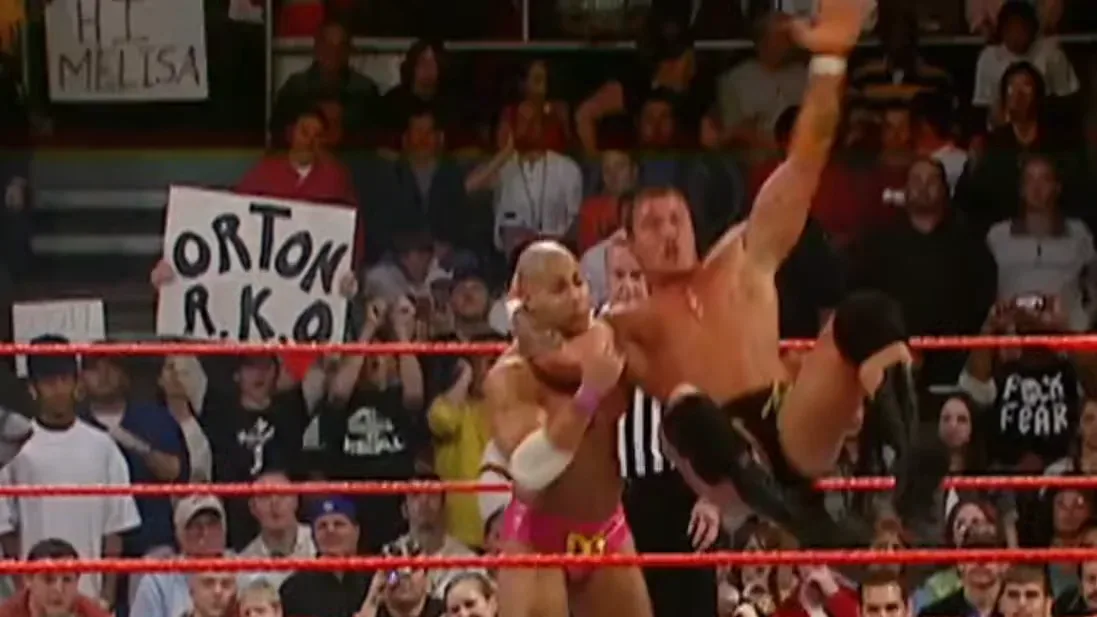
WWE live events have long served as a valuable proving ground for performers, giving talent a chance to refine timing, test crowd responses and experiment with material away from the pressure of television. Maven has recalled one especially memorable house show experiment from his WWE run: a “dropkick match” against Randy Orton.
The concept was exactly as unconventional as it sounds. Rather than merely using the move as part of the match’s normal opening exchange, Maven and Orton planned to repeatedly hit dropkicks, immediately get back to their feet and gauge which wrestler received the louder reaction from the audience. The sequence was short-lived, but it came from an organic element of their established match structure and demonstrated the freedom that can exist on the live-event circuit.
Maven discussed the match while reflecting on his work with Orton during WWE’s more active house show schedule. The two wrestlers could find themselves working together regularly, creating an opportunity to build familiarity and develop a rhythm in front of different crowds. In this case, their shared athleticism and confidence in the dropkick inspired them to take a simple spot further than usual.
A House Show Test Between Maven and Randy Orton
As Maven explained, Arn Anderson was the agent assigned to the show. Anderson, a respected veteran whose wrestling knowledge and behind-the-scenes experience have made him a major influence on generations of performers, was approached by Maven and Orton with the idea before they went through with it.
For more background on this topic, read Bobby Roode Remains WWE Producer as Drake Maverick Continues Writing for Raw.
“We had a house show. Arn Anderson was our agent. If you’re going to do anything in wrestling, house shows are where you want to practice. They’re where you want to get the bugs out of anything.”
That philosophy has been central to WWE’s touring model for decades. Television is where storylines and major angles must be delivered precisely, often against strict production schedules and with extensive coordination across the roster. A live event is still a performance in front of paying fans, but it can offer more room to adjust the pacing of a bout, try a new sequence or learn how a particular audience responds to a character.
For Maven, the move at the center of the experiment was especially significant. The dropkick was widely associated with him as a standout part of his offense. It was a clean, explosive maneuver that fit his athletic presentation and helped him stand out during his time in WWE. Yet he also recognized that Orton, even early in his career, possessed the ability to execute the same move at a similarly high level.
“Randy is as athletic as anybody. The dropkick was the one move I could throw. Well, Randy can throw a dropkick as equally impressive as mine, if not more so. But he can also do all the other moves as perfect as you can imagine.”
The proposed sequence grew out of a familiar spot that already worked for them. Maven said that their matches would feature a standoff after each man had landed a dropkick. The crowd would react to the athletic exchange, and the wrestlers would use that response as a natural beat before moving into the next phase of the contest.
Rather than stop after one dropkick apiece, they wondered what would happen if they built the entire opening around the move and let the fans decide which man was receiving the greater response. It was not a formal stipulation advertised to the crowd. Instead, it was an in-ring challenge between two performers looking to give the audience something different while learning what they could from the reaction.
Arn Anderson Approved the Idea
Before putting the plan into action, Maven and Orton took it to Anderson. Their pitch was simple: keep hitting dropkicks, rise quickly and listen for the audience. Anderson gave them permission, with one important condition. The sequence had to connect with the crowd.
“So we went to Arn and asked, ‘What if we both just hit dropkicks just to see who [fans] cheers the loudest?’ Arn was like, ‘If you guys can get it over, I’m fine with it.’”
That response speaks to the practical mindset required in professional wrestling. An innovative idea is only worthwhile if it serves the match and gives the audience a reason to care. A string of identical moves could easily become repetitive if it lacks energy, structure or character work. Maven and Orton had to make the crowd understand the point of the competition almost immediately, then transition smoothly into the body of their planned bout.
Maven described the idea as something the pair pursued somewhat casually, but the structure was clear. Each man would land a dropkick, jump back up and pause for the crowd’s verdict. They repeated that pattern several times before the heel interrupted the exchange and took control, allowing the match to settle into a more traditional format.
“So me and Randy, kind of half-hearted, [said], ‘Let’s do something different.’ I think we each probably threw three to four dropkicks. We would hit the dropkick, jump up, and see who the fans cheered for the most. We started that off. Then the heel would cut the other person off, and we’d get into the match. But yeah, we had a dropkick match.”
While the phrase “dropkick match” naturally carries a humorous edge, the story highlights a real part of how WWE talent develops. Touring regularly means learning how to react in real time, recognizing when a crowd wants more of a particular moment and understanding the difference between a spot that looks good and a spot that truly draws a response.
Maven Gives Orton the Edge
When asked which of the two had the higher dropkick, Maven did not turn the story into a competitive claim. Instead, he gave Orton strong praise, saying that Orton was better than him at virtually everything, even while acknowledging that the dropkick was the move most closely tied to Maven’s own reputation.
“Randy’s better at anything than me. I was just known for a dropkick. Randy’s great. There’s nothing he can’t do.”
Orton’s career has more than supported Maven’s assessment. Over the years, Orton has become one of WWE’s most decorated and durable main-event stars, recognized for his smooth movement, deliberate pacing and ability to adapt across multiple eras of the company. His arsenal became synonymous with the RKO, but his broader athletic foundation has always been a defining trait. Maven’s recollection offers a glimpse at that ability during a far earlier stage of Orton’s development.
It also underlines the value of an opponent who can work within a simple concept without making it feel mechanical. A dropkick is not just about elevation. In a match built around crowd comparison, both wrestlers must sell the impact, regain their footing at the right moment, play to the audience and maintain enough personality to make fans feel invested in choosing a side.
The pair’s approach also preserved a traditional wrestling principle: the opening was there to establish the contest, but it could not overwhelm the story of the match. Once the sequence had made its point, the heel cut off the other wrestler and the bout moved into its expected progression. That transition ensured the experiment remained a useful hook rather than the entire presentation.
Why Live Events Matter to WWE Performers
Maven’s account is a reminder that some of wrestling’s most valuable lessons happen in settings that never become part of WWE television history. A house show crowd may not see the same elaborate production as a premium live event or weekly broadcast, but the connection between wrestlers and fans remains immediate. Every cheer, lull, chant and reaction can inform how talent approaches future matches.
For wrestlers in the early and middle stages of their careers, repeated live-event work can be essential. It allows them to learn the fundamentals of pacing, crowd control and communication with an opponent. It also builds trust. Maven and Orton could attempt a playful sequence involving multiple dropkicks because they understood each other’s timing and had a shared sense of where the match needed to go afterward.
The story does not reveal a famous television angle or a major title match. Instead, it captures a smaller, human element of WWE life on the road: two performers recognizing that a routine exchange was drawing applause, seeking permission to expand it and then using the live audience as the ultimate judge of whether the idea worked.
For Maven, the memory remains tied to respect for Orton’s exceptional all-around ability. For fans, it is an amusing look at a creative house show moment that likely existed only for the people in that building. In an industry built on spectacle, it is often those untelevised experiments that help wrestlers sharpen the skills needed for the biggest stages.

Darryl Polo
Darryl Polo is a passionate wrestling fan covering WWE, AEW, TNA and beyond. He loves great rivalries, breakout stars and the moments that keep fans talking long after the bell. How we work.