
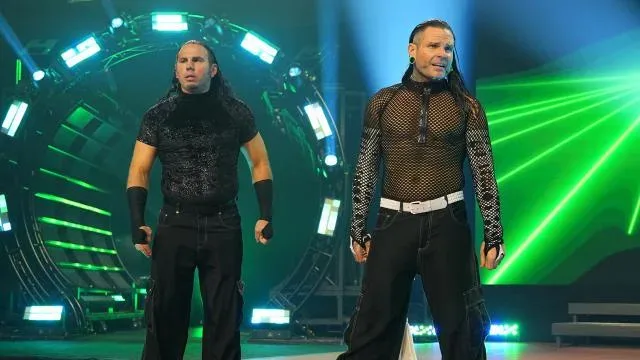
Matt Hardy has looked back on an early effort to split The Hardys in WWE, revealing that a proposed storyline was halted after Jeff Hardy was uncomfortable with some of the material being suggested.
The Hardy brothers have spent much of their professional wrestling careers linked as a team. Even when Matt and Jeff have been positioned against one another or taken separate paths as singles wrestlers, their history has repeatedly brought them back together. That enduring connection, Matt explained, was central to why the first major WWE attempt to separate them did not move forward as planned.
During an interview in which he fact-checked details from his Wikipedia page, Matt discussed a period in the 1990s when WWE wanted the brothers’ on-screen characters to split. He said the creative direction included a few requests that Jeff did not feel comfortable doing. Matt stated that the response was for both brothers to be taken off WWE television for a while, though they continued working live events.
“There was a storyline for our characters and they wanted us to split up and there was a couple things that we were asked to do and Jeff was uncomfortable and didn’t want to do it so we were off TV for a while as a punishment, I guess. But we still did live events, and then they put us back together because we knew we weren’t ready to separate and split up as a team yet.”
For more background on this topic, read Matt Hardy Reveals He Sewed The Hardy Boyz’ WWE Tights During Their 1990s Run.
An Early Attempt To Divide The Team
Matt’s recollection offers a revealing look at the balancing act behind a tag team’s presentation in WWE. A split can be one of the most reliable directions available for a successful duo, particularly when two performers have a built-in personal connection that can create immediate emotional stakes. For The Hardys, the fact that they were real-life brothers naturally gave any possible divide added weight.
However, Matt made clear that the brothers did not believe the timing was right. Rather than forcing a separation before the act was ready, WWE ultimately reunited them on television. The key detail in Matt’s account is that their absence from TV did not mean they were completely removed from work. The Hardys continued to perform on live events before returning together.
Matt described the time away as a punishment “I guess,” leaving some uncertainty in his own characterization of the decision. What he did not leave uncertain was the basic outcome: Jeff objected to certain proposed elements, the brothers were pulled from television for a period, and WWE later put them back together because they felt they were not ready to split as a team.
The account also underlines the distinction between being willing to pursue a storyline and being comfortable with every specific idea offered within it. Matt did not identify the pitches that made Jeff uncomfortable, and there is no reason to speculate about what they may have been. The relevant point is simply that Jeff drew a line on material he did not want to perform, while Matt and Jeff collectively felt the team should not yet be separated.
The Hardys’ Strength Was Always Their Connection
The Hardys became defined by a style and identity that made them stand out as a unit. Their brotherhood was not merely background information; it was a foundational part of the act. Audiences could understand their bond immediately, and that connection provided a natural basis for both their teamwork and the possibility of conflict when they did eventually meet as opponents.
Matt’s comments show why an early breakup may have felt premature from the performers’ perspective. A tag team needs enough time to establish its collective identity before a split can carry maximum impact. If the audience is not yet fully invested in the idea of two wrestlers as an inseparable tandem, the emotional consequences of separating them can be diminished.
In the case of Matt and Jeff, their partnership was ultimately allowed to continue. That decision preserved the core of the act at that stage of their WWE run. It also fits with the broader arc of their careers, in which the brothers have periodically competed against each other but continually found a route back to the same side.
That cycle is an important part of The Hardys’ wrestling legacy. Their relationship has always allowed for different stories: loyalty, competition, frustration, reconciliation, and renewed partnership. Matt’s recollection does not suggest that a singles rivalry between the brothers was impossible. Instead, it emphasizes that the initial effort came before they believed it was the right time to pursue one.
Live Events Continued During Television Absence
One of the more notable parts of Matt’s story is that The Hardys remained active on live events despite being removed from WWE television. In wrestling, television absence can easily create assumptions about a talent’s position or future, but Matt’s description illustrates that the situation was more limited than a full departure from the company’s schedule.
They were still working in front of crowds. The difference was that they were not appearing on WWE programming while the issue surrounding the proposed split was being worked through. Eventually, the company returned to the pairing that Matt and Jeff believed still had more to accomplish together.
The situation also reflects the leverage of clarity between performers and creative plans. Matt did not frame the period as a triumphant stand or offer details beyond what he and Jeff experienced. His wording was comparatively matter-of-fact: there were requests, Jeff was uncomfortable, they were off television, and then they were reunited because they were not ready to split.
That straightforward recollection is significant. Wrestling storylines can involve performers taking on heightened characters and difficult emotional material, but Matt’s comments reinforce that there are limits to what an individual may be willing to do. Jeff’s discomfort with unspecified pitches was enough to alter the immediate direction for both members of the team.
A Reminder That Timing Matters
For audiences, a tag team breakup can feel inevitable once a promotion begins hinting at friction. Yet Matt’s account is a reminder that not every proposed split reaches the screen, and not every idea that reaches the discussion stage is suited to the people involved or the moment in a team’s development.
The Hardys’ eventual body of work demonstrates the value of allowing a partnership to grow. Their careers have included moments in which they stood opposite each other, but the team itself remained the defining image. Matt and Jeff as a unit have endured through changes in promotions, eras, and individual career directions.
In this earlier WWE instance, the brothers’ shared assessment was that separating them would have been too soon. The subsequent decision to place them back together meant that their television identity remained centered on the partnership rather than a forced rupture.
Matt’s comments also put the spotlight on Jeff’s role in shaping that outcome. Jeff was uncomfortable with some of what was proposed, and he declined to participate in those elements. The result affected both brothers’ television status in the short term, but it also led back to the team presentation they felt was right for that point in their careers.
Beyond the storyline recollection, Matt also discussed the practical realities of the brothers’ early WWE years, including having to sew their own tights. Taken together, the stories paint a picture of performers learning and adapting while building the foundation of an act that would remain closely associated with both of them.
Ultimately, Matt’s reflection is not about a completed Hardy split but about one that never fully came to fruition. WWE considered dividing the brothers, Jeff objected to aspects of the plan, and the team was briefly absent from television while still appearing on live events. When they returned, they returned together—an outcome that, in Matt’s view, made sense because The Hardys were not ready to become separate acts.

Darryl Polo
Darryl Polo is a passionate wrestling fan covering WWE, AEW, TNA and beyond. He loves great rivalries, breakout stars and the moments that keep fans talking long after the bell. How we work.