
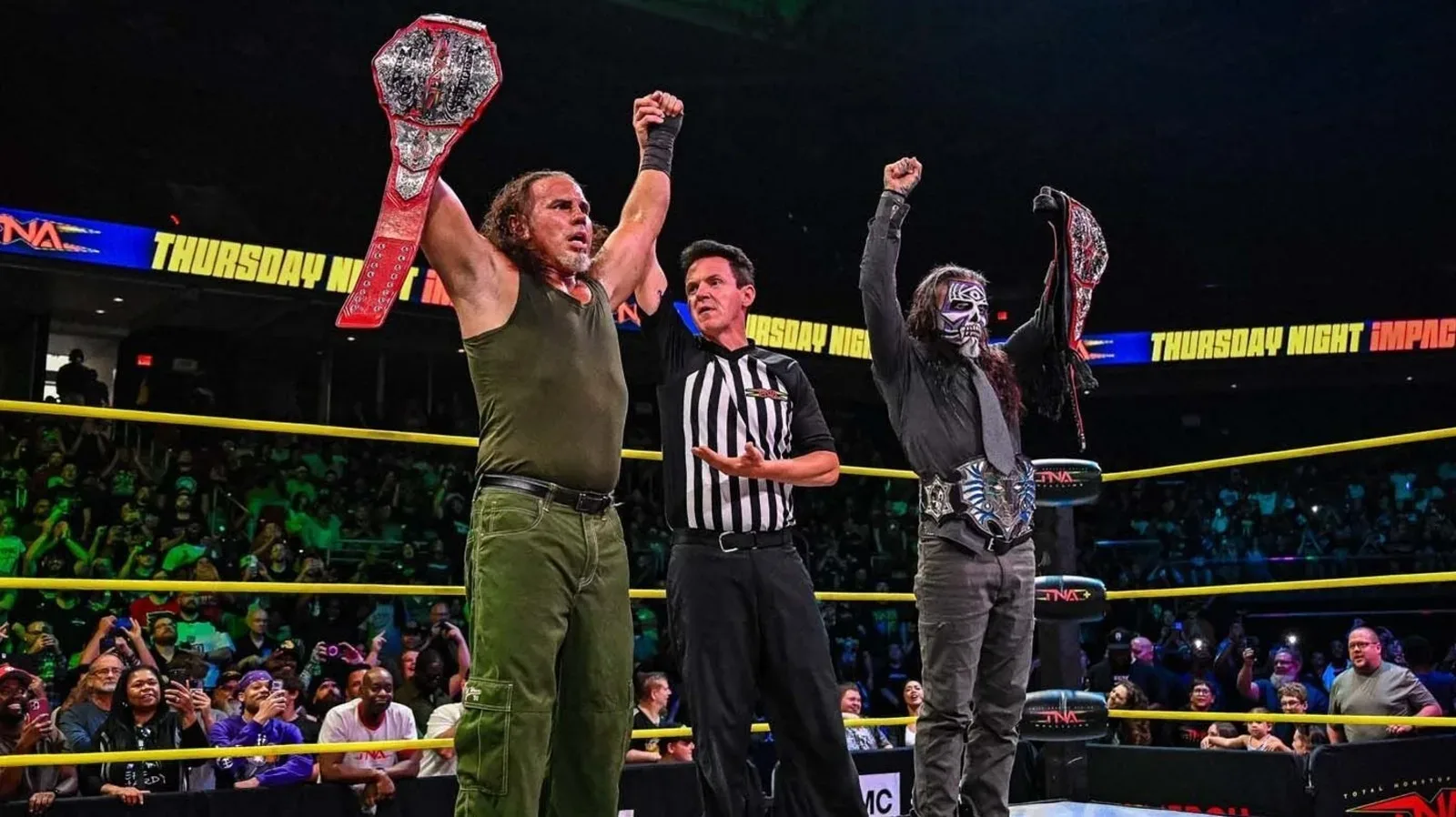
Matt Hardy has opened up about stepping into a creative role for a special episode of TNA Impact, describing the experience as both enjoyable and educational while leaving the door open to becoming a lead booker later in his career.
Hardy and his brother Jeff were given the chance to help book the October 15 edition of Impact, the first show following Bound for Glory. The episode also carried additional personal significance for the Hardys, as it coincided with their 35th anniversary in professional wrestling. Rather than simply appearing on the program, the decorated tag team was involved in constructing the night’s matches, segments and overall presentation.
The opportunity was set in motion by TNA booker Delirious, who wanted the anniversary to be marked in a meaningful way. For Matt Hardy, helping guide the show naturally began with an element that has long been inseparable from the Hardy Boys’ legacy: ladders.
A Hardy Anniversary Built Around Ladders
During The Extreme Life of Matt Hardy, Hardy explained that a ladder match was immediately at the top of the brothers’ list. The Hardys’ careers have been closely linked to ladder-based matches dating back decades, including their landmark bouts alongside Edge, Christian, and The Dudley Boyz. With the October 15 episode intended to celebrate their longevity, Hardy felt that connection had to be represented.
For more background on this topic, read Amazing Red Believes AJ Styles Could Be Drawn Back to Wrestling.
“First and foremost, if we were booking the show, I mean, the first thing, you know, when people think about the Hardy Boys, they think about ladders, ladder matches,” Hardy said. “I said, ‘We got to have a ladder match on it.’”
Hardy also said the main championship picture was a key consideration while planning the opening portion of the broadcast. The direction depended on what happened at Bound for Glory, specifically whether Nic Nemeth retained the championship or Leon Slater emerged with the title. Regardless of that outcome, the plan was for Slater to be involved in the first segment with the Hardys.
That detail illustrates the kind of fluid planning required when booking television around a major event. The team working on the October 15 episode needed to account for more than one possible Bound for Glory finish, then ensure the post-event show could effectively react to the result. It was not simply a matter of selecting matches; it involved creating a program that could establish the next chapter after one of TNA’s biggest events of the year.
Hardy’s comments also point to the importance of giving the audience a clear first impression after a pay-per-view. A post-Bound for Glory Impact has to acknowledge what just happened while directing viewers toward the stories that matter next. Involving either Nemeth or Slater in a major early segment alongside the Hardys would have helped place the championship scene at the center of that transition.
Ideas Extended Beyond the Main Event Picture
The Hardys were not limited to a single match or storyline when contributing ideas for the show. Matt Hardy noted that the brothers also discussed possibilities for the Nemeth family. Nic Nemeth and Ryan Nemeth wrestled one another in a singles match on the episode, and Jeff Hardy even floated an especially unconventional suggestion for the rivalry.
Jeff proposed a bra and panties match for the Nemeths. The idea was one of several creative discussions connected to the program, though the brothers ultimately worked within the broader plan for the show that aired. The fact that the suggestion was considered in conversation reflects the freedom and collaborative nature of the process, even as the final version of Impact needed to maintain a cohesive tone.
For veteran performers, booking can involve balancing different instincts at once. There is the desire to offer something memorable, the need to serve ongoing rivalries, the responsibility to feature the right talent, and the practical work of making every segment fit within the television format. Matt Hardy made clear that those details were a major part of what made the experience compelling.
Rather than portraying booking as a simple extension of coming up with angles, Hardy focused on the nuts-and-bolts work behind a televised wrestling show. Building a card is only one piece of the process. A creative team must also consider the placement of segments, who is needed to represent a story, what material should be pre-taped, and how everything will be blocked for the live production.
Hardy Enjoyed the Process of Laying Out Television
Hardy said he found the assignment fun, but his enthusiasm was especially clear when discussing the detailed work that happened before cameras rolled. He described the process of sitting down, talking through the episode and organizing its structure as “real interesting.”
“It was fun. I enjoyed it,” Hardy said. “Just figuring it all out was real interesting to us, especially when we went there and we were talking about the show and, like, laying it out and blocking everything out and how we’re going to do the segments and, you know, what pretapes are going to be, who we got to represent, how can we do it, and everything else.”
That description captures the difference between being a performer on a show and taking responsibility for the architecture of the show itself. Wrestlers spend their careers understanding crowd reactions, timing and match construction from an in-ring perspective. Booking adds a wider set of considerations: pacing a full two-hour episode, ensuring stories connect, working around production needs and making sure each act has a purpose.
For the Hardys, whose careers have spanned multiple generations and promotions, that perspective is likely informed by unusual experience. They have worked in major televised environments, performed in high-pressure marquee matches, reinvented themselves through different eras, and watched the creative process from many vantage points. Their anniversary episode offered a chance to apply that accumulated knowledge in a more direct way.
Hardy said the show was received well and experienced a ratings increase. While he did not present that as a sweeping verdict on his future in creative, it is a positive sign for an experiment built around the Hardys’ anniversary and their involvement behind the scenes. The episode had a clear hook, but it also had to function as a consequential post-Bound for Glory broadcast.
A Potential Post-Retirement Direction
The discussion is particularly notable because Matt Hardy has previously spoken about moving into a backstage role once his in-ring career is over. His work on the October 15 Impact provided a practical look at what that next stage could involve.
Hardy did not suggest that a full-time booking position is imminent, nor did he identify a specific company where he expects to take such a job. Still, he indicated that he believes creative work is likely part of his future in some capacity.
“And I’m sure eventually I’m going to be doing that as well somewhere, wherever it may be,” Hardy said.
He also expressed interest in taking the top creative position should the right opportunity present itself. That is a significant ambition, especially in a business where the lead booker is responsible for the long-term direction of a roster, the weekly television product and the major stories surrounding a promotion’s biggest events.
A lead booking role would demand more than the ability to generate individual angles. It would require managing immediate television needs while protecting longer arcs, adapting to changes in availability and audience response, and finding opportunities for talent across a roster. Hardy’s comments about blocking segments, choosing representatives for stories and planning pretapes suggest he appreciates that broader responsibility.
There is also value in the fact that his first publicly discussed experience of this kind came as part of a celebration of the Hardys’ career. The October 15 Impact was not presented merely as nostalgia. It was an opportunity to connect the brothers’ history—particularly their association with ladder matches—to current TNA stories involving names such as Nic Nemeth and Leon Slater.
That combination of legacy and forward movement is often essential in wrestling creative. A company can honor established stars while using their presence to elevate current championship programs and newer talent. Hardy’s account indicates that this was part of the thinking behind the episode, especially in the plan to include Slater in the opening segment regardless of the Bound for Glory title result.
What the Experience Means for Matt Hardy
For now, Matt Hardy remains a veteran performer with a strong interest in the creative side of the industry. The post-Bound for Glory Impact assignment gave him and Jeff a chance to test that interest in a tangible setting, from brainstorming match concepts to structuring the presentation of an entire television episode.
It also appears to have reinforced Matt’s belief that he could eventually contribute in a larger backstage capacity. He enjoyed the work, found the planning process engaging and saw encouraging results from the broadcast. None of that confirms when or where he might become a full-time booker, but it does establish that the idea is more than a distant retirement thought.
The Hardys’ 35th anniversary episode offered fans a celebration of one of wrestling’s most recognizable teams. Behind the scenes, it may also have marked the beginning of a new professional chapter for Matt Hardy. If the right opening arrives, he has made it clear that he would welcome the chance to take on the challenge of leading a creative team.
In pictures

Darryl Polo
Darryl Polo is a passionate wrestling fan covering WWE, AEW, TNA and beyond. He loves great rivalries, breakout stars and the moments that keep fans talking long after the bell. How we work.