
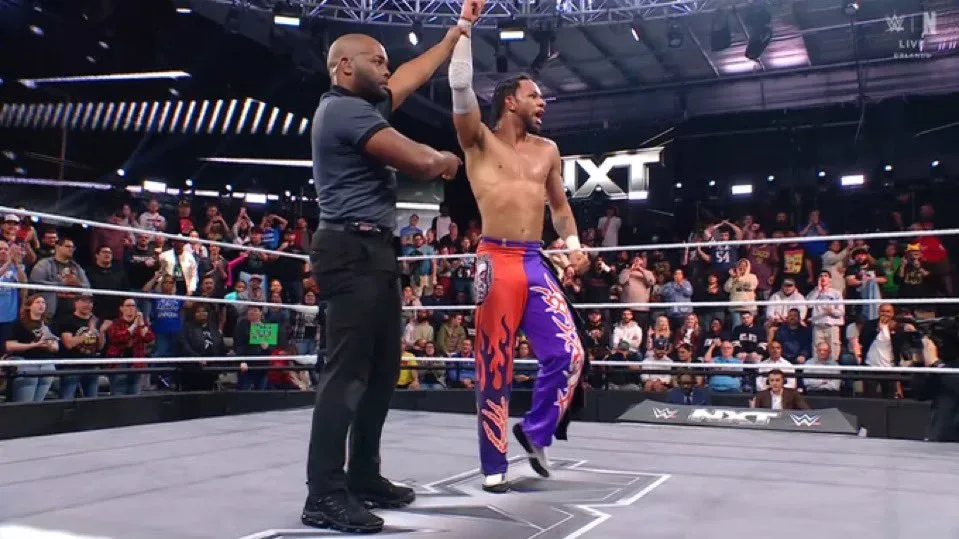
Leon Slater believes his time working with WWE NXT was a vital part of the path that led him to the TNA World Championship.
Slater, who captured the TNA World Championship at Bound For Glory, has reflected on the opportunities he received through the working relationship between TNA and WWE. Although he has not signed with WWE, Slater made appearances in NXT last year and into the beginning of this year, in addition to what he described as a couple of main roster appearances. In his view, those experiences brought a level of development, exposure and perspective that he was able to take straight back into TNA.
The champion stressed that WWE reaching out was significant because the opportunity was earned through the work he had already put in within TNA. Slater said performers cannot simply decide they will appear on WWE programming; the company has to make that call. For him, that call came after he had built his profile and established himself through TNA.
“I built my way up, and I built my way up to the point within TNA that WWE reached out to us,” Slater said. “Obviously, everybody, if they could, would reach out to WWE and be like, ‘Oh, I’ll show up this Tuesday,’ this and that. But unfortunately, that’s not how it works. They reach out to you.”
For more background on this topic, read Charlie Dempsey Explains Why His WWE NXT Move From No Quarter Catch Crew To BirthRight Made Sense.
That distinction matters to Slater because it frames the NXT run not as a detour from his TNA career, but as an opportunity created by it. He did not present his appearances as the beginning of his ascent. Instead, he saw them as a chance to apply the momentum he had developed in TNA to a different environment and then return with more experience.
Slater says the NXT opportunity felt substantial
While Slater’s WWE appearances did not come with a full-time contract, he felt the amount he gained from the experience was unusually meaningful for someone outside the company. He said the platform and lessons he received gave the run a weight that exceeded its length.
“For someone that doesn’t work there and that hasn’t ever signed a deal there, I feel like my run there was as if I’d been working there for two or three years,” Slater said.
Slater credited himself with making the most of the opening. He said the key difference was using the chance to grow rather than merely treating an appearance on a major platform as a moment to check off. Exposure is valuable, but Slater placed equal importance on learning from the environment around him and carrying those lessons into the next stage of his TNA work.
“I used my opportunity there,” Slater said. “I gained the platform, the exposure, countless lessons learned, and I’ve run them back to TNA.”
That approach has clearly shaped how Slater assesses his championship reign and the journey to it. He was direct in saying that the WWE experience made a tangible difference in his present standing as TNA World Champion. Rather than making a broad claim about the benefits of crossover exposure, Slater connected it specifically to the title he now holds.
“I’ll be honest, I wouldn’t be TNA World Champion right now if it wasn’t for my time in NXT and those couple of times on the main roster as well, because, like I said, those lessons have been invaluable,” Slater said.
It is a notable assessment from a wrestler whose career continues to be associated strongly with TNA. Slater’s comments recognize WWE’s role in his development without diminishing the work that made those appearances possible in the first place. His perspective is that his rise was built in TNA, enhanced through the WWE opportunities, and ultimately brought back to TNA’s championship scene.
A partnership rather than a stepping stone
The broader point Slater made was about the nature of the TNA-WWE relationship. He pushed back against the idea that TNA should be viewed solely as a stepping stone toward WWE. In Slater’s opinion, the arrangement works best when it is understood as a two-way partnership that benefits talent on both sides.
For TNA wrestlers, the chance to work in NXT can mean learning a different style, performing before a new audience and gaining experience inside another major wrestling system. For NXT talent visiting TNA, Slater believes the value is found in sharing rings and locker rooms with accomplished veterans whose careers span decades.
“To anyone that thinks TNA is just the stepping stone, I don’t think that’s the case at all,” Slater said. “I think it is a true partnership where people from our side, from the TNA side, get to go over there and learn a complete style, and the same thing with the people from NXT that have come over to TNA in the past.”
Slater specifically pointed to Nic Nemeth, Matt Hardy, Jeff Hardy and Frankie Kazarian as examples of the experienced names available to wrestlers who work in TNA. Each represents a different body of experience, but the common point is the amount of knowledge that can be passed along to younger or less established performers.
“They get to work with people like Nic Nemeth, like Matt and Jeff Hardy, like a Frankie Kazarian,” Slater said of NXT wrestlers who have had chances to come to TNA. “These guys that have been in the game 20, 25, 30, 35 years. Which is, again, absolutely invaluable experience for wrestlers of any caliber.”
Slater’s framing is especially relevant because the benefits of a wrestling partnership are not limited to wins, losses or the novelty of a crossover match. A talent can gain experience by adjusting to a different pace, preparing for a different television environment, working with unfamiliar opponents, and receiving feedback from performers and producers with varied backgrounds. Slater’s comments suggest he sees those unseen elements as every bit as important as being seen by a larger audience.
The champion’s experience reflects TNA’s value
As reigning TNA World Champion, Slater is in a position to make that argument with credibility. His statement is not that TNA needs WWE to validate its top stars. Rather, he described a system in which TNA talent can expand their skill set through outside opportunities while remaining central figures in TNA’s own major stories.
Slater’s own career is the example he offered. TNA provided the stage where he developed enough momentum to attract WWE’s attention. WWE NXT and the main roster appearances gave him additional exposure and lessons. Then, in Slater’s telling, those lessons helped him return to TNA better prepared to reach the top of the company.
That sequence is why he prefers the word “partnership.” It acknowledges that both promotions can offer something different while allowing talent to benefit from the contrast. WWE’s platform and structure were influential to Slater, while TNA’s roster provides its own high-level learning opportunities through veterans and established champions.
“I think the partnership is a perfect word to describe what we’ve got going on with WWE right now, for sure,” Slater said.
Slater also discussed the moment he learned he would be wrestling on John Cena’s retirement show during the same interview. But his comments on NXT offer the clearest explanation of how he views the connection between his WWE appearances and his current position in TNA.
For Slater, the result was not simply added visibility. It was an education that he says helped transform an already rising TNA performer into the company’s world champion. As he continues his run at the top of TNA, he sees his time in NXT as one of the defining experiences that helped prepare him for it.

Darryl Polo
Darryl Polo is a passionate wrestling fan covering WWE, AEW, TNA and beyond. He loves great rivalries, breakout stars and the moments that keep fans talking long after the bell. How we work.