
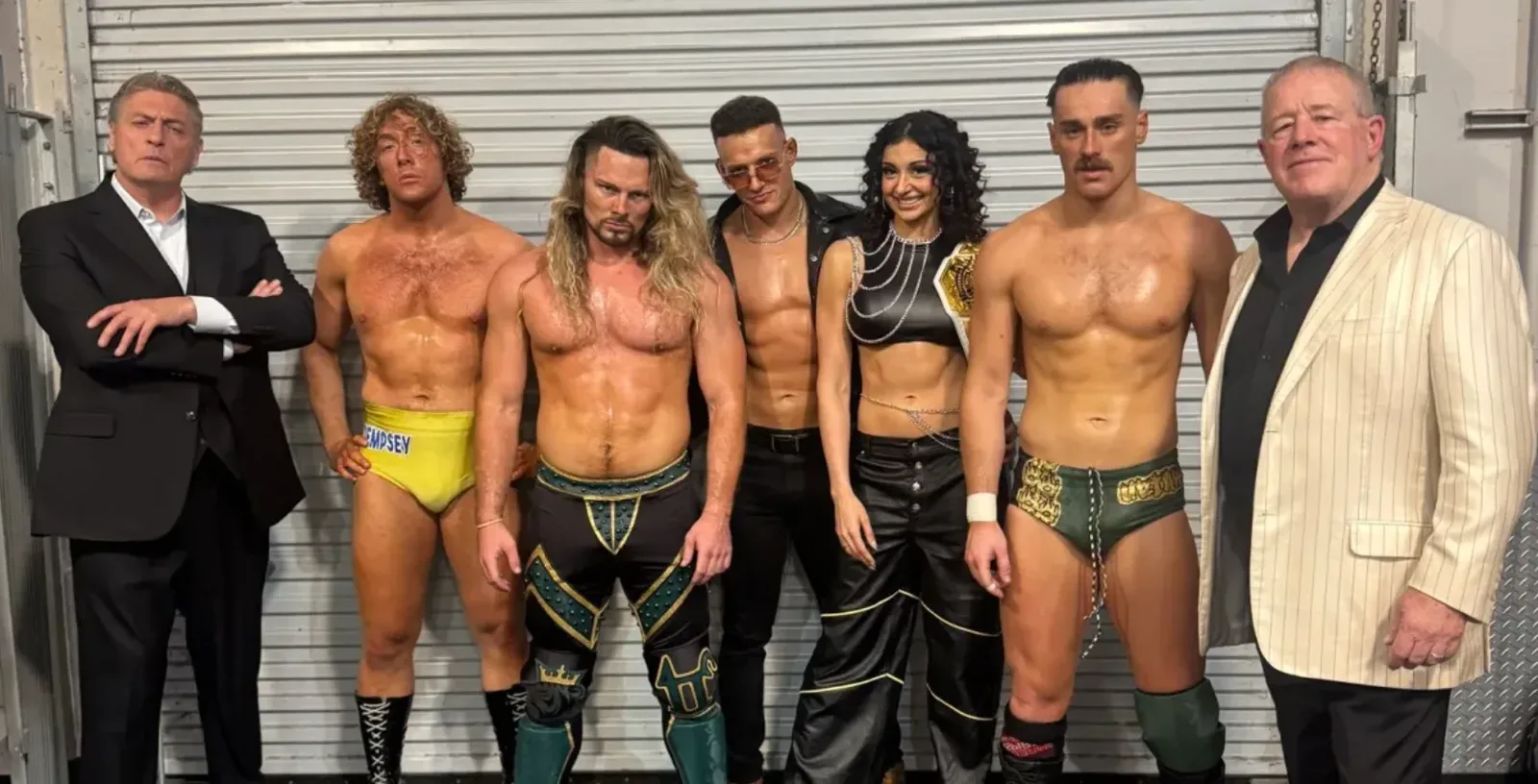
Charlie Dempsey’s transition from No Quarter Catch Crew to BirthRight represented more than a simple WWE NXT faction change. For Dempsey, it was a shift that followed the natural life cycle of a group while also opening the door for him to more openly embrace a wrestling legacy he had previously worked to keep in the background.
Speaking on Busted Open, Dempsey looked back on his time with No Quarter Catch Crew and discussed the circumstances that led him toward BirthRight. He made clear that he valued what the former group became, particularly after its lineup grew beyond its original configuration. At the same time, he saw an opportunity to move into a different direction alongside other NXT talent connected to wrestling families.
No Quarter Catch Crew initially paired Dempsey with Drew Gulak and Bobby Steveson. The faction later came into its own with the additions of Myles Borne, Tavion Heights and Wren Sinclair, creating a unit with a more distinct identity and a blend of amateur wrestling, catch wrestling and competitive in-ring personalities. Dempsey believes that expanded lineup was when the act truly found its footing.
“So, starting with No Quarter Catch Crew, it was something I was thrown into with Drew Gulak at the time. It was what it was,” Dempsey said. “It really got off its feet I feel like when Tavion Heights, Myles Borne, Wren Sinclair all joined it, and I felt like we had a real nice cohesiveness to us. We all got on. It was great, and then, obviously with wrestling, nothing can last forever.”
For more background on this topic, read Leon Slater Details How a Travel Conversation Revealed His Place on John Cena’s Retirement Show.
That assessment presents Dempsey’s departure as an evolution rather than a rejection of his former stablemates. He did not characterize No Quarter Catch Crew as a group that had failed. Instead, he described the changing landscape of wrestling and the availability of different creative and professional possibilities as factors in making a move.
Dempsey said a faction can reach a point where there are alternatives worth exploring without necessarily becoming stale. In NXT, where performers often develop new identities, alignments and rivalries as their careers progress, a change in presentation can be just as significant as a change in opponents. BirthRight provided Dempsey with a fresh setting while keeping him among a collection of performers tied together by their backgrounds.
No Quarter Catch Crew’s Importance To Dempsey
For Dempsey, No Quarter Catch Crew was an important stage in establishing his presence in WWE NXT. Its members were connected by a hard-nosed approach that suited his technical style, and the group gave several developing talents an opportunity to work within a recognizable unit. The eventual inclusion of Borne, Heights and Sinclair gave the stable greater depth and, in Dempsey’s view, a strong internal chemistry.
His comments also underline the distinction between a faction’s on-screen direction and the relationships formed within it. Dempsey spoke positively about the cohesion of the group, noting that its members got along well. That history matters as he moves into another alliance, because the BirthRight concept similarly depends on its members being able to present themselves as a united group with a shared foundation.
Rather than framing his career as defined by a single stable, Dempsey’s remarks suggest he views each association as part of a larger progression. No Quarter Catch Crew allowed him to sharpen a persona built around intensity and grappling credibility. BirthRight, meanwhile, gives him a chance to add another dimension by directly acknowledging the family history that has always been part of the discussion around him.
Embracing A Family Legacy After Making His Own Name
Dempsey explained that he deliberately avoided leaning on his father’s name earlier in his career. He wanted to establish himself first and did not want his path to be viewed solely through the lens of his family connection. While he acknowledged that people already knew who his father was, he said he had reached a point where he felt comfortable making that legacy a more visible element of his presentation.
“I never relied on who my father was before. I never even brought up who my father was. I always wanted to make my own way,” Dempsey said. “But I feel like I’d done that enough, and I made my own name for myself, and then it got to the point where, like, I can start telling people who my dad is, which everyone already knew. I can start relying on his name and having more people see me because of who my dad is.”
The distinction is central to understanding the move. Dempsey is not presenting BirthRight as the beginning of his identity in NXT. He is presenting it as a next chapter after he had already spent time building recognition on his own terms. The group allows him to acknowledge a well-known part of his background while maintaining that he first sought to prove he belonged through his own work.
BirthRight’s lineup makes that approach a natural fit. Dempsey named Arianna Grace, Lexis King and Uriah Connors as fellow members with fathers who worked in the business. He also referenced Stacks, noting that Stacks is tied to the group through marriage rather than having a father in wrestling. The collective concept is built around varied family associations, with each member bringing a different perspective to the idea of inherited wrestling connections.
“We got tons of people who have fathers who were in the business,” Dempsey said. “Again, Arianna, Lexis, Uriah. Stacks doesn’t but, you know, married into the group, and for all of us to come together in a group, it made sense to because why wouldn’t we?”
That explanation captures the straightforward logic Dempsey sees in BirthRight. NXT has no shortage of wrestlers working to create their own names despite famous relatives, but the faction gives its members room to explore the opposite side of that experience as well. Instead of avoiding those connections, BirthRight can use them as a foundation for a shared identity.
Halloween Havoc Loss To Zilla Fatu
Dempsey’s first high-profile test while representing BirthRight came at NXT Halloween Havoc, where he faced Zilla Fatu in a Falls Count Anywhere match. The stipulation created an environment in which BirthRight’s numbers could have been a major advantage, and Dempsey did have assistance from the faction during the contest.
Even with that support, Dempsey was unable to secure the victory. Fatu defeated him in the Falls Count Anywhere encounter, giving Dempsey and BirthRight an immediate setback on a major NXT event.
The loss does not change Dempsey’s belief in the logic behind his new alliance, but it does add pressure to the group’s next steps. BirthRight has the benefit of a clear theme and a roster of members with interconnected histories. It now also has a reason to respond after Dempsey was unable to capitalize on faction involvement against Fatu.
For Dempsey personally, the result reinforces that a new group does not automatically erase the challenges of NXT competition. He entered BirthRight after deciding that he had sufficiently established himself apart from his family name. Now, with that legacy more openly incorporated into his character, his task is to turn the new presentation into sustained success inside the ring.
His reflections on No Quarter Catch Crew show appreciation for the group that helped shape his NXT run, especially once Borne, Heights and Sinclair joined the fold. His explanation of BirthRight makes equally clear that he sees the new faction as a sensible progression. The next question is whether Dempsey and his new allies can recover from the Halloween Havoc defeat and demonstrate that their shared lineage can translate into results.

Darryl Polo
Darryl Polo is a passionate wrestling fan covering WWE, AEW, TNA and beyond. He loves great rivalries, breakout stars and the moments that keep fans talking long after the bell. How we work.