
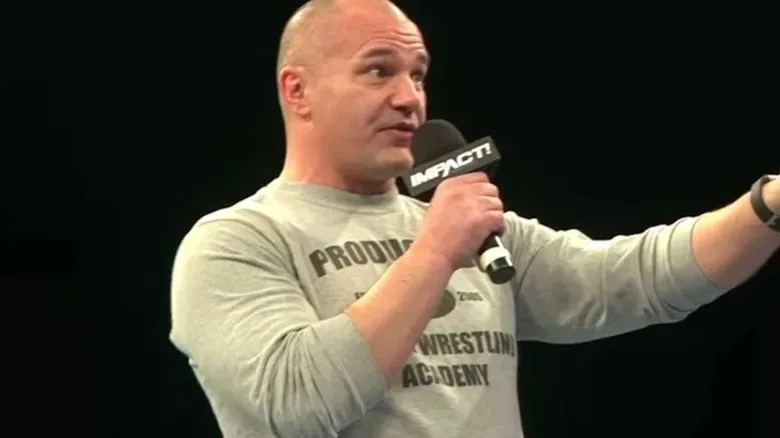
Lance Storm has outlined a production philosophy that places trust in TNA Wrestling’s performers rather than asking them to conform to one veteran’s idea of what every match should be.
Storm, who returned to TNA as a producer in 2022, discussed his approach while reflecting on the large number of matches he has helped put together for the company. His core point was straightforward: his experience is meant to support the wrestlers, not erase the individuality that made them stand out in the first place.
That principle came into focus during a discussion involving Trey Miguel and Jason Hotch. Storm recalled that the pair had a sequence planned that gave him pause initially. With several matches to oversee on a given show, Storm said the production process can involve repeated conversations, moving on to other talent, and then returning to a match later in the day. In this case, he voiced his concern about the proposed moment, only for Miguel to express confidence that he could execute it.
“I think it was Trey and Jason Hotch. I’ve got multiple matches in the day, so you talk and you leave, you talk and you leave and you come back,” Storm said. “They had this one sequence or spot where it’s like, my 57 year old brain was like, ‘That’s a bit much.’ But, I know it’s sort of in their realm. I mentioned it and Trey is like, ‘No, I think I’m good.’ I’m like, ‘Alright bro.’ I trust to let you do it.”
For more background on this topic, read TNA iMPACT! Calgary Spoilers: Leon Slater Retains, Rich Swann Wins Revolver Match.
The spot worked as Miguel envisioned, and Storm said the outcome reinforced why a producer must be willing to listen to the people who are actually going to perform the match. Rather than treating his first instinct as the final word, he accepted that Miguel’s knowledge of his own style was more relevant in that situation.
“It was so rewarding because it went the way he wanted it to and it worked, 57 year old brain was wrong,” Storm said. “I trust these guys, they know their style, they know what they’re doing.”
Storm’s role is built around collaboration
Storm’s comments offer a clear look at how he views the producer position. Producers are often responsible for helping performers shape matches, address timing, build toward planned finishes, ensure ideas fit a television presentation, and identify any potential concerns before wrestlers enter the ring. Experience matters greatly in that role, particularly from someone with Storm’s background in the industry. But his remarks make clear that he does not see experience as a reason to impose the same match structure on everyone.
Instead, Storm views the process as a collaboration. The producer can offer perspective, question an idea, and draw from years of wrestling knowledge. The talent, meanwhile, understands their own physical capabilities, rhythm, character, and the style they have developed in front of audiences. When both sides are communicating honestly, the result can preserve a wrestler’s identity while still benefiting from a producer’s guidance.
That distinction is especially significant in a roster with a broad range of performers. TNA’s wrestlers do not all approach matches in the same way, and they should not be expected to. A sequence that suits Trey Miguel may not suit another wrestler. An approach that works for a rising aerial athlete might not fit a hard-hitting brawler, a technical specialist, a powerhouse, or a personality-driven character. Storm’s stated aim is to make room for those differences rather than flatten them.
He emphasized that idea with two specific examples: Leon Slater and Miguel.
“I say this so many times — I don’t want them to have a Lance Storm match,” Storm said. “I want Leon Slater to have a Leon Slater match. I want Trey Miguel to have a Trey Miguel match.”
The statement does not diminish Storm’s own reputation or his wrestling instincts. Rather, it identifies the line he believes a producer should avoid crossing. A match should not become an imitation of the producer who helped assemble it. If performers lose the qualities that distinguish them, then even a technically sound match can feel less authentic than it should.
Trust does not mean a lack of oversight
Storm’s account of the discussion with Miguel is also notable because he did not simply approve the sequence without thought. He heard the idea, considered it, and raised a concern. That is part of the value of having a veteran producer involved in the process. Wrestlers can receive feedback from somebody who has seen countless matches and understands how quickly a promising idea can become difficult if it is not executed at the intended level.
But after Miguel responded with confidence, Storm chose to trust the wrestler’s judgment. The choice was not framed as surrendering responsibility. It was an acknowledgment that the performer had a better read on whether the sequence belonged in his wheelhouse. When it succeeded, Storm openly admitted that his initial hesitation had been misplaced.
That willingness to acknowledge being wrong is an important part of the collaborative environment Storm described. It tells talent that feedback can be a discussion rather than a command. It also means the producer’s role is not limited to saying no. At times, the right call is to let a wrestler take ownership of an idea and prove why it belongs in the match.
“So when he came through it, I’m like, ‘Dude, you were right, I don’t want to argue with results,’” Storm said. “He was like, ‘Well, thanks for trusting me.’ I’m like, ‘Yeah, we’re collaborating here.’”
That exchange captures the practical impact of trust. Miguel was able to work in a manner he believed in, while Storm was able to see the decision pay off. Neither side had to turn the conversation into a contest of authority. The result was a successful sequence and, by Storm’s telling, a productive working relationship.
Protecting individual styles in TNA
Storm’s mention of Leon Slater underscores the importance he places on allowing younger and newer-generation talent to express their own strengths. Slater and Miguel are different performers, and Storm’s comments suggest that he wants their matches to reflect that fact. The goal is not to make every contest feel disconnected from the wider show, but to ensure that each wrestler’s choices make sense for who they are.
For Miguel, that can mean trusting him with a sequence that aligns with the style he has built. For Slater, it means giving him the freedom to present the version of a Leon Slater match that best showcases his own abilities. In both cases, Storm’s philosophy places the wrestler’s identity at the center of the planning process.
That approach can be valuable across a television product. Fans respond to performers who feel distinct, and distinct performers give a promotion more ways to structure cards and tell stories. If every match follows the same template, audiences may see solid work but have less reason to invest in the specific people involved. When wrestlers retain their individual approaches, their matches can communicate character as well as athleticism.
Storm was clear that he does not want to force anyone into something they do not want to do. He is prepared to give performers an opportunity when they believe in an idea, particularly when it is a choice that fits their own style and capabilities.
“I never want to make something do something they don’t want to do and if they believe it, I’m willing to give them the chance,” Storm said.
His phrasing points to a producer’s balance between preparation and flexibility. Wrestling matches require planning, particularly in a televised setting, but planning does not have to mean rigid control. A productive process can include questions, alternative ideas, and disagreements while still respecting the people responsible for carrying out the action.
A veteran perspective without a veteran template
Storm’s experience remains a major resource for TNA, but his comments show that he sees the best use of that resource as guidance tailored to the individual. His “57 year old brain” line was delivered in reference to the Miguel and Hotch sequence, yet the broader point extends well beyond one spot. Longtime experience can identify risks and raise valuable questions. It can also recognize when the next generation understands something about its own style that cannot be fully judged from outside the ring.
By trusting Miguel after voicing his concern, Storm says he was rewarded with proof that the wrestler’s instinct was correct. More importantly, the exchange appears to have strengthened the collaborative dynamic that Storm wants in his work at TNA.
For Storm, the objective is not to create a roster full of Lance Storm matches. It is to help TNA performers produce matches that feel like the best and most complete versions of themselves.

Darryl Polo
Darryl Polo is a passionate wrestling fan covering WWE, AEW, TNA and beyond. He loves great rivalries, breakout stars and the moments that keep fans talking long after the bell. How we work.