
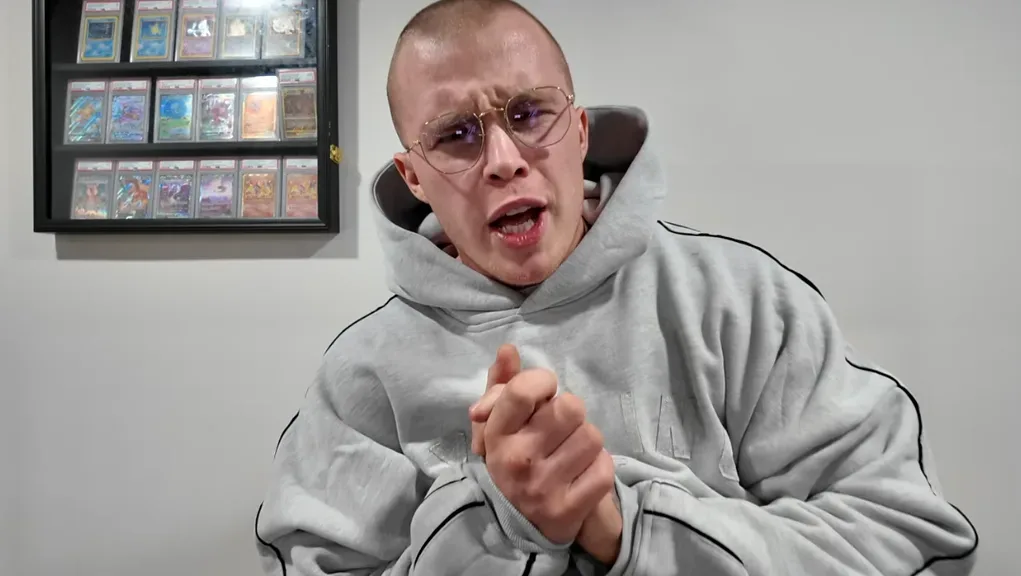
Kyle Fletcher believes the character he presents in All Elite Wrestling is much closer to his childhood vision than it may initially appear.
In comments made during a recent interview, Fletcher was asked whether the wrestler he has become matches what he imagined when he was growing up and dreaming about a career in the industry. The AEW performer said the answer is largely yes, framing his current identity as the natural result of the interests, influences and tastes he has carried with him over the years.
Rather than viewing his on-screen presentation as something disconnected from the person he was before entering professional wrestling, Fletcher described it as an amplified continuation of that same person. The tattoos, fashion, color choices, musical interests and wrestling ambition all fit together in his view.
“I don’t think it’s too far off what I pictured when I was a kid,” Fletcher said. “The person that I am today, not just in wrestling but in general, is an accumulation of all the things that I loved as a kid growing up.”
For more background on this topic, read WWE Raw Preview: Roman Reigns and Sami Zayn Set for Face-to-Face as San Diego Hosts October 19 Episode.
A character built from personal interests
Fletcher explained that he regularly thinks about how the things he was drawn to as a child have remained part of who he is as an adult. He cited interests ranging from wrestlers and music to tattoos and collecting Pokémon cards, along with his preference for dressing well and wearing pink.
Those details matter because modern wrestling characters often work best when the audience can identify a genuine foundation underneath the performance. A wrestler does not necessarily need to play an exact version of themselves, but the strongest presentation can come when the performer understands the instincts behind it. Fletcher’s comments suggest that is how he approaches his own identity: not as a costume assembled from unrelated traits, but as a more visible and heightened version of his long-standing personality.
“Everything makes sense,” Fletcher said while reflecting on the overlap between his younger interests and his current persona. He characterized himself as fundamentally the same person, only “a larger version” of that person now that he is performing on a major wrestling stage.
That perspective also helps explain why Fletcher does not see a dramatic divide between the child who played wrestling video games and the performer now seen on AEW programming. He said that if 10-year-old Kyle had been handed SmackDown vs. Raw 2009 and asked to use its Create-A-Wrestler mode, the resulting creation would likely look much like the version of Fletcher in front of audiences today.
“If you gave 10-year-old Kyle SmackDown vs. Raw 2009 or whatever, I’d probably create exactly what you see in front of me in Create-A-Wrestler,” Fletcher said.
Fletcher’s evolution in AEW
Fletcher has continued to develop as one of AEW’s prominent younger performers. Still under the age of 30, he has received opportunities to show his ability in a variety of settings, including tag team competition and singles matches. His growth has involved more than simply adding wins or appearing in higher-profile bouts; it has also required the refinement of a presence that separates him from the many talented athletes around him.
Professional wrestling places an unusual demand on performers because they must build an identity on several levels at once. The athlete has to execute in the ring. The character has to be recognizable in a brief entrance, a piece of gear, a facial expression or a line delivered on the microphone. The performer must also understand what gives the audience a reason to react emotionally, whether that response is admiration, frustration, anticipation or something else.
Fletcher’s comments point to a process rooted in authenticity rather than imitation. He spoke about looking at the people and wrestlers he admired while growing up, but he did not present his current character as an attempt to replicate any one figure. Instead, he described an accumulation of influences. That distinction is important. Wrestling history is full of performers who entered the industry with obvious heroes, but lasting identities tend to emerge when a wrestler turns those inspirations into something personal.
For Fletcher, the individual pieces appear deliberately connected. His affinity for fashion is part of how he sees himself. His interest in pink is not treated as an arbitrary visual decision. His tattoos, music and childhood hobbies all occupy the same broader picture. The point is not that every personal interest must become a storyline detail. It is that those interests give the performer a base from which to make creative choices that feel coherent.
The value of knowing who the character is
There is a significant difference between being assigned a role and understanding the reasons behind a presentation. Wrestlers can be successful in either situation, but the latter often provides more room to adapt. If a performer knows the personality at the core of the character, they can react more naturally to a changing opponent, a different crowd or a new direction.
Fletcher’s answer indicates that his current work is guided by that understanding. He is not describing a finished product that cannot change. Like any active wrestler, his presentation can evolve with the stories around him and with his own experience. But he sees the central identity as established in something more lasting: the same collection of tastes and ambitions that existed when he was younger.
The Create-A-Wrestler comparison is especially revealing. For generations of wrestling fans, video game character creation has been an outlet for fantasy booking a personal ideal: the entrance gear, the colors, the music, the attitude and the move set all become choices that reflect what the player finds exciting. Fletcher’s observation that his younger self would have designed this version of him speaks to the fulfillment of a childhood ambition.
It also underscores the unusual trajectory of making a career in wrestling. Many people who grow up watching the industry imagine what they would do if they had the chance to step through the curtain. Very few ultimately get the opportunity to test that idea in front of a worldwide audience. Fletcher is now in that position, and he believes the answer he has arrived at has remained consistent with the vision he had long before he entered the profession.
Studying the work remains part of the process
Elsewhere in the same conversation, Fletcher discussed his habit of watching back every match he wrestles. That practice fits naturally alongside his remarks about character development. A performer can have a strong sense of identity, but wrestling still demands continual review and adjustment.
Watching matches back allows wrestlers to assess the details that are difficult to judge in the moment: the timing of a reaction, the way an expression reads to the camera, whether the crowd responded to a key moment, or whether an idea that felt right in the ring was actually communicated clearly. It also gives performers a chance to recognize what worked and what needs to be sharpened next time.
For a wrestler continuing to rise in a highly competitive AEW environment, that willingness to study his own work can be as important as confidence in his character. Fletcher’s comments present both qualities together. He has a firm understanding of the personal elements that define his presentation, while also maintaining the discipline to review his performances.
That combination can be essential for a young wrestler with major visibility. The audience expects evolution, but it also responds to consistency. Fletcher appears to see no conflict between those ideas. His character can become more polished, more experienced and more established while remaining rooted in the interests that shaped him from the beginning.
For Fletcher, the path from childhood wrestling fan to AEW performer has not required abandoning the personality he imagined bringing to the ring. In his own assessment, the connection is straightforward: the kid who loved wrestling, music, tattoos, fashion, Pokémon cards and bright colors is still there. The difference is that the childhood concept is now being performed on a professional wrestling stage.

Darryl Polo
Darryl Polo is a passionate wrestling fan covering WWE, AEW, TNA and beyond. He loves great rivalries, breakout stars and the moments that keep fans talking long after the bell. How we work.