
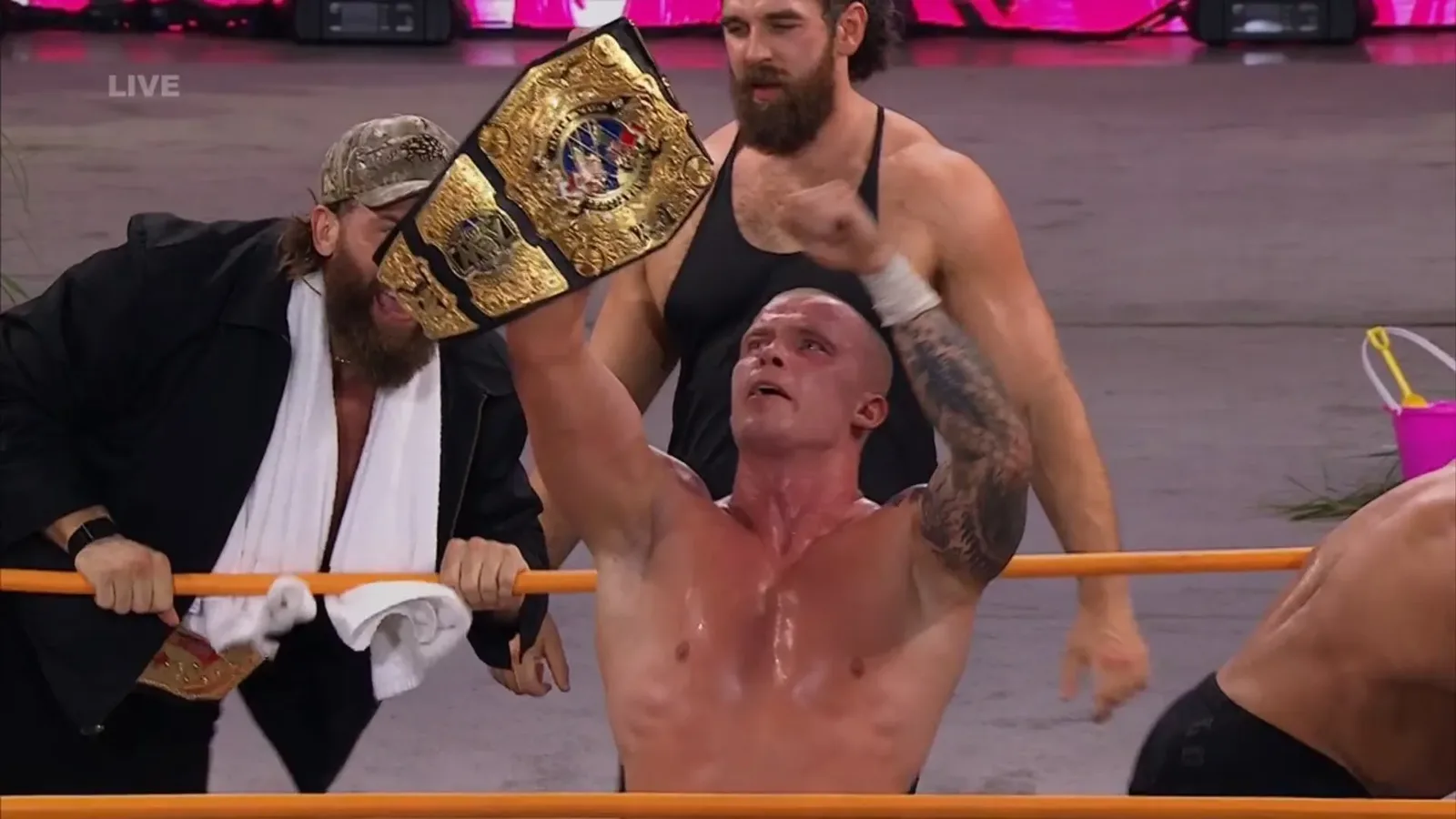
Kyle Fletcher has explained why the AEW International Championship did not receive the same pink makeover that accompanied his earlier run with the TNT Championship.
Fletcher’s time as AEW International Champion ended when Kazuchika Okada defeated him for the title at AEW All In. During Fletcher’s reign, some fans expected him to introduce a customized pink version of the International Championship belt, mirroring the visual change he had made with the TNT Title. That expectation never became reality, and Fletcher has now made clear that the decision was intentional.
Speaking with Simon Miller on Under The Mat, Fletcher said that he did not want to simply repeat the move because people were asking for it. In his view, the response to the prior pink title created an expectation that he was unwilling to satisfy a second time.
“Yeah, I don’t know, man. I feel like last time I gave in to the masses, the masses wanted the pink title, and this time everyone was like, we want it again, and I was like, fuck you motherfuckers, bro. I don’t want to do that.”
For more background on this topic, read Kevin Knight Sees Himself As Wrestling’s Jamie Foxx Amid Expanding AEW Profile.
Fletcher Chose Not to Repeat a Familiar Championship Visual
The explanation reflects a straightforward approach from Fletcher: the pink design worked as part of a previous presentation, but that did not mean it had to become a permanent feature of every title reign. Rather than turn the color scheme into a predictable calling card whenever he held championship gold, Fletcher opted against bringing that same variation to the International Championship.
Customized title belts have long been an effective way for wrestlers to add another layer to their on-screen identity. A different strap, plate design, or color palette can quickly establish that a championship reign belongs to a specific competitor. It can also give a wrestler a visual element that remains memorable well after the title changes hands. Fletcher’s pink TNT Championship variation evidently made enough of an impression that supporters were looking for a sequel during his International Title run.
But Fletcher’s comments suggest he sees a limit to that idea. The appeal of a custom championship can diminish if it is used too often or becomes an automatic part of every reign. By declining to duplicate the TNT Title concept, Fletcher kept the International Championship presentation distinct from what he had done before.
His language also made the point in a typically blunt fashion. Fletcher did not frame the decision as an issue with the AEW International Championship itself, nor did he indicate that there was any obstacle preventing the creation of a pink version. Instead, he presented it as a personal creative choice rooted in not wanting to “give in to the masses” after fans began requesting another customized belt.
The Pink Title Had Become a Point of Fan Interest
Championship presentation can often become part of the conversation around a wrestler’s run, particularly when a performer embraces a look that is noticeably different from the standard belt. In Fletcher’s case, the pink TNT Championship variation had clearly become associated enough with him that fans were watching to see whether he would carry the idea into his next major title reign.
That type of reaction is significant because it shows that the visual element had registered with the audience. Fans were not merely focused on who held the championship; they were also interested in how Fletcher would make that championship feel like his own. The request for another pink belt was, in that sense, an invitation to revisit something audiences already connected with his presentation.
Fletcher, however, chose the opposite route. He did not treat the demand as a reason to deliver an expected callback. Instead, he treated it as a reason to avoid one. The result was that his AEW International Championship reign stood without the same bright alteration to the physical title belt.
That choice can also be viewed as a way of avoiding an overly fixed image. A wrestler’s visual presentation evolves through gear, entrances, promos, alliances, rivalries, and championship reigns. Reusing the exact same championship concept every time an opportunity arises may create consistency, but it can also prevent a performer from moving into a different phase of their character. Fletcher’s decision meant that the International Title was not simply framed as a continuation of his TNT Championship run.
Okada Ended Fletcher’s International Championship Reign at All In
The discussion arrives after Fletcher’s AEW International Championship reign came to an end at AEW All In, where Kazuchika Okada captured the title. The title change closed the chapter on Fletcher’s run as International Champion and ensured that the unanswered question about the pink variation will remain just that: a question about what could have happened, rather than a design that actually appeared on AEW programming.
For Okada, the victory placed the AEW International Championship in the hands of one of the most prominent names on the AEW roster. For Fletcher, it marked the conclusion of a reign that brought attention not only to his matches and title status, but also to the presentation choices surrounding him.
There is no indication from Fletcher’s remarks that he regrets not creating the alternate belt. If anything, his answer indicates the reverse. He appeared comfortable with the decision to leave the International Championship in its standard form, even if that meant disappointing viewers who had been hoping to see the pink design return.
That distinction matters. The absence of a pink International Championship was not presented as an abandoned plan, an unfulfilled production request, or a missed opportunity caused by timing. Fletcher described a conscious refusal to repeat an idea simply because it had become popular.
Why the Decision Fits Fletcher’s Message
Fletcher’s response centers on independence from audience expectation. Professional wrestling is built on performers responding to crowd reactions, whether that means leaning into something fans enjoy, rejecting it to generate antagonism, or using it to shape a larger character direction. Fletcher’s comments occupy an interesting space because he acknowledged that people wanted the pink title but made it clear that the request alone was not enough to persuade him.
There is a difference between a visual trademark and a repeated gimmick. A trademark can remain effective because it is deployed with care and tied to a particular moment. A repeated gimmick risks becoming routine when it arrives on schedule. Fletcher’s stance suggests that he did not want the pink belt to become an obligation attached to every championship accomplishment.
It also leaves room for the idea to retain some novelty should it ever return in a different context. Fletcher did not say that the color scheme was permanently retired, only that he did not want to use it for the AEW International Championship reign. For now, though, the most important point is that he consciously separated that reign from the TNT Title presentation that preceded it.
AEW fans frequently pay close attention to small choices involving championships, from who carries a title to how it is displayed and what it represents for a wrestler’s persona. Fletcher’s explanation answers one of those presentation questions directly. The pink variation was not overlooked. It was not forgotten. Fletcher simply did not want to do it again because people expected him to.
Fletcher Remains Focused on the Next Chapter
Although his International Championship reign is over following the loss to Okada at AEW All In, Fletcher’s remarks underline a performer who is thinking beyond the most obvious callback. The former champion had an opportunity to recreate a visual fans had already embraced, but he chose not to make the same choice twice.
That does not erase the connection between Fletcher and the pink TNT Championship variation. On the contrary, the continued calls for another version demonstrate that the earlier design remains memorable. What Fletcher has clarified is that its popularity did not obligate him to reproduce it during his time with the AEW International Championship.
With Okada now holding the title, Fletcher’s reign has a defined endpoint, and one notable piece of its presentation history is now explained. There was no pink AEW International Championship because Fletcher did not want to repeat what the audience had requested. In his own words, he had already given the masses what they wanted once, and he was not interested in doing so again.

Darryl Polo
Darryl Polo is a passionate wrestling fan covering WWE, AEW, TNA and beyond. He loves great rivalries, breakout stars and the moments that keep fans talking long after the bell. How we work.