
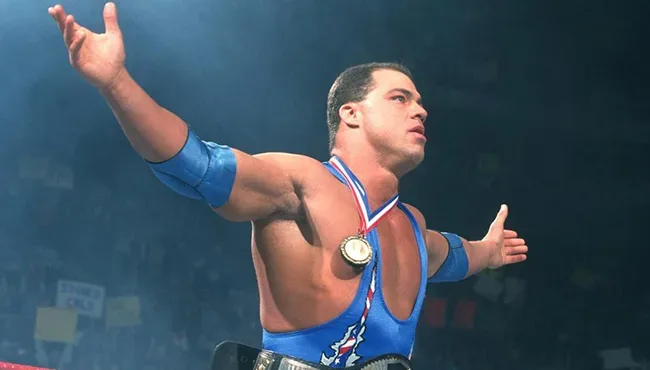
Kurt Angle has worn a wide range of championships throughout a career that included major runs in WWE and TNA, but one design remains closest to him: the WWE Eagle Belt.
Speaking on GTV Network, Angle was asked which title belt design stands as his personal favorite. His answer was direct, naming the championship associated with one of the defining wins of his early WWE career.
“The Eagle Belt. The WWE Eagle Belt. Uh that was the first title I won when I beat The Rock for the World Championship.”
For Angle, the answer is not simply about the appearance of the physical championship. While the winged eagle-style WWE title remains one of the most celebrated belt designs among wrestling fans, Angle explained that the meaning behind the belt is what truly elevates it in his mind.
For more background on this topic, read Rey Mysterio Says Retirement Is Not on His Mind as He Balances WWE and AAA Roles.
The title represented a major turning point. Defeating The Rock for the World Championship gave Angle a championship moment that he says changed how he was viewed in WWE, moving him into the company’s main-event picture on a full-time basis.
“It made such a huge impact on my career. Uh, that that’s what made me a main eventer full-time. I’m very grateful that The Rock did business and he dropped the title to me. It was really cool to have somebody that stature, you know, do a job you know for for me who was a rookie at that particular time. So I had an incredible rookie year, and beating The Rock capped it off.”
The Belt and the Breakthrough
Angle’s comments make clear that his favorite championship design cannot be separated from the match and the opponent attached to it. The WWE Eagle Belt was the title he first won when he defeated The Rock for the World Championship, and that milestone has remained central to his assessment of the belt ever since.
Rather than framing the choice as a purely aesthetic ranking, Angle connected it to the professional opportunity represented by the championship victory. The visual identity of a title can become inseparable from the wrestler who carries it and from the matches that define its history. In Angle’s case, the belt evokes a career-changing night and the endorsement implied by defeating one of WWE’s biggest stars.
Angle specifically emphasized The Rock’s stature at the time and expressed gratitude that he was willing to lose the championship to a wrestler who was still a rookie. That aspect remains particularly meaningful to Angle. He described the victory as the capstone to an “incredible rookie year,” while also identifying it as the result that helped establish him as a consistent main-event presence.
The distinction matters. A title reign can be significant because of the belt itself, because of the champion who holds it, or because of the circumstances under which it was won. Angle’s explanation touches on all three. The WWE Eagle Belt has lasting appeal as a design, but its personal importance comes from the fact that it was the championship he captured from The Rock at a pivotal stage of his ascent.
Why the Eagle Design Endures
The winged eagle designs associated with WWE’s New Generation and Attitude Era periods have long held a special place among fans. Angle’s selection fits within that broader appreciation, even if he places the focus on his own memories rather than offering a detailed critique of the belt’s look.
Championship belts are among the most recognizable symbols in professional wrestling. They communicate status, history, and identity before a match even begins. For performers, however, the emotional weight of a belt often comes from the events surrounding it: the opponent across the ring, the stage of a career, the moment of victory, and the responsibility of being recognized as champion.
Angle’s answer illustrates that divide between a fan discussion and a wrestler’s experience. Fans may debate the shape of the plates, the color scheme, or how a championship looks around a performer’s waist. Angle did not dismiss the visual appeal of the Eagle Belt, but he made it apparent that its impact on his career is the reason it rises above every other design he held.
That is also why the belt’s popularity has endured beyond any one champion. For many viewers, a classic championship design becomes a shortcut to an entire era. For Angle, it serves as a reminder of a singular accomplishment: winning the World Championship from The Rock and reaching a new level in WWE.
Angle Credits The Rock for a Defining Moment
Angle has previously expressed appreciation for The Rock, and his latest remarks again underline how strongly he values that match and its outcome. He did not present the championship win as an individual achievement detached from the other person in the ring. Instead, he acknowledged what it meant to receive that opportunity from someone of The Rock’s standing.
Professional wrestling titles are won within stories and matches, but the significance of a victory is often shaped by the stature of the champion being defeated. In Angle’s view, defeating The Rock gave the moment an importance that extended well beyond a first world title win. It also reinforced that WWE was prepared to place him at the top of the card on a regular basis.
Angle called himself a rookie at that point in his career, making his reflection especially notable. He sees the result as a major vote of confidence from an established star and as a critical milestone in a year he remembers fondly. The fact that the championship was the WWE Eagle Belt has therefore become part of the memory rather than merely a piece of presentation.
His appreciation for The Rock is also consistent with the way Angle framed the moment: as an opportunity that had to be given as well as earned. By thanking The Rock for doing business and dropping the title, Angle highlighted the trust involved in putting a newer wrestler over in such a prominent championship match.
A Personal Choice Among Many Championships
Angle’s career featured championship success across more than one major promotion, and belt designs changed significantly through the years he was active. That range makes his choice more revealing. He had ample experience with titles that carried different looks, histories, and associations, yet he returned to the belt tied to his first World Championship victory.
There is no indication that Angle’s selection should be read as a technical verdict on every belt design he encountered. His reasoning is much more personal. The Eagle Belt is his favorite because it symbolizes the match that confirmed his arrival as a full-time main-event talent.
That context also explains why the answer resonates beyond a standard discussion of wrestling memorabilia or presentation. The title belt stands as a physical connection to a career milestone. It represents the conclusion of Angle’s remarkable rookie year, his victory over The Rock, and the beginning of his time at the highest level of WWE competition.
For fans who already rank the winged eagle-style championships among WWE’s strongest designs, Angle’s comments add another layer to the belt’s legacy. It is not only remembered for its appearance or its era. It is also the title that marked one of Kurt Angle’s most important professional breakthroughs.
In the end, Angle’s favorite belt is defined by both style and substance. The WWE Eagle Belt may be a popular selection in any conversation about championship designs, but for Angle, its value comes from what happened when he won it. Beating The Rock for the World Championship did more than put a title around his waist; Angle says it made him a main eventer full-time, and that personal history is why the design remains his No. 1 choice.

Darryl Polo
Darryl Polo is a passionate wrestling fan covering WWE, AEW, TNA and beyond. He loves great rivalries, breakout stars and the moments that keep fans talking long after the bell. How we work.