
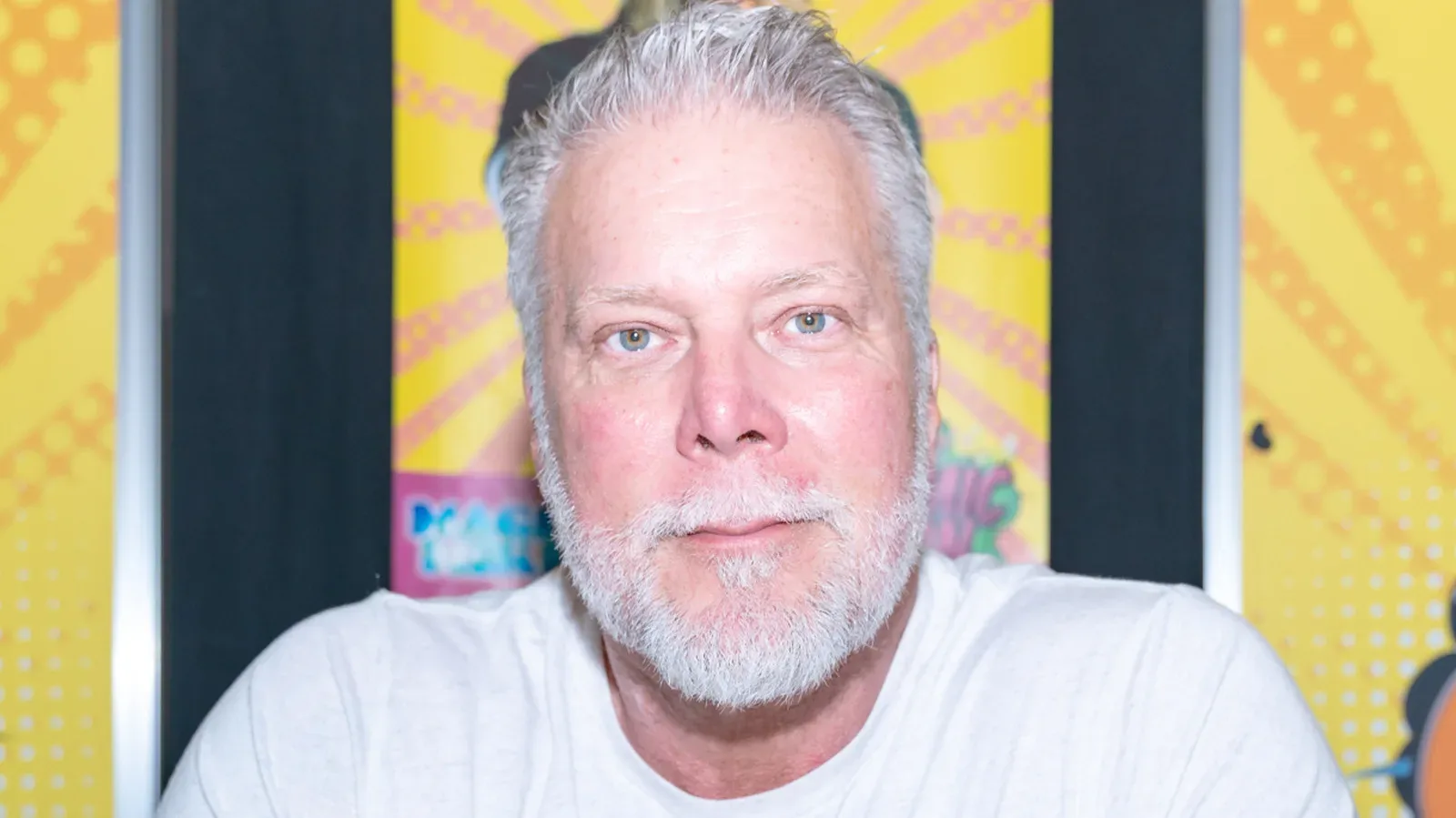
Kevin Nash has made it clear that he sees more potential in Omos than WWE has shown to date.
Discussing the 7-foot-3 Nigerian Superstar on Kliq This: The Kevin Nash Podcast, the WWE Hall of Famer delivered a brief but emphatic assessment of how he would handle Omos on television: “I would use him differently.”
Nash did not expand on precisely what changes he would make to Omos’ presentation, match selection, storylines, or place on the WWE roster. Still, the comment carries weight coming from a performer whose own size, presence, and booking were central to his rise as Diesel in WWE and later as a defining figure in WCW. Nash’s statement also arrives after Omos put together an eye-catching two-night stretch for AAA in September.
For Omos, the issue is not whether he looks like a major attraction. At his height, he is among the most immediately recognizable physical presences in modern wrestling. The lingering question is how a promotion best builds around that kind of talent, especially when giants are at their most effective as special attractions rather than simply another name in a crowded weekly rotation.
For more background on this topic, read Joe Hendry Says a Matt Cardona Matchup Would Be Better Suited for UFC Than WWE.
A Statement Made Without a Full Blueprint
Nash’s comment was concise, but it naturally invites discussion because Omos has already been used in several different capacities during his WWE tenure. He has appeared as an imposing enforcer, worked alongside AJ Styles in a successful tag team, competed in featured singles matches, and been positioned opposite some of WWE’s most established names.
What Nash did not do was offer a public playbook. He did not identify a specific opponent, title program, manager, or character direction for Omos. That distinction matters. There is a significant difference between recognizing that a performer could be presented in a more effective way and declaring that there is one simple solution.
Still, the phrase “use him differently” speaks to a familiar debate surrounding towering wrestlers. Size can create instant spectacle, but it also requires discipline in presentation. A giant can lose some of his unique quality if he is regularly placed in situations that make him feel routine. Conversely, a carefully protected attraction can make every appearance, confrontation, and match feel more significant.
That is particularly relevant with Omos because he does not need a lengthy introduction when he walks into a building. His stature communicates the premise before he says a word. The challenge is making sure the booking around him reinforces that visual advantage.
Omos’ September Success in AAA
The timing of Nash’s remarks follows a productive September for Omos outside WWE. He recorded two notable victories across AAA TripleMania 34 events, demonstrating the kind of impact that comes when his size is emphasized as a central part of the presentation.
On Friday, September 11, in Las Vegas, Omos defeated WWE and AAA Hall of Famer Rey Mysterio. The visual contrast alone was striking, with Omos ragdolling Mysterio during the match and leaving the veteran star in a neck brace.
Two days later, on Sunday, September 13, Omos competed in Mexico City, Mexico, and outlasted 14 other challengers to win the Copa Bardahl Cup. The result made him the first wrestler to win the cup in consecutive years, having also secured the victory the previous year.
Those wins did not give Omos a singles championship in AAA, but they reinforced that he can be positioned as a major force in that environment. The Mysterio result gave him a high-profile victory over one of the most famous luchadores in wrestling history, while the Copa Bardahl triumph added a distinctive accomplishment to his AAA record.
AAA’s use of Omos has leaned into the obvious appeal of a giant entering a setting filled with speed, aerial offense, and competitors of dramatically different sizes. That contrast can make his appearances feel especially dramatic. When the biggest athlete in the match is also presented as an obstacle that a field of challengers must survive, the attraction is easy for an audience to understand.
The WWE Resume So Far
Omos has achieved championship success in WWE, though it has come in the tag team division rather than in singles competition. Alongside AJ Styles, he held the Raw Tag Team Championship, a title now known as the World Tag Team Championship.
The partnership with Styles offered an effective contrast. Styles brought elite experience and quickness, while Omos supplied the scale and power that made the duo visually memorable. It also provided Omos with a prominent platform early in his WWE run and put a championship on his resume.
However, Omos has not yet won a singles title in WWE. He also has not captured a singles championship in AAA. That absence does not erase the importance of his victories or his physical upside, but it remains a clear marker of where his career stands. He has been presented as a threat and has accumulated notable moments, yet he has not had the sustained singles title run that would firmly establish him near the top of a division.
That is why comments such as Nash’s resonate. A performer with Omos’ dimensions is not easily compared to the average member of the roster. He cannot be treated as interchangeable, and the biggest question is whether WWE sees him as a long-term special attraction, a title challenger, a destructive force used selectively, or something else entirely.
The Importance of Rarity for a Giant Attraction
There is no confirmed indication that WWE is preparing a new direction for Omos, and Nash did not reveal any backstage insight or specific creative proposal. The broader conversation is instead about presentation.
For giants, rarity has often been a key part of maintaining mystique. The less frequently an audience sees a towering athlete wrestle, the more likely a match can feel like an event. That does not mean a giant must disappear for months at a time. It means the appearances that do happen need a purpose: a confrontation that sets up a challenge, a decisive win that changes the landscape, or a match where the opponent has a credible and compelling reason to believe they can overcome the size disadvantage.
Omos’ AAA results demonstrate another useful principle: the giant does not always need a championship to feel important. Winning a tournament-style attraction, overwhelming a legendary opponent, or being framed as a problem that multiple wrestlers cannot solve can be enough to create momentum. A title can then become the next step rather than the only way to signal importance.
At the same time, WWE’s depth creates complications. Any major Omos program would require a credible opponent and a story that does not rely only on pointing out the height difference. The most effective programs would need stakes beyond spectacle, whether that is championship ambition, a personal conflict, or the challenge of a respected competitor trying to solve a seemingly impossible physical matchup.
What Nash’s Comment Ultimately Highlights
Nash’s one-line assessment should not be treated as a detailed public critique of WWE’s current creative plans. He did not lay out an alternative strategy, nor did he suggest that Omos has been entirely mishandled. But the comment does spotlight a legitimate question around a wrestler with rare physical attributes.
Omos has already held WWE tag team gold with AJ Styles. He has now added a pair of significant AAA TripleMania 34 victories, including a win over Rey Mysterio and a second straight Copa Bardahl Cup triumph. Those accomplishments show that he can be positioned as a consequential force when a promotion chooses to make his size and dominance central to the story.
The next chapter in WWE will determine whether that potential translates into a more sustained singles role. For now, Nash’s remark is simple: Omos is different, and his presentation may need to reflect that more strongly. Given the giant’s recent success in AAA and the visual impact he brings whenever he appears, it is a conversation that is unlikely to fade soon.
In pictures

Darryl Polo
Darryl Polo is a passionate wrestling fan covering WWE, AEW, TNA and beyond. He loves great rivalries, breakout stars and the moments that keep fans talking long after the bell. How we work.