
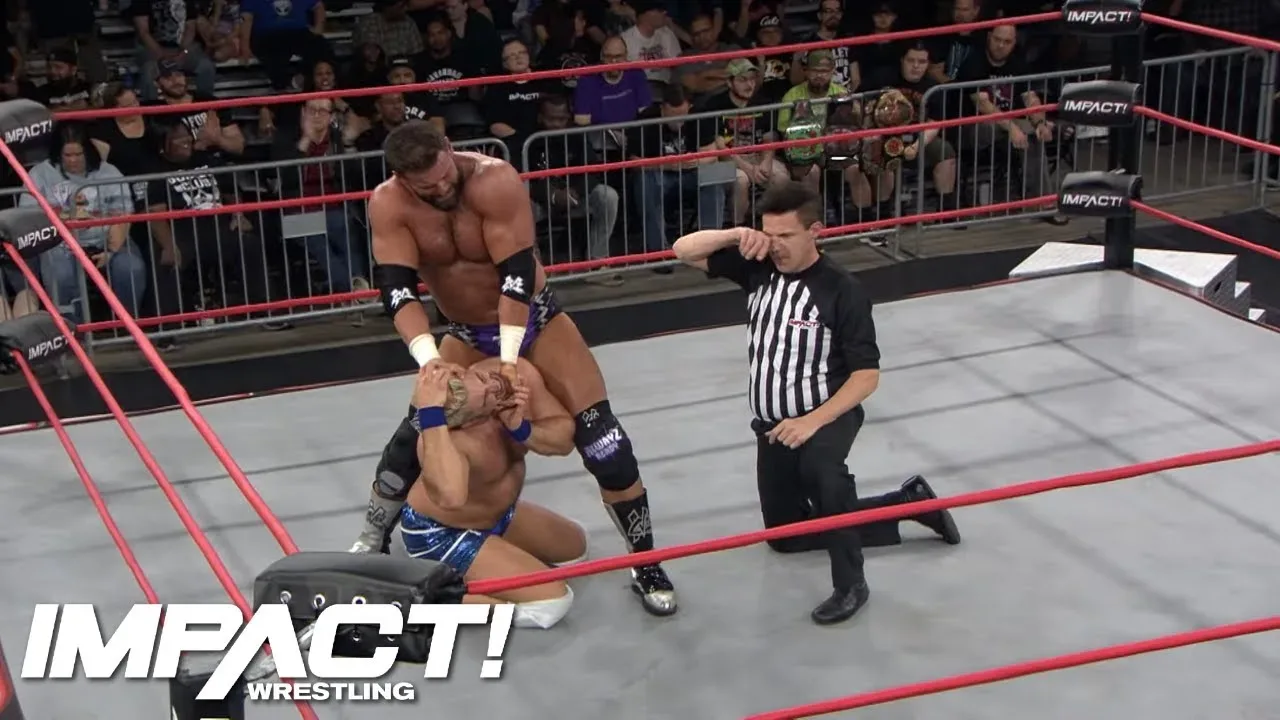
Joe Hendry has drawn a sharp distinction between competing with Matt Cardona in professional wrestling and fighting him under mixed martial arts rules.
In a new appearance on My Mom’s Basement with Robbie Fox, Hendry was asked to consider the wrestlers he has worked with and singled out Cardona as the stiffest opponent he has encountered. Hendry was complimentary of Cardona’s work, but his answer came with an unusually direct hypothetical: if the two were ever to meet, Hendry would rather do so in the UFC than in WWE.
“I just have to say, by the way, I think that Matt Cardona is, is very good at what he does, by the way. That said, I would rather face him in the UFC than WWE. So TKO, if you ever want me to face Matt Cardona, it has to be in the UFC.”
The remark was delivered as a hypothetical rather than an announcement of any proposed fight, wrestling match, or formal challenge. There has been no confirmation of a Hendry-Cardona bout in either WWE or UFC. Still, Hendry’s framing made clear that he views the physicality of working with Cardona as substantial enough that he would choose a regulated combat-sports setting over a pro wrestling environment for a one-on-one encounter.
For more background on this topic, read Joe Hendry Names Bron Breakker as the Strongest Wrestler He Has Faced.
Hendry gives Cardona credit while making his preference clear
The most notable part of Hendry’s comments is that he did not present the statement as a dismissal of Cardona’s wrestling ability. Before making his UFC preference known, Hendry explicitly said Cardona is “very good at what he does.” That qualification matters because the exchange was not framed as Hendry questioning Cardona’s skills as a performer. Instead, it centered on the intensity Hendry associates with sharing a ring with him.
Calling another wrestler “stiff” can carry different meanings depending on the context. In wrestling, it can refer to a performer whose strikes, contact, or overall style feels especially forceful. It does not automatically mean there was a problem between the two wrestlers, nor does it establish that anyone acted improperly. Hendry’s comments, as presented in the interview, were a pointed assessment of Cardona’s physical style and a humorous but emphatic statement about where he would prefer a future confrontation to take place.
Hendry did not identify a specific past match, event, or incident that led him to name Cardona. He also did not lay out rules for the imagined UFC meeting, say that discussions have taken place, or suggest that either side is pursuing a sanctioned fight. The only concrete point was his preference: given the choice between WWE and UFC for a showdown with Cardona, Hendry chose UFC.
A distinction between wrestling and combat sports
Hendry’s answer plays on the obvious contrast between the two settings he named. WWE is professional wrestling, where athletes work within a performance structure while executing physical action in front of a live audience. UFC presents sanctioned mixed martial arts competition, where the objective is to defeat an opponent under an established set of fighting rules.
By saying he would choose UFC, Hendry was not merely naming a different venue. He was contrasting the demands of a wrestling match with the more direct premise of an octagon fight. That is what gives the quote its edge: rather than saying he would prefer a different wrestling stipulation or a different ring, he took the hypothetical outside of professional wrestling entirely.
The reference to TKO also fits that contrast. TKO is the corporate organization connected to both WWE and UFC, making Hendry’s line a way of placing the imagined Cardona encounter under the same wider umbrella while insisting it should happen on the UFC side rather than the WWE side. The comment does not establish that TKO has any plans involving the two men. It simply gave Hendry a playful, concise way to state his preference.
Hendry has combat-sports training
Hendry is among the professional wrestlers with martial arts training and a legitimate combat-sports background. That history provides context for why an MMA-style hypothetical would be a natural direction for him to take during an interview. His answer did not include details about a prospective fight camp, a weight class, an opponent agreement, or any timeline. It was instead a broad declaration that, against Cardona specifically, he would rather compete in an environment designed for fighting than in a WWE ring.
That distinction is important when evaluating the comment. Wrestlers frequently speak in competitive terms about potential opponents, dream matches, and physical confrontations. Those conversations can create fan interest without representing a booked match or an active negotiation. Hendry’s words fall into that category based on what was said: a memorable hypothetical, not a confirmed development.
There is also no indication in Hendry’s statement that Cardona has responded to the UFC suggestion or that he shares Hendry’s view. The interview comments represent Hendry’s perspective only. Until either wrestler or the relevant organizations publicly announce something more concrete, the possibility remains just that—a possibility raised in conversation.
Cardona is the wrestler Hendry identified as his stiffest opponent
Hendry’s selection of Cardona answered a specific kind of question: the stiffest wrestler he has worked with. That made the name especially significant, even as Hendry balanced it with praise. The answer suggests that Cardona left a strong impression on Hendry through their in-ring physicality, enough to immediately inspire the UFC comparison.
Professional wrestling is built on cooperation as well as competition. Wrestlers must communicate, protect one another, and maintain the illusion of conflict while performing demanding physical sequences. Within that environment, some performers develop reputations for a harder-hitting presentation or a more forceful style. Hendry’s observation placed Cardona in that conversation from his own experience, but he did not turn it into an accusation or offer an extended criticism.
Instead, Hendry’s wording kept the focus on a hypothetical rivalry. He praised Cardona, described his own preferred terms for a showdown, and addressed TKO as the company that could theoretically place them in either of the two worlds he mentioned. It was a compact answer that connected wrestling’s physical culture with the appeal of a genuine combat-sports setting.
No announced match or fight between Hendry and Cardona
For now, fans should view Hendry’s statement as commentary rather than a preview of an announced event. No WWE match between Hendry and Cardona was revealed in the interview, and no UFC fight was announced. There was no claim that contracts had been discussed, no event date was named, and no promoter was identified as working toward the idea.
What Hendry did provide was a clear answer to a clear hypothetical. If the decision were his, and if a confrontation with Cardona were to happen, he would choose the UFC over WWE. That answer was rooted in Hendry’s view of Cardona as the stiffest wrestler he has shared the ring with, while still recognizing Cardona’s effectiveness as a professional wrestler.
Elsewhere in the same interview, Hendry also discussed the strongest wrestler he has worked with. The Cardona comments, however, stand apart because they turn an assessment of in-ring physicality into a larger combat-sports proposition. Whether it was said in jest, competition, or a blend of both, Hendry left little ambiguity about his preferred setting for a match-up with Cardona: not a WWE ring, but the UFC octagon.

Darryl Polo
Darryl Polo is a passionate wrestling fan covering WWE, AEW, TNA and beyond. He loves great rivalries, breakout stars and the moments that keep fans talking long after the bell. How we work.