
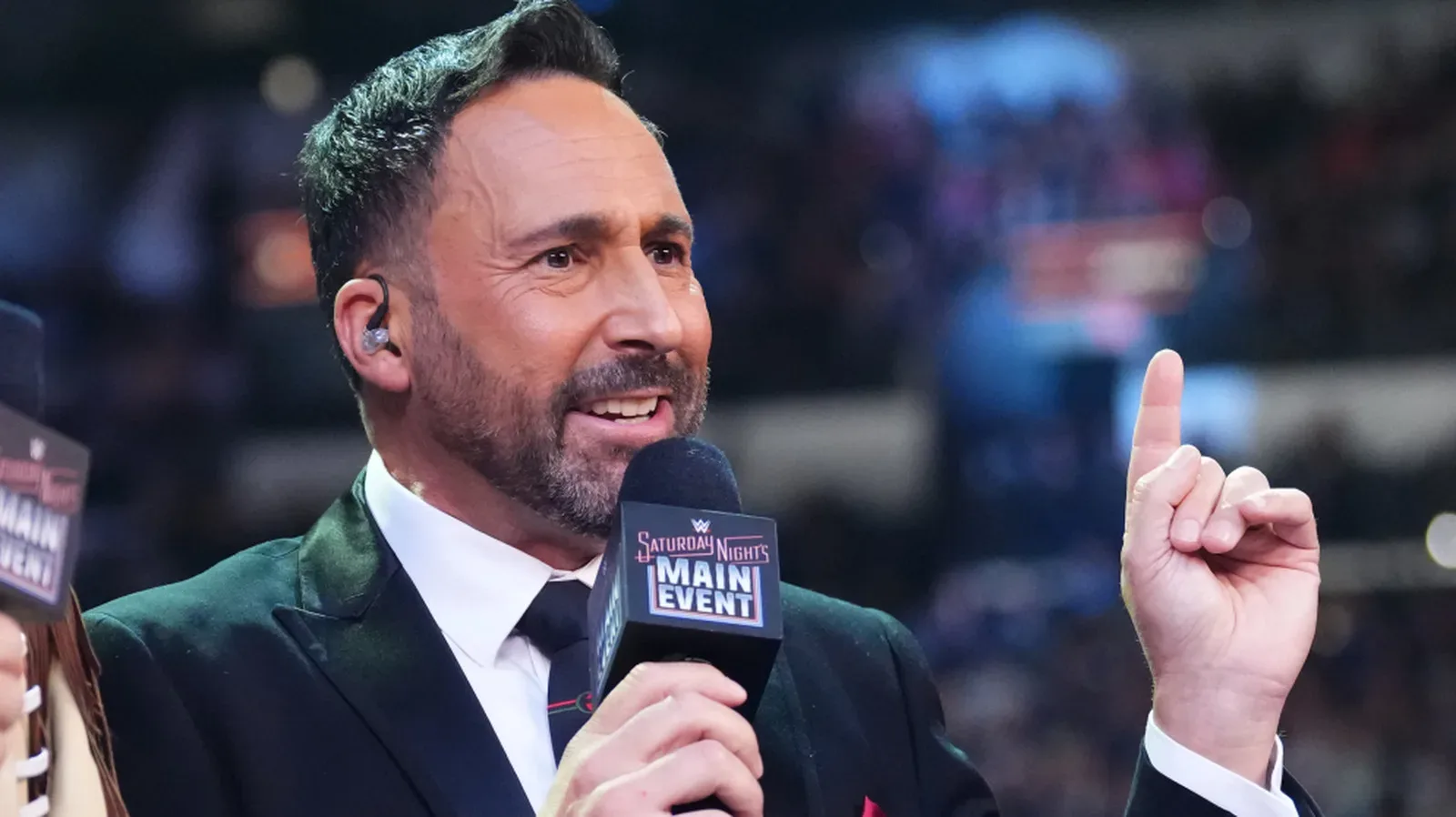
Kevin Nash likes a little more restraint than Joe Tessitore sometimes brings to the broadcast booth. Speaking with Sean Oliver on Kliq This: The Kevin Nash Podcast, the WWE Hall of Famer singled out Tessitore as a commentator who can come close to going over the top. But the call Nash reached for to explain his criticism wasn't from Raw or SmackDown. It was from college football, and Nash couldn't quite remember which game he had been watching.
“I think the guy that does the WWE, that does sports, would probably be the closest one to being a little over the top,” Nash said. “I watched him. What was he calling the other day? He was calling maybe the Notre Dame game. He was calling something and it was just...too much for me.”
Nash's wording matters. He didn't say Tessitore was incapable of judging a big moment, and he didn't point to a specific WWE call that had bothered him. He was describing how Tessitore's delivery lands with him as a viewer, particularly when the event already has enough energy on its own. Tessitore, whose broadcast work also includes college football and TKO's Zuffa Boxing, has the kind of cross-sport résumé that makes it easy to hear the same voice in very different settings. For Nash, the football example was the clearest way to explain what he finds excessive about that voice.
Kevin Nash Thinks the Game Can Supply Its Own Excitement
As Nash and Oliver unpacked the point, they used a college football broadcast to illustrate how Tessitore sounds to Nash. An SEC game, in Nash's telling, is already “rapidly hot.” The stakes and atmosphere are there before the announcer raises his voice. What Nash doesn't need in that setting is an emphatic explanation layered over action that is already getting a reaction. His issue is less with a commentator getting loud once than with how frequently he hears Tessitore go to that level.
For more background on this topic, read Cody Rhodes Explains His Complicated Bond With The Rock and the WWE Story He Wants to Revisit.
The possible Notre Dame broadcast and the SEC example aren't necessarily the same game. Nash floated Notre Dame while trying to remember what he had seen, then used the SEC to describe the kind of environment that, in his opinion, needs no extra push from the booth. He didn't identify a play or a particular line from the broadcast. The criticism was about tone and frequency, not whether Tessitore got a call right or missed something important on the field.
There's a meaningful difference between a call that rises with the action and one that tries to keep the audience at the same pitch from moment to moment. A raised voice can make a sudden turn feel even more immediate. Used often enough, it gives the next big moment less room to stand out. That's the practical question behind Nash's criticism: not whether a broadcaster should sound excited, but whether the action warrants that degree of excitement every time the broadcaster reaches for it.
What the Critique Means for WWE Commentary
Tessitore's WWE tenure dates back to 2024, with his arrival announced that July. He has called both WWE Raw and WWE SmackDown, returning to the blue brand in January alongside Wade Barrett. Barrett brings a former wrestler's perspective to the desk, while Tessitore handles play-by-play. That division of labor makes the timing of a call important: the play-by-play voice identifies what just happened, and the analyst can explain why it mattered once the audience has had a chance to take it in.
Wrestling gives a broadcaster several opportunities to make that choice in a single match. A count of two can deserve a sharp call because a kickout changes the audience's expectation that the match is about to end. A wrestler taking time to register the kickout can be just as important, but it may not need the same volume or as many words. The crowd's reaction can help tell that part of the story. And when an analyst has something to add about why the pin attempt failed, the audience needs to be able to hear that explanation rather than just the tail end of the initial call.
There is a case for bringing a big voice to those moments, too. A viewer at home doesn't experience the building the way someone in the seats does, and the play-by-play announcer can help convey the urgency of a sequence as it happens. Wrestling also asks the booth to connect what is in front of the camera with what a viewer may have missed earlier in the match or on a previous show. Done well, that context makes the reaction easier to understand. It isn't the same as simply turning up the intensity, which is the part of Tessitore's style that Nash was reacting to.
The difference between wrestling and football also puts a limit on how far Nash's example can be taken. A football call has to follow the pace of a game that stops and starts between plays. On a wrestling show, the booth can move from a match to an entrance, a confrontation or a replay, each of which asks for a different kind of attention. None of that means Tessitore needs a separate broadcasting personality for every assignment. It does explain why a delivery that strikes one viewer as too much during a football game may land differently when the job is to sell a sudden development on SmackDown.
Nash didn't offer Tessitore a list of adjustments, and his comments weren't a verdict on the pairing with Barrett. He was clear about his own threshold: when the event already feels big, he would rather the broadcaster not keep telling him how big it is. Tessitore remains a prominent WWE voice, and his run on both main-roster shows gives viewers plenty of chances to judge the approach for themselves. The next time a match has the crowd on its feet before anyone at the desk says a word, the choice Nash is talking about will be easy to hear: whether to meet that reaction with a big call or give it a beat to come through on its own.
In pictures

Darryl Polo
Darryl Polo is a passionate wrestling fan covering WWE, AEW, TNA and beyond. He loves great rivalries, breakout stars and the moments that keep fans talking long after the bell. How we work.