
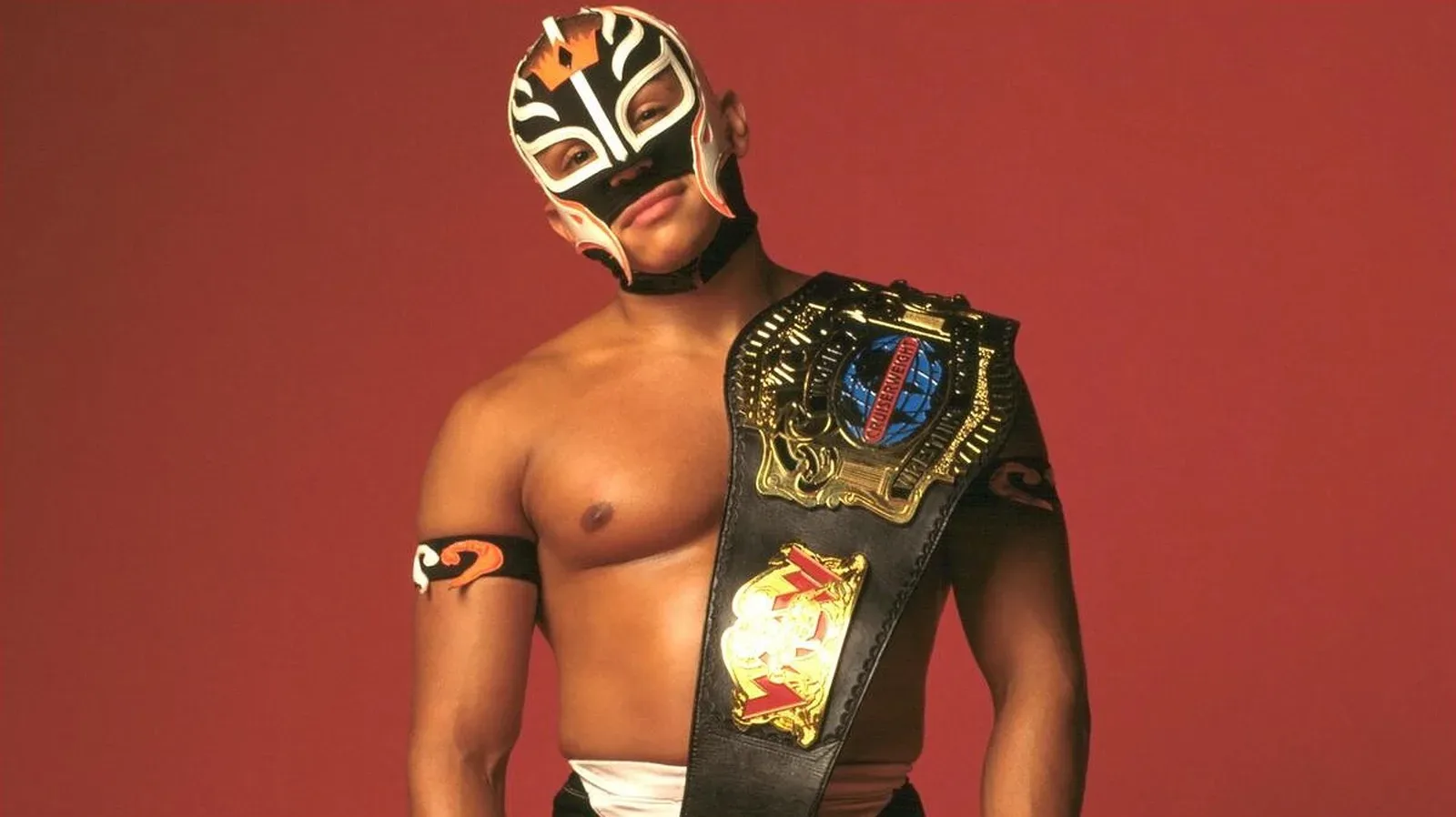
Kevin Nash has offered a new perspective on one of the most debated creative decisions in WCW history: Rey Mysterio losing his mask at SuperBrawl IX.
Mysterio’s mask is inseparable from his identity for generations of wrestling fans. It has been central to his presentation, his connection with lucha libre traditions, and his enormous merchandising appeal throughout his WWE career. But there was a period in WCW when Mysterio wrestled without it, following a stipulation loss that remains a major point of criticism whenever the company’s treatment of masked luchadores is discussed.
Speaking on Kliq This, Nash said he believes the decision to unmask Mysterio was his idea. Nash and Scott Hall defeated Mysterio and Konnan at SuperBrawl IX, with Mysterio’s mask and Konnan’s hair at stake. The result forced Mysterio to remove the mask, beginning the unmasked phase of his WCW run and leading into his association with the Filthy Animals.
Nash framed the choice as a marketing decision rather than an attempt to diminish Mysterio. In his view, WCW’s advertising plans at the time created an incentive to put Mysterio’s face in front of a wider audience. Nash recalled that the company was preparing a significant promotional campaign and that those involved in advertising had already seen Mysterio without his mask.
For more background on this topic, read Tony D’Angelo Sets His Sights on WWE Main Roster Grand Slam.
“I think I f***ing booked that,” Nash said on Kliq This.
Nash explained that he believed the company could not effectively use a masked wrestler in the type of large-scale advertising it was pursuing. He specifically referenced the challenge of presenting Mysterio in prominent public advertising while he remained covered by a lucha mask. From Nash’s perspective, Mysterio had the charisma and looks to become even more recognizable if WCW showcased his face.
That reasoning is notably different from the way many fans, and Mysterio himself, have viewed the decision. For critics, the issue was never whether Mysterio could work successfully without a mask. He clearly could. The issue was what the mask represented, both to Mysterio personally and within the traditions from which he came. In lucha libre, a mask is not merely a costume piece. It can embody lineage, mystique, cultural pride, marketability, and a wrestler’s entire professional identity.
Mysterio had already become one of WCW’s most electrifying performers while masked. His matches helped introduce a broader American television audience to an acrobatic, fast-paced style that differed sharply from the heavyweight-centered wrestling commonly featured on major U.S. programming. His work in WCW helped establish the cruiserweight division as a vital part of the promotion’s weekly presentation.
On the podcast, Nash acknowledged that a mask could be a valuable piece of merchandise. He argued, however, that WCW was not equipped to fully capitalize on that opportunity. Nash’s point was that Mysterio potentially could have sold new masks constantly, but the company did not have the merchandising infrastructure in place to turn that demand into the type of revenue stream it might have been elsewhere.
“The mask doesn’t make Rey Mysterio,” Nash said on Kliq This, while adding that masks could make Mysterio money through merchandise sales.
Nash said he looked at Mysterio as someone whose face should be seen by the largest possible audience. He called Mysterio a “handsome” performer and suggested that revealing him could help WCW sell him as a star outside the traditional confines of a masked luchador character. In that sense, Nash’s recollection presents the decision as an effort to broaden Mysterio’s commercial reach.
There is also a competitive element to Nash’s memory of that period. He pointed to a subsequent match in which Mysterio defeated him cleanly in the middle of the ring. Nash viewed that result as an important statement: a wrestler of Mysterio’s size could beat one of WCW’s biggest stars without interference or a convoluted ending. For Nash, putting Mysterio over in that manner demonstrated that the promotion could elevate a smaller athlete in a credible way.
That is a significant part of Nash’s argument. He was not describing the unmasking as a means of moving Mysterio down the card. Instead, he saw it as part of a larger attempt to portray him as a performer who could be marketed more broadly and who could win decisively against heavyweight opposition. Whether that creative intent translated into the best possible outcome is a separate question, and it is one Mysterio has answered emphatically over the years.
Rey Mysterio Has Long Opposed The Decision
Mysterio has repeatedly made clear that he did not support losing his mask in WCW. As recently as this year, he criticized the choice and said he had strongly opposed it. Mysterio has argued that the decision hurt not only him, but other luchadores who were working in the company and carrying traditions that WCW did not fully understand or protect.
His criticism has also extended to the executives who approved the stipulation. Mysterio has stated that WCW and Eric Bischoff made the wrong call by allowing the mask to be removed. That position reflects the longstanding view that an American promotion should have treated the mask with greater importance, particularly in the case of a performer whose reputation had been built around it.
The disagreement between Nash’s explanation and Mysterio’s position illustrates why the moment remains so controversial. Nash is discussing marketability in terms of mainstream advertising, facial recognition, and the possibility of creating a more conventional American television star. Mysterio is discussing the real-world and professional consequences of removing an emblem that carried profound meaning in lucha libre.
Those views are not necessarily addressing the same definition of success. Nash’s recollection centers on an intended opportunity: make Mysterio more visible, emphasize his physical charisma, and establish that he could be protected as a credible star against larger opponents. Mysterio’s objections center on what was lost in the process: a foundational element of his character, the merchandising potential connected to that identity, and a tradition that he believed deserved more respect.
The Lasting Importance Of Mysterio’s Mask
History has added another layer to the debate. Mysterio eventually returned to wearing his mask, and it became even more deeply identified with his career during his time in WWE. The mask has been present for the defining accomplishments of his later run, through championship pursuits, landmark feuds, major family storylines, and his enduring role as one of wrestling’s most recognizable international stars.
That later success makes it difficult to separate Mysterio from the masked image that fans know today. For many supporters, the fact that he regained the mask only reinforces the belief that it was essential to his presentation all along. The visual is instantly recognizable, adaptable for merchandise, and connected to a legacy that reaches far beyond a single promotion or storyline.
At the same time, the WCW period without the mask remains part of Mysterio’s career. It showed another side of him as a performer, including his ability to adjust to a different character presentation. The Filthy Animals gave him a different on-screen environment, and Mysterio continued to display the athleticism and personality that had made him a standout. Yet adaptability does not erase the disagreement over whether he should have been put in that position in the first place.
Nash’s comments do not settle that debate, but they provide a clearer account of how he says he viewed the decision at the time. He believed Mysterio had the potential to be even more marketable with his face visible, and he maintains that his own booking of Mysterio afterward was meant to underscore the smaller star’s value to WCW.
Mysterio’s perspective remains just as important to the story. He was the wrestler asked to give up the mask, and he has consistently said that he opposed doing so. The result is one of WCW’s most enduring creative controversies: a decision presented by one participant as a bid for greater exposure, but remembered by the wrestler at its center as a damaging mistake.
More than two decades later, the discussion still matters because Mysterio’s mask remains one of professional wrestling’s most powerful symbols. It is a reminder that wrestling gear can carry meaning far beyond appearance, and that creative choices involving cultural traditions and a wrestler’s identity can have consequences that continue long after a storyline ends.
In pictures

Darryl Polo
Darryl Polo is a passionate wrestling fan covering WWE, AEW, TNA and beyond. He loves great rivalries, breakout stars and the moments that keep fans talking long after the bell. How we work.