
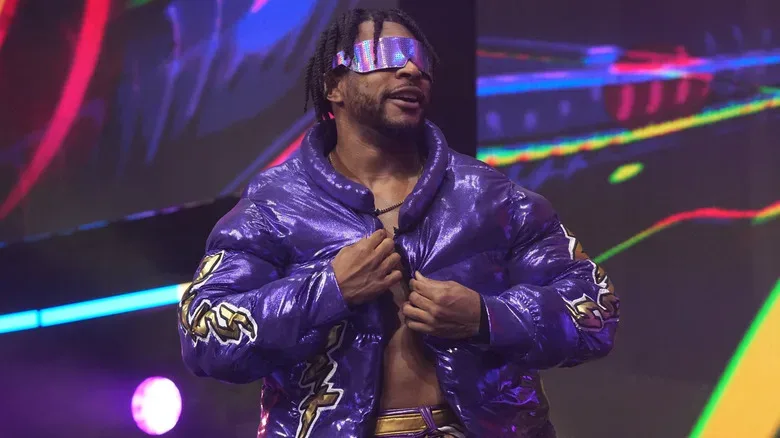
Kevin Knight is not interested in treating the traditional wrestling divide between hero and villain as the central point of his career. As “The Jet” continues his run in AEW alongside the Don Callis Family, Knight has made clear that his focus is not on whether fans see him as a babyface or a heel. For him, the defining motivation is much simpler: winning championships.
Knight currently finds himself positioned on the antagonistic side of AEW television through his association with Don Callis and his upcoming partnership with Kyle Fletcher. The two are set to challenge the Young Bucks for the AEW World Tag Team Championships at WrestleDream, placing Knight in one of the biggest matches of his AEW tenure. Yet when discussing the role of a wrestler’s alignment, Knight rejected the idea that the labels themselves should define the competitors involved.
“It’s all the same thing. I really don’t like the term heel or babyface because we all just have motives. We all want to win gold. Nobody got into this business to be a heel or a babyface. We all got into this business to win, and it’s all about how you go about doing that.”
It is a perspective that fits the current version of Knight particularly well. The Don Callis Family has become synonymous with competitors who place their own success above popular approval, and Knight’s comments suggest he sees that approach less as a change in fundamental ambition than as a different route to the same destination. Whether a wrestler receives cheers or boos, the objective remains a victory, a title, and a stronger position within the company.
For more background on this topic, read Tanea “Rebel” Brooks Named First Honorary Member of I AM ALS Board of Directors.
That distinction is important as Knight heads toward a championship match. The Young Bucks are established champions with a long history as a unit, while Knight and Fletcher are being brought together by a shared opportunity. Knight’s belief that motives matter more than the assigned hero-or-villain role gives the team a straightforward outlook: they are not seeking validation from the audience or attempting to fulfill a particular moral identity. They want the AEW World Tag Team Championships.
Knight’s View Of The Babyface Role
Knight did not dismiss the appeal of being presented as a babyface. He acknowledged that there is an obvious benefit to competing with the crowd behind you. Support from the audience can make a performer’s success feel communal, with fans invested in every comeback, near fall, and major victory. A babyface can draw energy from the people in the building, and that relationship can elevate the stakes of a match.
“Babyface is cool. You’ve got the support of the fans, hopefully.”
The word “hopefully” is notable. Even on the fan-friendly side of a wrestling story, crowd support is never entirely guaranteed. Audiences respond to personalities, momentum, rivalries, performances, and results. A wrestler can be positioned as a babyface, but the connection still has to be built in the ring and maintained over time. Knight’s framing recognizes that the audience relationship is valuable, while also underlining that it is not the ultimate prize he is chasing.
His broader point is that a wrestler’s pursuit of success does not disappear simply because that wrestler is supported by fans. A babyface may fight with the audience’s encouragement and may choose a more direct path in pursuit of a win, but the desired outcome remains the same. The championship is still the destination. In Knight’s view, the difference comes through the methods used along the way.
Why Knight Believes Heels Have More Freedom
While Knight sees both sides as driven by ambition, he believes performing as a heel can give a wrestler greater room to express themselves. That freedom comes from operating without the need to earn the audience’s approval. A heel can make decisions that are selfish, aggressive, or opportunistic because the character is not constrained by the expectation of being admired.
“But then when you’re a heel, you’ve got to do things your own way and by any means necessary, and I think it naturally makes you a heel.”
For Knight, that can include taking shortcuts. The wrestler who is willing to bend the rules, use an object, strike when an opponent is vulnerable, or take advantage of a moment that others may consider unfair is not necessarily motivated by a different ultimate goal. The heel is simply more willing to pursue that goal without concern for public perception.
“You may take a shortcut here or there, you may hit the guy with a belt or take a cheap shot every once in a while, but it’s all for the same common goal, and that’s winning gold.”
That explanation captures the logic of Knight’s present AEW alignment. The Don Callis Family is not built around being liked. Its members are united by a willingness to prioritize their own advancement, and Knight sees that as an environment where he can act with fewer restrictions. The emotional payoff of hearing cheers is replaced by the satisfaction of doing whatever is needed to move closer to a title.
“Being heel, you have more freedom to express yourself because we’re not looking for the approval of the audience. We’re just doing it because we want gold.”
In that sense, Knight’s current role is not presented as a complete rejection of who he was before. Instead, it is an extension of the competitive drive he believes exists on every side of wrestling. The character may change, the crowd reaction may change, and the tactics may change, but the chase for championships remains constant.
WrestleDream Title Match Raises The Stakes
Knight will have the opportunity to put that philosophy into practice at WrestleDream when he teams with Fletcher against the Young Bucks. The AEW World Tag Team Championships will be at stake, giving Knight a direct chance to pursue the gold he says every wrestler enters the business to win.
The match also creates an intriguing contrast between established teamwork and shared intent. The Young Bucks arrive as a proven tandem and the reigning champions, while Knight and Fletcher enter with a title opportunity that can reshape both of their positions in AEW. Knight’s comments make it clear that he is prepared to approach the situation without worrying about how his actions are received, provided they help create a winning result.
That mentality can be especially significant in a tag team championship match. Tag wrestling demands timing, trust, and an ability to capitalize when an opening appears. It can also create situations where outside factors, quick decisions, and small advantages determine the outcome. Knight has openly stated that he sees shortcuts and ruthless tactics as possible parts of the heel approach, so the champions will have to be ready for challengers who are focused on results over approval.
For Knight, WrestleDream is not merely another high-profile appearance. It is an opportunity to turn his stated goal into a concrete accomplishment. Winning the AEW World Tag Team Championships with Fletcher would validate the direct, uncompromising mentality he has described and would give “The Jet” a major prize within AEW.
A Competitive Mindset Beyond The Labels
Knight’s comments offer a clear statement of how he views the wrestling business. Babyfaces and heels may occupy opposite sides of a story, but he does not see them as pursuing fundamentally different dreams. Both want to stand at the top of their division. Both want recognition as champions. Both want to leave the ring with their hand raised.
The deciding factor, in his eyes, is the route each competitor takes. A babyface may want to earn support and win within the expectations placed upon them. A heel may decide that public acceptance is irrelevant and that any available advantage is worth taking. Knight currently embraces the latter freedom, particularly as he works beside the Don Callis Family and prepares to challenge for tag team gold.
At WrestleDream, the question will not be whether Knight is a heel or a babyface. The question will be whether he and Fletcher can defeat the Young Bucks and claim the AEW World Tag Team Championships. Knight has already explained the standard by which he intends to judge the night: did he leave with gold?

Darryl Polo
Darryl Polo is a passionate wrestling fan covering WWE, AEW, TNA and beyond. He loves great rivalries, breakout stars and the moments that keep fans talking long after the bell. How we work.