
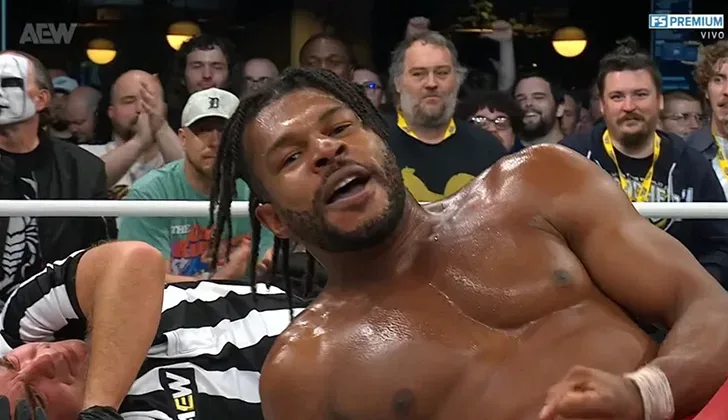
Kevin Knight has identified The Hurt Syndicate as the group that has provided him with the most significant guidance during his time in AEW, citing lessons that range from professional presentation to financial awareness and understanding his role on a given show.
Speaking with Hot 100.9, Knight reflected on the number of experienced performers available to him and emphasized that he has made a point of listening. The rising AEW talent said he has benefited from conversations with Dustin Rhodes, whom he knew as Goldust while growing up, but singled out MVP, Bobby Lashley and Shelton Benjamin for the advice that has had the broadest impact on his approach to the business.
Knight’s comments offer a look at the value of veteran leadership in a locker room filled with performers at different stages of their careers. The advice he described was not limited to executing matches or developing moves. Instead, it focused on the wider responsibilities that come with building a sustainable career as a professional wrestler.
Dustin Rhodes remains an important resource
Before discussing The Hurt Syndicate, Knight spoke warmly about his opportunity to work alongside Dustin Rhodes. The connection carries personal meaning for Knight because Rhodes’ Goldust character was one he enjoyed watching as a fan.
For more background on this topic, read Chris Jericho vs. Nick Wayne Set for AEW Grand Slam: France.
“There’s been so many people throughout my career, period,” Knight said. “Like I said, I loved Goldust growing up, so it’s crazy that I get to work with him daily.”
For Knight, being around Rhodes provides a direct link to a performer whose career has stretched across multiple eras of the industry. Rather than simply appreciating that history from a distance, Knight said he regularly asks Rhodes about the thought process behind major points in his career, including the beginning of the Goldust persona.
“And seeing his mindset of — I ask him all the time like, ‘Yo, what was it like going through that time period? What was it like — did you imagine being this character when he first got into wrestling,’ things like that? So, hearing his mindset going into that is crazy.”
That curiosity is notable because the questions Knight described go beyond surface-level career advice. He is interested in how Rhodes navigated creative decisions, how a distinctive character was approached, and what it meant to commit to an idea at the beginning of its run. Those are lessons that can inform a wrestler’s own development even when their on-screen identity and career path are very different.
Rhodes’ longevity also makes him a useful voice for talent looking to understand the changing realities of wrestling. Knight did not outline specific advice he received from Rhodes, but he made clear that their conversations and daily proximity have been meaningful. For a younger wrestler, access to that kind of perspective can be as important as observing the veteran’s work in the ring.
The Hurt Syndicate’s advice reaches beyond matches
When asked who has given him the strongest advice, Knight was direct in naming The Hurt Syndicate. MVP, Lashley and Benjamin have all accumulated extensive experience at the highest levels of the wrestling business, and Knight said their support has covered both the visible and less visible sides of being a professional.
“But the people that’s giving me the most advice is the Hurt Syndicate guys like MVP, Bobby, Shelton,” Knight said. “They give me financial advice. How to carry yourself in and out the ring, how to be taken seriously, how to move backstage.”
Financial advice is an especially important part of that guidance. Wrestling careers can involve unusual demands, changing schedules and a level of uncertainty that makes long-term planning essential. Knight did not disclose any specific recommendations from the group, but the fact that he highlighted the topic suggests the conversations have addressed a fundamental part of maintaining a career beyond what fans see on television.
The group’s lessons on conduct are equally central. Knight pointed to how to carry himself in and out of the ring, how to be regarded seriously, and how to navigate the backstage environment. Each of those subjects can affect a performer’s reputation and working relationships. In a profession where talent must collaborate with opponents, partners, producers, coaches and a large crew of behind-the-scenes personnel, knowing how to operate professionally can have lasting importance.
Knight’s comments also underline that mentorship does not always come in the form of a formal partnership on screen. The Hurt Syndicate’s influence, as he described it, comes through conversations and shared experience. Their advice has helped him consider how a wrestler presents themselves at all times, not just during an entrance or a match.
Understanding when the spotlight is elsewhere
One of the clearest lessons Knight shared concerned patience and perspective. He said The Hurt Syndicate have taught him that it is acceptable when a given night is not centered on him. That message can be difficult for any ambitious competitor to absorb, particularly in an environment where wrestlers are working to create opportunities and make an impression.
“How to — if it’s not your night per se, if it’s not about you, it’s okay,” Knight said. “Like wrestling, you don’t have to be selfish all the time. But when it is your time, take the ball and run with it.”
The balance in that advice is important. It is not a call for wrestlers to lose confidence or stop seeking growth. Instead, it is a reminder that a wrestling program is built around many moving pieces, with different stories and performers taking priority at different times. A talent can continue to be a professional, support the overall product and prepare for future opportunities even when they are not at the center of the show.
At the same time, Knight said he has learned that a wrestler must be ready to capitalize when the moment arrives. The phrase “take the ball and run with it” captures the other side of the equation: patience should not be confused with passivity. Preparation, professionalism and a clear sense of self can allow a performer to make the most of a prominent assignment when it is presented.
That advice is particularly relevant for someone building momentum in a major promotion. Television time, championship opportunities and storyline focus can shift quickly. The ability to remain steady through those changes while being ready to deliver when called upon is a trait frequently associated with long-term success.
Knight credits presentation for his progress
Knight ultimately tied the advice from MVP, Lashley and Benjamin to his own advancement. He said their teachings on presentation have made a substantial difference in his career.
“So just how they taught me how to present yourself has taken me so far,” Knight said.
Presentation can mean many things in wrestling: the way a talent speaks, their body language, the seriousness they bring to a segment, their appearance, their awareness of the camera, and the consistency of their actions in a locker room. Knight did not narrow the term to one element, and his broader comments indicate that he sees it as an all-encompassing part of being a professional.
His willingness to seek advice from established names also speaks to a mindset centered on continued improvement. Knight has had a notable AEW run, including a TNT Championship reign and two Trios Championship reigns, but his remarks were focused less on past accomplishments than on the lessons he is still gaining from those around him.
That approach reflects a practical reality of professional wrestling. Success in the ring can create a platform, but sustaining it requires adaptability, discipline and an understanding of the business beyond the match itself. The veterans Knight named have each worked through different eras and environments, giving their observations particular value for performers who are still shaping their paths.
A veteran presence in AEW’s locker room
AEW’s roster includes a broad mix of established names and emerging talent, creating opportunities for wrestlers such as Knight to learn from people with decades of experience. Knight’s comments show that he is taking advantage of that environment, whether by discussing character creation with Rhodes or receiving career-oriented advice from The Hurt Syndicate.
For Knight, the most meaningful instruction has come from MVP, Lashley and Benjamin because it has addressed the complete picture. Their guidance has included financial responsibility, backstage conduct, how to be taken seriously, the importance of recognizing when another performer’s story is the priority, and the need to seize an opportunity when it becomes available.
Those lessons may not always be visible to the audience, but they can shape how a wrestler develops over time. Knight’s praise for The Hurt Syndicate makes clear that he views their influence as a key part of his ongoing growth in AEW.

Darryl Polo
Darryl Polo is a passionate wrestling fan covering WWE, AEW, TNA and beyond. He loves great rivalries, breakout stars and the moments that keep fans talking long after the bell. How we work.