
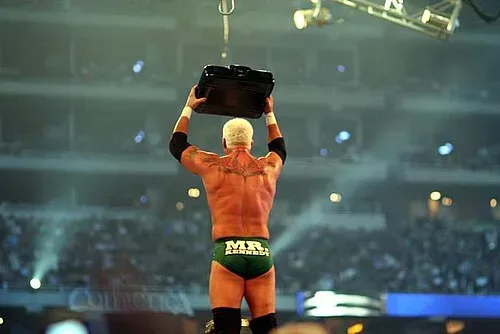
Ken Anderson’s path to WWE was not an overnight climb, even if the timeline can appear relatively compact when viewed from a distance. Anderson, who signed with WWE in 2005 and became known to a wide audience as Mr. Kennedy, has reflected on the roughly six-and-a-half-year stretch between deciding he wanted to become a professional wrestler and reaching the company.
Speaking with Going Ringside, Anderson described that period as a process that seemed to move much more slowly from inside the ring than it does in retrospect. He said that the time from first pursuing wrestling, breaking into the industry and beginning training through earning his WWE opportunity “felt like it was forever.”
“It took me six and a half years to go from realizing that I wanted to be a wrestler, breaking into the business, starting training, realizing that I could actually have a shot at it if I kept doing the right things to getting to WWE,” Anderson said. “In that six years, it felt like it was like forever.”
Anderson’s recollection speaks to the reality of a wrestling career before a major-company contract arrives. A performer can look back at a six-year span as a defined chapter, but the experience of trying to establish oneself can be considerably more uncertain. It involves taking the initial step of training, getting into the business, learning what works and attempting to turn potential into a genuine opportunity. In Anderson’s case, those stages were not separate, neat milestones. They were part of the same extended push toward the level he wanted to reach.
For more background on this topic, read Charlotte Flair Opens Up On Her ‘Unspoken Bond’ With Bianca Belair.
From pursuing wrestling to earning a WWE deal
The former Mr. Kennedy explained that his outlook changed as he progressed. At first, there was the realization that he wanted to wrestle. Then came actually getting started, training and breaking into the industry. Eventually, Anderson recognized that a WWE run was not simply an aspiration but something that could be attainable if he continued making the right decisions and improving in the areas needed to advance.
That evolution is important in the way Anderson told the story. He did not present the WWE signing as something that appeared immediately once he entered wrestling. Rather, it came after he had enough experience to understand that he had a realistic chance. The journey required him to move from interest, to participation, to the belief that he could compete for a place on a much larger stage.
For a wrestler working toward a national platform, that distinction matters. Wanting to make it and believing there is a route to getting there are not always the same thing. Anderson’s comments reflect a gradual process of building that confidence through the work he was doing. The long wait could feel endless while he was in it, even though six-and-a-half years later became the period he could identify as the foundation of his WWE arrival.
Anderson ultimately signed with WWE in 2005. Once there, he began wrestling under the Mr. Kennedy name, a presentation that became central to how fans remember his time in the company. While he had independent wrestling experience before joining WWE, Anderson has long been associated with his speaking ability and personality. His microphone work became a particularly memorable part of the Mr. Kennedy character.
The value of finding a distinct voice
Professional wrestling careers are built through a combination of in-ring ability, presence and the ability to connect with an audience. Anderson’s WWE run is often remembered through the lens of his verbal performances. That does not erase the years he spent working before reaching WWE; instead, it helps explain why the opportunity was meaningful once it arrived.
A wrestler’s voice can be as vital to their identity as a finishing move, entrance or attire. Anderson’s comments put the focus on the development that took place before the Mr. Kennedy name reached WWE television. He had already spent years learning the industry and pursuing the chance to make an impression. When WWE signed him, the company provided a bigger environment for the traits that would become closely tied to his presentation.
The contrast between Anderson’s independent experience and the qualities that fans most strongly remember from his WWE time is also notable. Independent wrestling gave him the chance to break in and develop. WWE gave him a platform where his personality and work on the microphone could be showcased to a far broader audience. The road to that platform, however, was not brief in his own estimation.
“When it happened,” Anderson said of reaching WWE, “it was just, it was a really crazy ride, especially at first.”
That description captures the adjustment that comes with a long-sought opportunity finally becoming real. After years spent working toward a goal, the arrival itself can bring an entirely different set of experiences. The early stage of a WWE tenure carries the scale of the company, the visibility of television and the pressure of making a lasting impression. Anderson’s remarks make clear that the transition stood out to him as a whirlwind after such a drawn-out buildup.
A timeline that feels different while it is happening
There is a tendency to reduce career stories to dates: a wrestler begins training, works independently and eventually signs with a major promotion. Anderson’s reflection adds the personal perspective that can disappear from that simple chronology. Six years may sound like a measurable and finite period on paper. For someone who is working toward a major breakthrough, it can feel much longer.
His wording also emphasizes the importance of persistence without turning the story into a guarantee. Anderson said he came to believe he could have a shot if he kept doing the right things. That is different from saying success was assured. The possibility had to be recognized and pursued, and the eventual WWE signing represented the payoff for staying with the process through a period that often felt endless.
That perspective is especially relevant to the unpredictable nature of professional wrestling. A performer’s career can be shaped by timing, readiness and whether the right opportunity emerges. Anderson did not frame his story around a single instant that changed everything. Instead, he pointed to the extended progression that led him from wanting to wrestle to being ready for WWE.
By the time he reached the company in 2005, he had already lived through the stages that preceded the breakthrough: choosing the profession, getting trained, entering the business and working toward the belief that he could make it. The Mr. Kennedy chapter may be the one most immediately associated with Anderson’s WWE identity, but his latest comments underline that it was preceded by years of effort.
Anderson’s perspective on the breakthrough
Anderson’s recollection does not attempt to make the timeline sound easier in hindsight. If anything, it acknowledges the patience required before the WWE door opened. The eventual destination did not change how long the climb felt at the time. For Anderson, the six-and-a-half years between first deciding to become a wrestler and arriving in WWE were a formative period that seemed to stretch on indefinitely.
His experience offers a clear reminder of how wrestling careers are often understood differently by those living them than by audiences looking back. Fans may first encounter a performer after the breakthrough, when the character, television exposure and major-promotion opportunity are already in place. The wrestler, meanwhile, remembers the years before that moment—the training, the early work and the uncertainty involved in trying to reach the next level.
For Anderson, WWE represented the destination of a lengthy first chapter, not the beginning of his story. The years before 2005 established the path; the Mr. Kennedy persona made the arrival memorable. Looking back now, Anderson can measure that road at six-and-a-half years. But as he explained, during the journey itself, it felt like forever.

Darryl Polo
Darryl Polo is a passionate wrestling fan covering WWE, AEW, TNA and beyond. He loves great rivalries, breakout stars and the moments that keep fans talking long after the bell. How we work.