
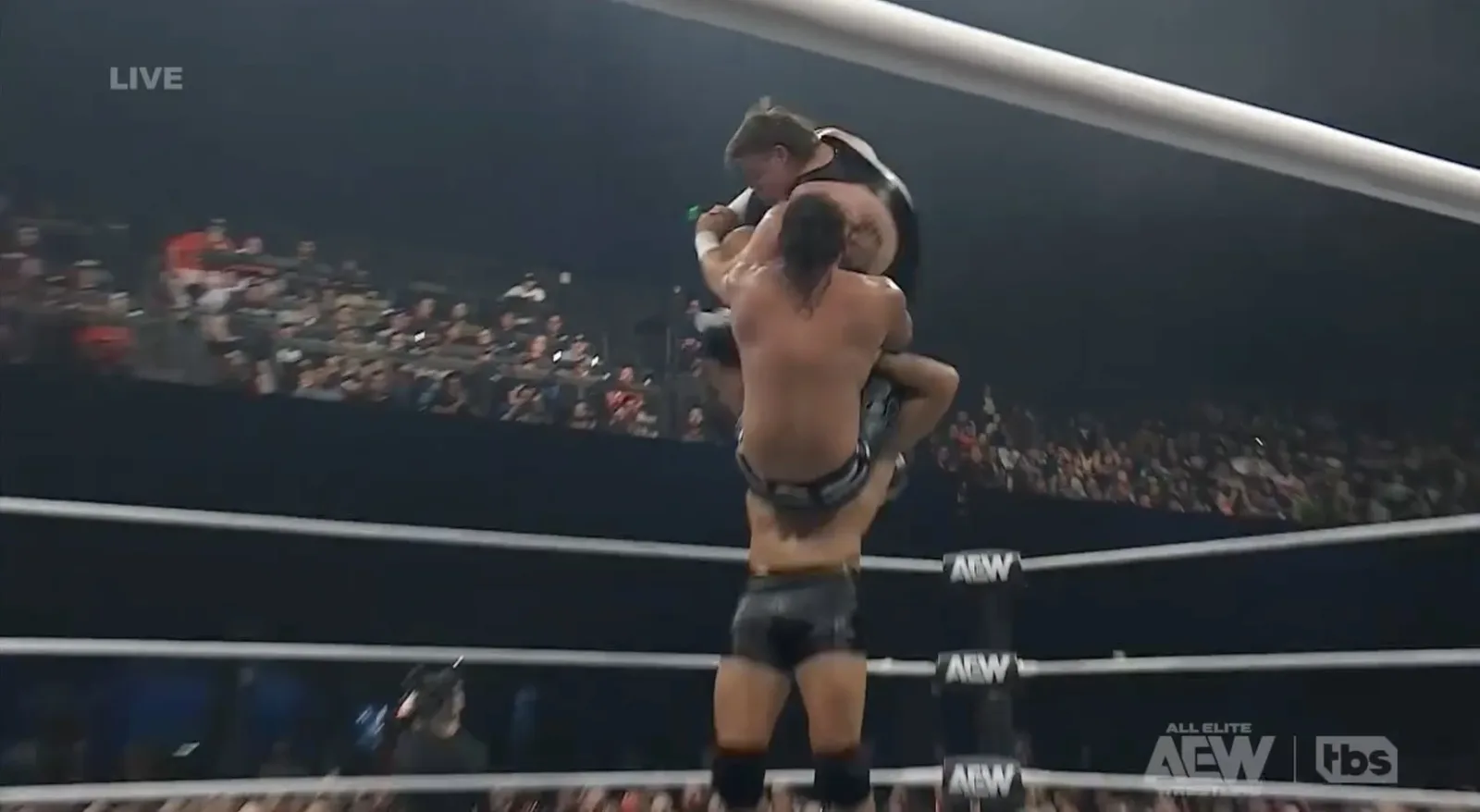
The Kasper Brothers have addressed criticism surrounding the Kasper Cannonball, the high-impact finishing move that drew immediate attention during Drew Kasper and Jacob Kasper’s AEW in-ring debut.
The brothers defeated Cody Devine and Kevin Koa in just under 90 seconds in their first AEW match. The bout ended when Jacob Kasper set up an opponent for a powerbomb while Drew Kasper launched from the top rope into the combination. The move, branded as the Kasper Cannonball, produced a rough-looking landing, with the receiving wrestler not fully positioned on Jacob’s shoulders as Drew came down from the ropes.
That visual prompted criticism and safety concerns from viewers. Speaking on The Ariel Helwani Show, Drew Kasper did not back away from the team’s approach. Instead, he argued that the response itself demonstrates the impact the Kaspers are making and maintained that no one has been seriously harmed by the move during its history.
“I don’t really have a response other than, ‘You’re watching and I know that it’s catching your attention one way or another,’” Drew said. “No one has actually physically gotten hurt from it. No one in the six years that we’ve been using it.”
For more background on this topic, read Swerve Strickland Announced for APC France Anniversary Show on January 9, 2027.
The comments place the debate around the Kasper Cannonball in a familiar wrestling context. Spectacular tandem finishers often invite a difficult balance between presentation and protection. A move can be designed and rehearsed with safety in mind, yet still look alarming when its timing or positioning appears even slightly off during a televised match. In this case, the concern was driven by what viewers could see: an opponent who was not entirely elevated into the intended powerbomb position before the top-rope impact arrived.
Drew’s response was clear that the brothers do not intend to remove the move from their repertoire because of the reaction. He said the Kaspers will continue to wrestle with the same physical style that helped define them before arriving in AEW.
“We’re going to continue to use moves, and we’re going to physically throw you through the mat,” Drew said. “If you’re not okay with that, tune out. I guarantee that you’re going to tune in because everyone talks about us. We’re a draw; whether you want to admit it or not, you’re still talking about us.”
A Statement of Intent in an Extremely Short Debut
The result against Devine and Koa was decisive. In less than 90 seconds, the Kasper Brothers established a clear presentation: a powerful, aggressive tag team built around a finishing sequence meant to look destructive. For a new act making an AEW in-ring debut, a quick victory can serve as an introduction rather than a competitive showcase. The match gave Drew and Jacob limited time to display a broad range of offense, but it made the Kasper Cannonball the central talking point.
That is a double-edged outcome. The move generated conversation, which Drew openly embraced in his remarks. At the same time, it generated discussion not only about the Kaspers’ intensity, but about the risk associated with the finish. Those are not necessarily the same thing. A finisher can succeed in making a team feel dangerous while still raising reasonable questions about execution, especially when a landing does not appear as clean as intended.
Drew’s position is that the available record matters more than the online response. He emphasized that the move has been used for six years without a participant being physically hurt, and he specifically rejected the idea that it has led to anyone being removed from a match on a stretcher.
“People want to say, ‘It’s unsafe.’ No one has physically gotten stretchered out because of it,” Drew said.
His comments do not dispute that the AEW debut spot looked rough to some viewers. Rather, they argue that the team’s longstanding experience with the move should be part of the assessment. The Kasper Brothers have apparently used the Cannonball enough times to regard it as an established piece of their act, not a one-off stunt created for a debut. Drew’s confidence suggests the brothers see the finish as a signature and are prepared to accept the attention that comes with it.
Why the Finish Drew Attention
Tandem offense depends heavily on timing. In a conventional powerbomb, the wrestler giving the move has to control the opponent’s body and establish the proper height before completing the landing. Adding a top-rope diving attack changes the calculation because it introduces another performer, another trajectory, and a narrow timing window. The receiving wrestler must be in the right place, while both attacking wrestlers must be aligned for the impact to look forceful without becoming uncontrolled.
The Kasper Cannonball is designed to combine those elements. Jacob provides the powerbomb component, while Drew adds the aerial collision from above. In theory, the result makes the opponent appear to be driven down by force from two directions. In practice, as the debut showed, the presentation is likely to be judged closely whenever the setup does not look completely secure.
Wrestling audiences are accustomed to evaluating major moves in real time, particularly finishes involving top-rope attacks, piledriver-style positioning, powerbombs, or multiple wrestlers. Fans can recognize that performers are trained professionals while still reacting strongly to a spot that appears to place someone in an awkward position. The conversation around the Kasper Cannonball is part of that broader reality.
Drew did not offer a technical explanation for the landing in the AEW match, nor did he say the brothers planned to make changes to the move. His message focused instead on its six-year use and the attention the act has received. That distinction is important: he answered the criticism by defending the team’s overall history with the finisher, not by providing a detailed breakdown of one particular execution.
The Kaspers Embrace the Conversation
There is also a promotional edge to Drew’s answer. His assertion that people will continue to watch because they are talking about the Kasper Brothers frames the criticism as evidence of momentum. For a team entering AEW and attempting to establish itself quickly, being ignored would be more damaging than being debated. The brothers’ debut finish has made them memorable, and Drew made no attempt to soften the confrontational aspect of that reality.
“We’re a draw,” he said, tying the ongoing reaction to the team’s value as an attraction. It is a bold declaration after a very brief debut match, but it fits the Kaspers’ apparent intent. Their offense is not designed to be subtle, and their response to scrutiny is similarly direct. They want the audience to view them as a physical threat, and they appear comfortable with a finish that leaves a strong impression.
Whether that reaction turns into sustained interest will depend on what follows. A short debut can establish a first impression, but future matches will give viewers a fuller sense of the brothers as a team: their in-ring chemistry, their ability to work longer contests, the variety within their offense, and the consistency of the Kasper Cannonball’s execution. The move will remain under a microscope whenever it is used, particularly after the discussion created by the debut.
WWE Rumors Also Addressed
Elsewhere in the same interview, the Kasper Brothers addressed rumors that they had backstage heat in WWE. The available comments concerning the Cannonball do not provide further details about those WWE rumors, and no additional claims about that topic are necessary to understand the current focus on their AEW presentation.
For now, the immediate issue is the finish that closed their first AEW match. The Kasper Brothers entered with a rapid win over Cody Devine and Kevin Koa, but the visual attached to that victory has become as notable as the result itself. Drew Kasper’s response leaves little doubt about the team’s position: they believe the Kasper Cannonball is a proven move, they plan to keep using it, and they are not treating criticism as a reason to change course.
The next time Drew launches from the top rope while Jacob has an opponent set for the powerbomb, the audience response will likely be just as close to the action. That is the consequence of a debut moment that was both emphatic and controversial—and one the Kasper Brothers have chosen to meet head-on.

Darryl Polo
Darryl Polo is a passionate wrestling fan covering WWE, AEW, TNA and beyond. He loves great rivalries, breakout stars and the moments that keep fans talking long after the bell. How we work.