
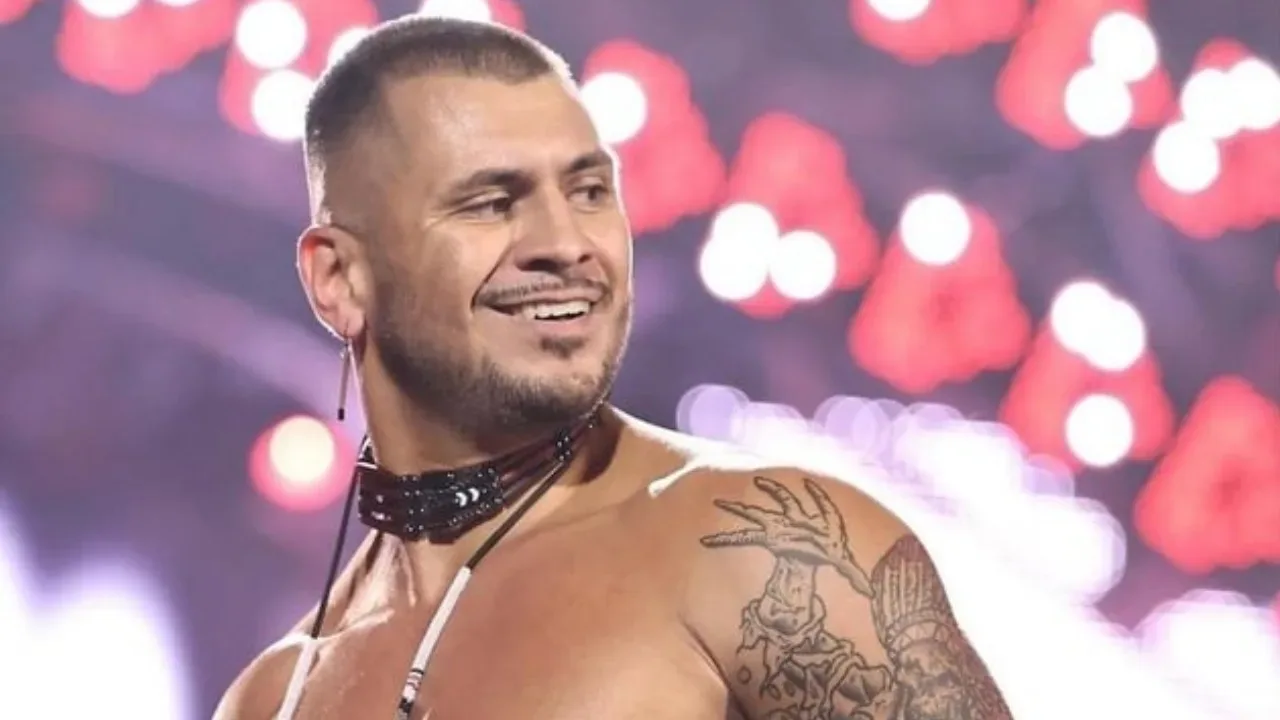
Karl Fredericks has reflected on the NXT run that saw him work as Eddy Thorpe, discussing the unique challenge of NXT Underground bouts, the significance he attached to strap matches, and the creative partnership that developed during his feud with Dijak.
Fredericks was given several opportunities to compete outside the usual WWE match structure during his time in NXT. As Thorpe, he worked three NXT Underground matches and two strap matches, building a body of work that blended his New Japan Pro-Wrestling Dojo background with a character presentation that frequently drew from his Indigenous identity.
Those stipulations were not merely occasional novelties to Fredericks. He viewed them as matches in which he could establish a distinct identity. His early NXT Underground outings resulted in victories over Damon Kemp and Dijak before Trick Williams ended his undefeated run on the March 18, 2025 edition of NXT. Williams beat Thorpe in under four minutes, a result that helped position Williams on the road toward the Stand & Deliver main event.
Fredericks understood the purpose of the Trick Williams loss
Fredericks said he understood the larger booking objective behind Williams defeating him, even if he would have preferred more time to develop the fight. He entered that match with a 2-0 Underground record, making the win an important piece of momentum for Williams at a pivotal point in his own program.
For more background on this topic, read Nic Nemeth Says WWE Official Asked Him To Stop Selling So Well And Putting Opponents Over.
“It was by design, not my design,” Fredericks said with a laugh. “Again, in that situation, I understand my role in that and what me being 2-0 and that being my match, what that does. The Stand & Deliver main event, that was the next [match for Trick].”
While he accepted the match’s role in the bigger picture, Fredericks admitted he was disappointed that the bout itself did not have more room to breathe. The aftermath also took television time, which limited what Thorpe and Williams could do between the ropes.
“To me, the bummer was that we only had four minutes. I wish we had ten maybe, but there was like five minutes of aftermath. That’s just how the show is. That’s one I haven’t watched back, but I remember being fine with it at the time. I was just bummed that we didn’t have time.”
The comments reflect a familiar reality of weekly television wrestling: performers can recognize why a result is necessary while still wishing the match had been afforded a different pace. In this case, Fredericks regarded the defeat as one that made sense for the performer and story being elevated, particularly because he had already been protected through his first two Underground encounters.
The NJPW Dojo background behind the Underground presentation
Although NXT Underground has obvious visual and stylistic similarities to combat-sports presentations, Fredericks said he did not arrive in WWE with prior experience in Josh Barnett’s Bloodsport or similar wrestling events. Instead, he credited time learning Muay Thai under Katsuyori Shibata during his New Japan Pro-Wrestling Dojo days.
Fredericks explained that his interest in incorporating kicks prompted a conversation with Shibata about his presentation. He noted the contrast in terminology, observing that wrestlers in Japan referred to what many North American wrestlers call ring gear as a “costume.”
“I wanted to wear kick pads,” Fredericks said. “Shibata was asking about my costume. It’s crazy for me — in Japan, a place where it’s as real as it gets, they don’t say ring gear, they call it a costume, which is so crazy to me. I was like, I want to do kicks and he was like, ‘Alright bitch, you’re going to learn Muay Thai.’ So, he was coming by, I was doing Muay Thai. You’re going to be safe and you’re going to be real.”
That combination of safety and authenticity became central to the way Fredericks approached Underground. The format demanded a different rhythm from a conventional WWE match. There was more emphasis on clinches, takedowns, submissions and striking exchanges, while the lack of ropes and traditional pinfall structure changed how wrestlers had to construct drama.
Damon Kemp match developed from a simple framework
Fredericks’ first Underground opponent was Damon Kemp, and he recalled that both men were still learning what the presentation required. Kemp’s legitimate amateur wrestling credentials shaped the story they could tell: Thorpe could use his length, movement and stand-up offense, but the dynamic would radically shift once Kemp got his hands on him.
“I was like, I have more than enough knowledge to at least try and defend on the ground,” Fredericks said. “This is like an All-American or top level collegiate wrestler. I was like, I’m taller than him, I’m longer than him, quicker laterally, things like that. Okay, I should shine in this stand up but if a guy like that gets hold of me — that’s what it was. Shining, boom, takeover.”
Rather than arriving with an elaborate match mapped out in full, Fredericks said he and Kemp had little prepared when they initially met with the agent. They built a basic skeleton and worked through the ideas organically. Fredericks felt that approach allowed the contest to retain a natural flow, with credible exchanges gradually escalating toward the larger moments.
That experience illustrates why Underground could offer a valuable outlet for performers with combat-sports-adjacent tools. The structure could be planned, but it also rewarded wrestlers who understood how to make transitions and positioning appear spontaneous.
Dijak feud carried deeper character and cultural stakes
The matches with Dijak meant even more to Fredericks because of the story NXT built around Thorpe’s character. Their late-2023 feud included an Underground match and a strap match, using Dijak’s antagonism to push Thorpe toward a more aggressive response.
Fredericks said the creative direction touched on the Declaration of Independence and its reference to “merciless Indian Savages,” framing Dijak’s approach as an attempt to provoke Thorpe into embracing a stereotype. For Fredericks, that added weight to the conflict and made the payoff more personal than a standard feud.
He also spoke warmly about the strap match’s connection to Wahoo McDaniel, a legendary Native American wrestler whose career included notable strap-match battles. Fredericks would have liked the bout to have been called the “Indian Strap Match,” describing it as an important part of the lineage he felt was being passed down, though WWE did not use that name.
“Doing the strap match was tight, that was Wahoo’s match,” Fredericks said. “For all these conversations we had, there’s these things about pro wrestling that are silly and dumb, I still would’ve loved to be able to call it the Indian Strap Match.”
Fredericks defeated Trick Williams in another strap match, a victory he described as significant both for Thorpe and for himself. He also praised Lola Vice’s work in Underground matches, but maintained that the stipulation had become especially associated with him among the men on the roster.
“Me beating Trick, that was huge for Eddy, for me,” he said. “It was also important for me. It’s my match but Lola was doing dope ass Underground matches too. The girls were doing awesome shit at the same time but out of the men on the roster, yeah, that was my match.”
Fredericks was clear that losing an Underground match to Williams was understandable because it served to elevate someone else. The strap match, however, remained the stipulation he most strongly connected to Thorpe’s character and his own history.
Family reaction gave the Dijak program added impact
One of Fredericks’ strongest memories from the Dijak strap match involved his family sitting in the front row. After Thorpe won, Dijak continued the attack, hanging him upside down and striking him with his belt. Fredericks said his niece was crying as the angle unfolded directly in front of his family.
His father, a police officer, had a different but equally emotional perspective. Fredericks recalled his father connecting the use of the belt to the historical trauma experienced by Native families whose relatives had been physically punished at schools. The angle was harsh by design, but Thorpe’s eventual ability to prevail gave the story its necessary resolution.
Fredericks also has one creative regret from the Underground match with Dijak. At one point, he got hold of Dijak’s belt for the first time since the earlier whipping and began striking back. Looking back, he believes he could have continued for another 10 to 20 seconds, fully losing control in the moment. The match had already run long, however, and its taped nature allowed production to assemble the material as needed.
Despite that small second guess, Fredericks remains proud of the series. He singled out Dijak as an especially strong collaborator, saying the former NXT rival was excellent to work with and that their matches helped the two become closer despite Dijak’s naturally quiet and reserved demeanor.
Fredericks will next be involved with PRODUCE Wrestling’s Season 2 premiere, SKODEN, on October 12 in Brooklyn, New York. The event is being co-produced by Fredericks and is scheduled around Indigenous Peoples’ Day. But his reflections on NXT make clear that the Underground and strap-match work remains a defining chapter of his WWE tenure: physical, personal and rooted in a style he believes he helped make his own.
In pictures

Darryl Polo
Darryl Polo is a passionate wrestling fan covering WWE, AEW, TNA and beyond. He loves great rivalries, breakout stars and the moments that keep fans talking long after the bell. How we work.