
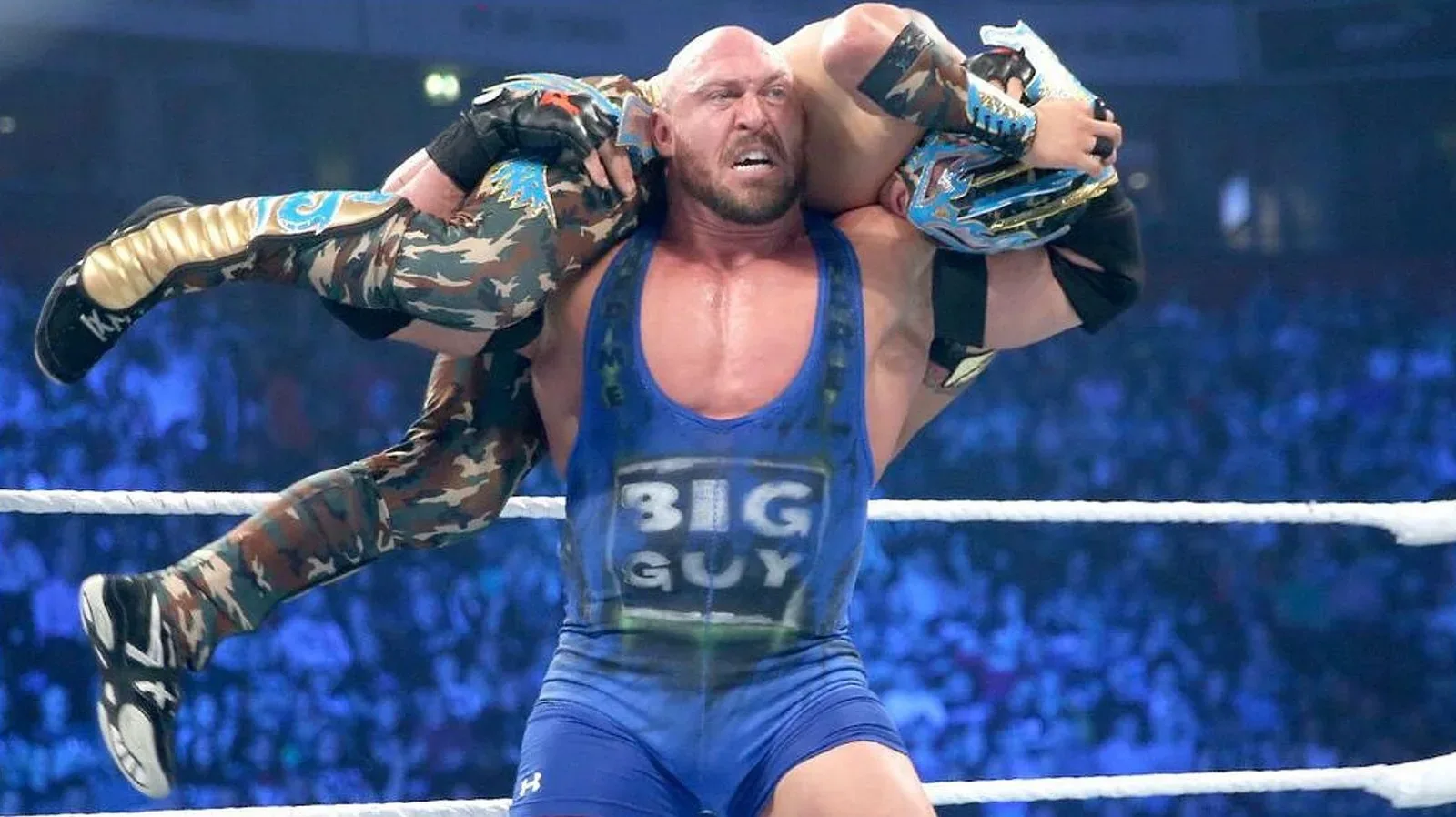
Kalisto has offered a notably positive reflection on his 2016 WWE rivalry with Ryback, describing the former WWE star as a “sweetheart” and one of his favorite opponents from his time with the company.
The comments stand out because Ryback has remained a divisive figure in wrestling discussion since leaving WWE. His outspoken presence on social media and his public frustrations with aspects of his career have often shaped the conversation around him. Kalisto, however, made clear that his firsthand experience working alongside Ryback was overwhelmingly positive.
“Oh, my God, man, he was nothing but a sweetheart,” Kalisto said. “I do get asked that a lot, too, and I always say, ‘Man, he was like the best human being on earth with me.’ He was awesome, he took care of me, I took care of him.”
For Kalisto, the important part of the story is not the public perception that later formed around Ryback, but the professional relationship they built while sharing the ring. Their WWE United States Championship program was constructed around a familiar but effective contrast: Kalisto, the fast-moving masked luchador, against Ryback, the larger and more physically imposing powerhouse.
For more background on this topic, read The Bollywood Boyz Announced for PWR Debut at New Delhi’s Talkatora Stadium in January 2027.
That type of matchup can create instant visual drama in professional wrestling. The smaller wrestler is required to sell the danger of the size difference while finding openings through speed, timing, movement, and resilience. The bigger wrestler, meanwhile, has to make the offense feel threatening without overwhelming the structure of the match or diminishing the smaller opponent’s credibility. Kalisto believes he and Ryback found that balance naturally.
A David vs. Goliath Dynamic That Worked
Kalisto and Ryback’s feud arrived during a period when the United States Championship remained a prominent prize on WWE television. Their physical differences made the premise easy for audiences to understand. Ryback could dominate through raw power, while Kalisto’s path to success depended on avoiding punishment, surviving bursts of offense, and capitalizing with his explosive aerial style.
Kalisto said the two performers developed chemistry quickly once they began working together.
“Man, we just clicked. When we got in the ring? We just clicked! ... When we started working with each other, man, just things started flowing.”
That feeling of immediate compatibility can be especially meaningful for wrestlers whose styles initially appear to be on opposite ends of the spectrum. A high-flyer and a heavyweight bruiser may have entirely different approaches to movement, pacing, and impact, but those differences can become strengths when both performers understand the intended story.
In Kalisto’s view, the size disparity was not an obstacle. It was one of the central reasons the pairing worked. Ryback’s power made every comeback attempt more urgent, and Kalisto’s athleticism gave the bigger man an opponent capable of creating unpredictable momentum swings. The result was a rivalry built around contrast rather than sameness.
Kalisto also emphasized the physical trust involved in their work. Wrestling requires opponents to cooperate while presenting conflict, and a hard-hitting match only succeeds when both performers have confidence in each other’s timing and judgment. He said that he and Ryback delivered the type of contact that feels satisfying for wrestlers without losing sight of protecting one another.
“I loved working with him,” Kalisto said. “I wish I can work him again.”
Kalisto Says Ryback Wanted the Program
Beyond the in-ring chemistry, Kalisto said Ryback was invested in working with him. He recalled that Ryback wanted the two to be paired together and was prepared to take the heat in the program in order to help put Kalisto over.
That detail gives further context to Kalisto’s appreciation for the feud. For a wrestler trying to establish or reinforce his position around a championship, having an opponent who is engaged with the program can make an enormous difference. A rivalry works best when both sides commit to the stakes, understand their roles, and are willing to make the other person look as strong as possible.
Kalisto’s comments suggest that Ryback approached their work with that mindset. Rather than framing the feud as a one-sided exercise, he described a mutual effort in which both men looked after one another and created a story that benefited from their opposing physical profiles.
There is also a distinction in Kalisto’s remarks between Ryback’s experience as a coworker and the frustrations that may have influenced Ryback near the end of his WWE run. Kalisto said he believed Ryback was unhappy with how his own career was unfolding when he eventually went in a different direction.
“At the time he went on his way, he was frustrated with his own career, I believe, and how things were going,” Kalisto said.
Kalisto did not present that frustration as a criticism of Ryback’s behavior toward him. Instead, he separated the professional concerns Ryback may have had from the personal experience they shared in the ring. It is a measured perspective from someone who was directly involved in one of Ryback’s later WWE programs.
A Different Perspective on a Polarizing Former WWE Star
Ryback’s WWE departure and his outspoken remarks after leaving the company have made him a frequent subject of debate among fans. Those public disputes have sometimes overshadowed discussion of the work he did during his WWE career, including his programs with performers of dramatically different styles and sizes.
Kalisto’s recollection does not erase the wider conversation surrounding Ryback, nor does it attempt to address every criticism connected to him. What it does provide is a personal account from a former opponent who says he was treated well and trusted Ryback as a partner in the ring.
That perspective matters because wrestling careers are built on countless working relationships that are not always visible to viewers. Fans see the finished match, the television story, and the outcome. The wrestlers involved experience the planning, the repetition, the physical risk, and the responsibility of ensuring that each sequence comes together safely and convincingly.
When Kalisto says Ryback “took care” of him and that he returned the favor, he is speaking to that less visible side of the profession. The best opponents are not merely those who can create memorable offense. They are the ones who understand how to build trust, read the flow of a match, and help their counterpart deliver their strongest performance.
Why the Rivalry Remains Meaningful to Kalisto
Kalisto had numerous noteworthy opponents during his WWE tenure, but he placed Ryback among the performers he most enjoyed working with. That is a significant endorsement given the particular demands of their matchup.
A smaller wrestler working with a powerhouse must convincingly absorb the threat of the larger competitor while retaining enough explosiveness to make a comeback believable. The larger wrestler must control the tone without making the match feel repetitive or limiting the opponent’s opportunities to shine. Kalisto’s comments indicate that he and Ryback were able to make those responsibilities feel instinctive.
Their feud was therefore more than a basic clash of size. It was a collaboration that Kalisto remembers as smooth, physical, and mutually respectful. His fondness for the rivalry remains rooted in how naturally the pieces fit together once the bell rang.
For Kalisto, the takeaway is straightforward: whatever perceptions exist outside the ring, his own time working with Ryback was positive. He remembers an opponent who wanted to share the spotlight, embraced the David-versus-Goliath premise, and helped create a program that remains one of Kalisto’s personal favorites from WWE.
“I loved working with him,” Kalisto said, leaving little doubt about how he views the experience years later. “I wish I can work him again.”
In pictures

Darryl Polo
Darryl Polo is a passionate wrestling fan covering WWE, AEW, TNA and beyond. He loves great rivalries, breakout stars and the moments that keep fans talking long after the bell. How we work.