
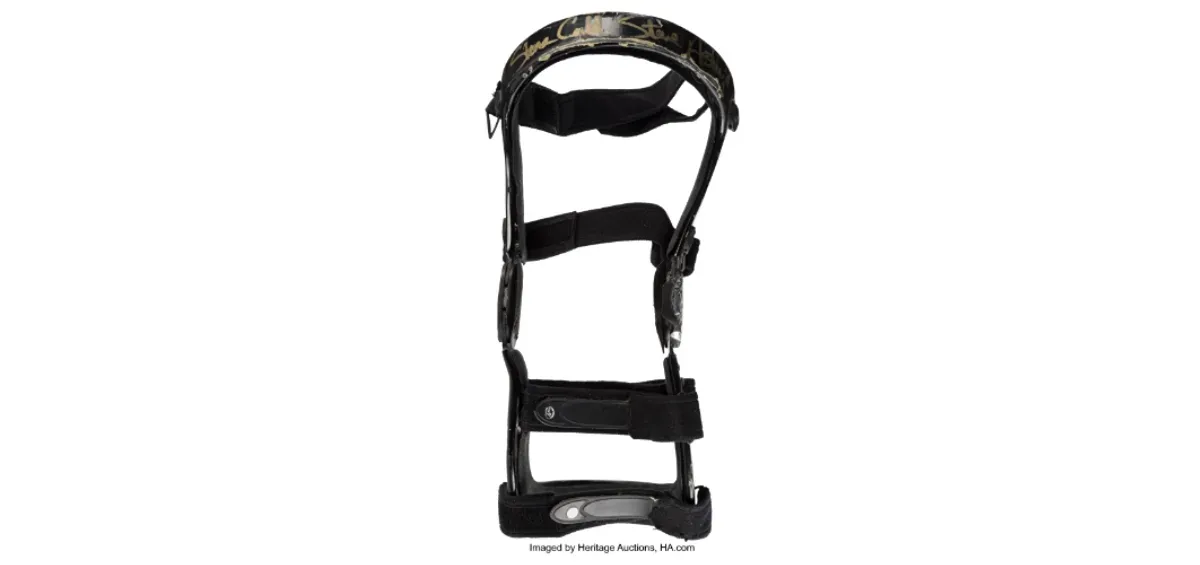
“Stone Cold” Steve Austin memorabilia has reached another extraordinary price point, as a match-worn and signed knee brace associated with the WWE Hall of Famer sold at auction for $225,700.
The item was described as a circa 1999 DonJoy knee brace used by Austin during his WWE run. The brace carries Austin’s signature in gold paint pen, along with the handwritten date “5-8-99.” It also includes a WWF authentication sticker near the inscription, while the auction listing was accompanied by a WWE letter of authenticity signed by Linda McMahon.
The sale is a significant one in the growing market for professional wrestling collectibles, particularly pieces with direct in-ring ties to the biggest names of the late 1990s. Austin was one of the defining performers of WWE’s Attitude Era and remains among the company’s most commercially important stars. As a result, authenticated gear connected to “The Texas Rattlesnake” has become especially difficult for collectors to acquire.
View the referenced post on X
A Rare Piece of Austin’s In-Ring History
The 16-inch DonJoy brace showed visible signs of use consistent with an item that had been worn in the ring. The listing noted scratches, paint loss and wear across the brace. Three of its four Velcro fasteners remained functional, while the top button had broken off. That damage may have been what ended the brace’s active in-ring use.
For more background on this topic, read WWE Crown Jewel Still Planned for Saudi Arabia as Security Concerns Draw Internal Unease.
Although the item was characterized as circa 1999, the accompanying description also connected it broadly to the period in which Austin was a central force in WWE’s battle with WCW. The signature date is a key point of identification: May 8, 1999 fell during a defining stretch of Austin’s career, when he was positioned at the center of WWE programming and regularly embroiled in his landmark conflict with Mr. McMahon.
Authentication accompanying the brace included the WWE letter signed by Linda McMahon, a letter from the auction house, a full letter of authenticity from PSA/DNA and a full letter from Beckett Authentication Services. For serious memorabilia buyers, that collection of documentation is central to the value of an item with this kind of historical and cultural association.
The brace was signed by Austin in gold paint pen and marked with the date “5-8-99,” with a WWF authentication sticker placed near the inscription.
Match-worn pieces are typically viewed as the most desirable category of sports-entertainment memorabilia because they establish a direct connection between the performer and their on-screen or in-ring career. In Austin’s case, those items have been especially scarce on the public market.
The scarcity has helped elevate the importance of objects that might otherwise seem modest when compared with championship belts, ring gear or major event signage. A knee brace is not a conventional centerpiece item in the way a title belt would be, but Austin’s history with knee injuries and his unmistakable late-1990s presentation give the accessory added significance. It was part of the physical reality of a performer who maintained an intensely demanding schedule while carrying WWE’s biggest stories.
Why Austin Collectibles Carry Such Weight
Austin’s rise transformed the landscape of WWE in the latter half of the 1990s. His rebellious, anti-authority character struck a powerful chord with audiences, particularly through his rivalry with Vince McMahon’s Mr. McMahon persona. The character’s defiance, direct speaking style and willingness to disrupt the established order made Austin a defining figure of the era.
His matches and promos became key attractions during the Monday Night Wars, when WWE and WCW were competing fiercely for viewers. Austin’s confrontation with McMahon gave WWE a weekly central narrative with broad appeal, while his intense physical style made him feel distinct from many of the larger-than-life personalities associated with earlier generations.
The “Stone Cold” character also became a merchandising phenomenon. Austin shirts, posters, action figures and other licensed products were ubiquitous during the Attitude Era. Yet mass-produced merchandise and a personal item actually used by Austin are vastly different collecting categories. The latter offers a direct connection to the performer’s working career, and the available supply is naturally limited.
That distinction is especially relevant because relatively few Austin match-worn items have surfaced for public sale. His iconic vests, for example, have not emerged on the open market in the same way some other high-profile wrestling gear has. That limited supply creates significant demand whenever an authenticated Austin-used piece becomes available.
For collectors, the knee brace also represents an era rather than simply one star. It evokes WWE’s late-1990s boom period, the company’s competition with WCW and the unmistakable image of Austin as a battered but unyielding brawler. The item’s condition, including its visible wear, likely reinforced that perception rather than diminishing it.
The Latest Benchmark for Wrestling Memorabilia
The $225,700 result dramatically surpasses several recent prices achieved by Austin knee braces. Earlier in May 2026, another knee brace used by Austin sold for $115,900. That result had been identified as the highest amount paid for a knee brace at the time.
A separate brace worn by Austin at WrestleMania 38 had also sold for $58,045. Taken together, those sales show how quickly the market has escalated for authenticated Austin memorabilia, particularly items that can be identified as ring-used and accompanied by strong provenance.
The newest result is nearly double the $115,900 price reached by the other Austin brace earlier in the year. Auction outcomes can vary based on documentation, presentation, condition, bidding interest and the specific historical association of an item. Still, the $225,700 figure is a clear indication that Austin’s place in the upper tier of wrestling collectibles remains secure.
The sale arrives during a period of heightened attention on historic wrestling artifacts. Championship belts, ring-used apparel, event-worn accessories and materials tied to major television eras have increasingly been treated as serious collectibles. The most sought-after pieces combine recognizable names, a verifiable connection to a major moment or period, and a robust authentication trail.
In that regard, Austin checks every major box. He is one of the most recognizable names in WWE history, the brace is represented as match-worn, the date on the autograph anchors it to 1999, and the documentation includes materials from WWE as well as independent authentication companies.
Context Within an Expanding Collectibles Market
The sale also follows another major development in the wrestling memorabilia world: a WWF Red Letter Intercontinental Championship was recently identified as the most valuable wrestling title ever sold. While belts have traditionally occupied the highest-profile segment of the hobby, the latest Austin result demonstrates that performer-specific gear can command comparable attention when the right combination of rarity and provenance is present.
Championship belts are visually grand and inherently connected to a promotion’s competitive history. However, personal items can offer a different type of appeal. A worn brace bears the marks of use and can feel more intimate, reflecting the physical toll of a wrestler’s career. For Austin, whose image was built on toughness, confrontation and resilience, that connection is particularly potent.
The fact that the brace was signed and dated further separates it from an unsigned piece of equipment. Autographs can vary in value depending on placement, presentation and authentication, but an inscription tied to a specific date gives collectors an additional layer of context. The WWF sticker and the WWE letter contribute to that chain of evidence.
As wrestling memorabilia continues to attract greater attention, items associated with Austin’s peak years will likely remain among the hobby’s most closely watched offerings. His impact on WWE’s business, creative direction and audience relationship has made him a generational figure, and the demand for tangible artifacts from that era reflects that status.
For now, the $225,700 sale stands as a remarkable result for a piece of equipment that was once simply part of Austin’s ring gear. Decades later, the signed and worn knee brace has become a high-end artifact from one of WWE’s most influential eras—and another reminder of the enduring collector appeal of “Stone Cold” Steve Austin.

Darryl Polo
Darryl Polo is a passionate wrestling fan covering WWE, AEW, TNA and beyond. He loves great rivalries, breakout stars and the moments that keep fans talking long after the bell. How we work.