
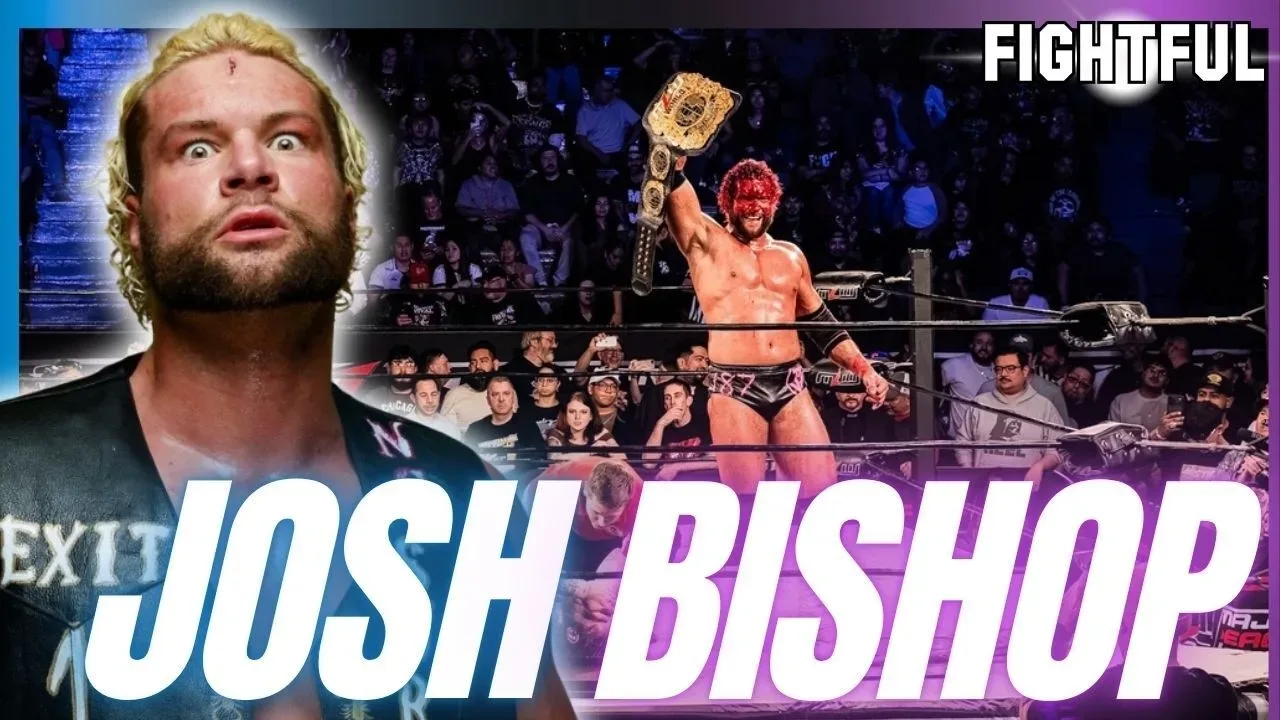
MLW World Heavyweight Champion Josh Bishop has offered a blunt response to comparisons between himself and the late Sid Eudy, who was known to wrestling fans as Sid Vicious and Sycho Sid.
Bishop addressed the subject during an interview with Sean Ross Sapp. While some observers have connected Bishop with Sid, the reigning MLW World Heavyweight Champion made it clear that the comparison is not one he has sought out or particularly values. His answer was not framed as an attempt to diminish the impact Sid had on wrestling history. Instead, Bishop explained that Sid simply was not a defining influence on him as a fan or as a performer.
“It’s fine, I guess, because did I ever wanna be like Sid? Did I ever grow up saying, oh my God, I’m such a Sid Vicious — no. I don’t care about Sid. I never did and I never will. To me, Sid was the guy that wrestled Heath Slater on Monday Night Raw one time.”
Bishop expanded on that thought by describing the version of Sid that stood out to him when he was younger. Rather than citing Sid’s major moments or presenting him as a personal hero, Bishop said his earliest association came from a much different place in wrestling fandom.
For more background on this topic, read CJ Perry Reflects On ‘Big Mommas’ Dance Role And How It Foreshadowed WWE Table Bumps.
“He was the guy from Botchamania, and the guy that wrestled Heath Slater to me as a kid.”
The comments draw a sharp line between a comparison made by viewers and the influences a wrestler chooses for himself. Fans frequently use familiar names to describe talent with a comparable presence, body type, intensity, or presentation. Those comparisons can be useful shorthand, but they do not always reflect how the wrestler involved sees his own career. Bishop’s response leaves little ambiguity: he does not view Sid as a personal template.
Bishop’s perspective comes from a different generation of fandom
Sid’s place in wrestling history was built over decades, under several names and in front of different generations of audiences. But Bishop’s remarks illustrate how that legacy can be experienced differently by fans who encountered Sid later, especially through individual television appearances and internet wrestling culture rather than through the periods that originally established his prominence.
For Bishop, the key memories were Sid’s match with Heath Slater on Monday Night Raw and appearances in Botchamania compilations. That is a notably different point of entry from the way many longtime viewers remember Sid. Bishop was not trying to rewrite Sid’s history; he was explaining his own relationship, or lack of relationship, to it.
That distinction matters whenever a current wrestler is compared with a past name. A performer can understand why the audience makes a connection while still rejecting the notion that it reflects their ambitions, inspirations, or identity. Bishop’s “It’s fine, I guess” captures that divide. He did not present the comparison as offensive, but he also did not embrace it as flattering or meaningful.
His answer was especially emphatic when he said, “I don’t care about Sid. I never did and I never will.” In a business where wrestlers are often asked to identify their influences or accept lineage-based comparisons, Bishop instead chose a direct answer that separates his own path from the legacy fans may see around him.
Sid Eudy’s death and posthumous WWE Hall of Fame recognition
Sid Eudy died in August 2024. Two years later, in 2026, he was inducted into the WWE Hall of Fame as part of the Legacy wing. Eudy was honored alongside Allen Coage, better known as Bad News Brown.
The Legacy wing recognition placed Eudy among the figures being formally acknowledged for their contributions and standing within wrestling history. His career was associated with multiple identities, most prominently Sid Vicious and Sycho Sid, and his name continues to surface whenever fans compare modern wrestlers to imposing personalities from earlier eras.
Bishop’s comments arrived against that backdrop, with Eudy’s name again prominent following the Hall of Fame recognition. Still, Bishop did not use the conversation to offer a retrospective assessment of Sid’s career. He answered from a personal standpoint, focusing on what Sid meant to him as a younger viewer. That perspective was limited, specific, and deliberately detached from the broader reverence that can surround a posthumous Hall of Fame honoree.
There is room in wrestling discussion for both realities. Sid can remain a significant historical figure whose work is recognized by WWE, while Bishop can say that he was never invested in Sid and never wanted to emulate him. The two positions do not need to be reconciled for the comments to be understood clearly.
Why comparisons do not always fit the wrestler being discussed
Comparisons are a constant part of professional wrestling coverage. They can emerge quickly when a wrestler has a physical presence, speaks with a certain force, or projects an attitude that reminds audiences of somebody from the past. In some cases, a wrestler welcomes that connection. In others, the comparison can feel superficial, based more on what the audience sees than on the work the performer is trying to create.
Bishop’s answer falls firmly into the second category. He acknowledged that the Sid comparison exists, but his response indicated that he has no emotional attachment to it. He did not describe Sid as someone he studied, nor did he identify any shared philosophy or influence. By pointing to the Heath Slater match and Botchamania, Bishop made the point that his own memories of Sid are tied to a later and narrower fan experience.
That is also a reminder that wrestling legacies are not fixed in the minds of every audience member. One fan may know a wrestler through celebrated championship moments. Another may remember a single television segment. Someone else may first encounter that same performer through clips, compilations, or online discussion. Those varying introductions can produce radically different opinions about the same name.
For Bishop, Sid was never the wrestler he imagined himself becoming. His comments were not cautious, and they were not designed to turn a comparison into a compliment. He answered plainly and placed the focus back on himself rather than on a connection others have drawn.
The MLW champion speaks for himself
As MLW World Heavyweight Champion, Bishop occupies a position where his presentation and persona will naturally invite discussion. Wrestling audiences regularly look for historical reference points when evaluating a champion, particularly one whose presence prompts comparisons to larger-than-life names. Bishop’s response shows that he is not interested in allowing one of those references to define him.
His message was straightforward: viewers are free to see a resemblance if they choose, but it does not reflect his own fandom or the way he views his career. Bishop did not grow up aspiring to be Sid Vicious, and he does not consider Sid an important influence in his life.
That makes this less a debate over whether a comparison is visually or stylistically valid and more a statement about ownership. Bishop is the one living his career, holding the MLW World Heavyweight Championship, and determining which influences matter to him. On the subject of Sid Eudy, his position could not have been more direct.
Sid’s posthumous WWE Hall of Fame Legacy wing induction in 2026 ensures that his name remains part of wrestling’s ongoing historical conversation. Bishop, however, has made clear that his own story is not rooted in that legacy. Whatever fans may see when they make the comparison, the MLW champion does not see Sid as a figure he ever wanted to follow.

Darryl Polo
Darryl Polo is a passionate wrestling fan covering WWE, AEW, TNA and beyond. He loves great rivalries, breakout stars and the moments that keep fans talking long after the bell. How we work.