
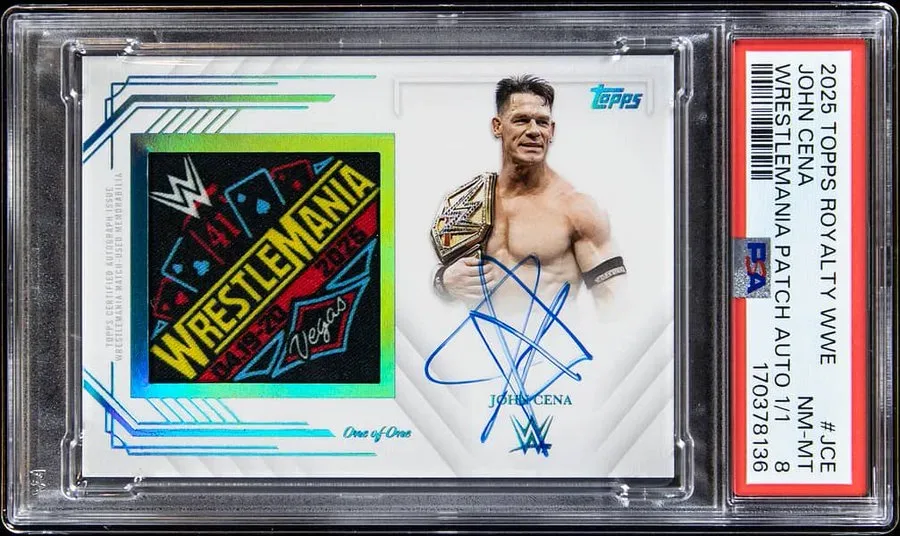
John Cena has offered a measured reaction to the remarkable $329,400 sale of his WrestleMania 41 patch autograph card, expressing both an understanding of why a passionate collector might pursue such an item and a clear hope that it was purchased for personal enjoyment rather than speculation.
The Topps card was auctioned through Goldin last month and ultimately sold for $329,400, after a $270,000 hammer price. The figure represents an extraordinary valuation for a modern wrestling trading card and speaks to both Cena’s stature within WWE history and the continued growth of high-end sports and entertainment collectibles.
For Cena, though, the headline-grabbing number created an understandably complicated response. The 16-time world champion recognized that collectors with the means to pursue a unique piece may assign enormous value to it. At the same time, he questioned the logic that can surround escalating prices in a market where objects can quickly become investment vehicles.
“There’s a lot of expendable income out there,” Cena said when asked about the sale. “I think collectibles might be overvalued at some point.”
For more background on this topic, read MVP Doubles Down On Triple H Criticism, Calls WWE Executive A “Spineless Coward”.
That comment was not a dismissal of the buyer or of collecting itself. Cena has long been open about his enthusiasm for automobiles, and he pointed to that interest when explaining why he can understand the desire to own a rare item. A collectible’s monetary value may be difficult to rationalize from the outside, but a person with a real emotional connection to a particular object may see the purchase very differently.
“If you want it and you’re passionate about it and you’ve got the resources for it, it deems a price,” Cena said.
A Record-Setting Cena Collectible
The WrestleMania 41 patch autograph card combined several elements that collectors typically place at a premium: Cena’s name, an autograph, a patch component, and a direct connection to WWE’s biggest annual event. Cena is one of the most recognizable and commercially successful performers in wrestling history, with a career that has extended far beyond WWE through acting, television, philanthropy, and mainstream pop-culture visibility.
His cards have naturally become important pieces in the wrestling memorabilia market, but the $329,400 total places this particular release in rare company. Modern cards tied to iconic athletes and entertainers can command immense sums when scarcity, condition, provenance, visual design, and cultural significance all align. In Cena’s case, the card also arrived during a period when his WWE legacy has been a major focus of fan attention.
Still, Cena did not present the sale as a simple victory lap. Instead, he acknowledged the strange feeling attached to seeing a card bearing his image reach such a price. “It’s weird,” he said, while emphasizing that he wanted to be careful in how he characterized the transaction.
That restraint is notable. Collectibles can generate fierce debate among fans because the same item can mean very different things depending on who owns it. For one buyer, it may be the centerpiece of a lifelong collection. For another, it may be a short-term asset bought with the expectation that its value will rise. Cena’s comments made it clear that he favors the former motivation.
Cena Hopes the Card Has a Personal Home
The central point of Cena’s reaction was his wish that the person who acquired the card did so because it has genuine significance to them. He said he hopes the buyer has “a lot of joy and connection” to what they purchased, rather than treating it as something to be moved along for a larger profit.
Cena specifically voiced concern over the possibility of a future flip, saying he hopes the card is not being used “as a commodity to possibly flip for future gain.” Drawing from his experience in the auto world, he called that kind of pursuit “a fool’s chase.”
The distinction is important in a hobby increasingly shaped by auction records and rapid online price tracking. A high-profile sale can boost interest in a particular card, wrestler, set, or manufacturer, but it can also invite a wave of speculative buying. Prices may surge because collectors want the item, because investors expect the market to grow, or because buyers do not want to miss the next major trend.
Cena’s perspective does not deny that expensive collectibles have financial value. A card that sells for hundreds of thousands of dollars is, by definition, a significant asset. Rather, he argued that the more durable reason to own something is the story and feeling attached to it. His view is rooted in the idea that material possessions become meaningful through the connection people form with them.
“Material things are just material things,” Cena said. “But we can give them meaning.”
For a WWE fan, that meaning could come from a personal memory of watching Cena headline WrestleMania, a connection to a particular era of WWE programming, or admiration for the work he has done in and outside the ring. A patch autograph card is not simply ink and cardboard to that kind of collector. It can serve as a tangible reminder of a performer and a career that mattered to them.
The Broader Wrestling Memorabilia Boom
Wrestling memorabilia has become a more visible part of the larger collectible market in recent years. Vintage action figures, ring-worn gear, championship replicas, event posters, signed photos, rare magazines, and trading cards have all found audiences. The appeal ranges from nostalgia-driven collecting to serious archival interest, with fans seeking items tied to major matches, historic title reigns, and the industry’s most influential names.
Trading cards occupy a particularly interesting place in that landscape. They are highly displayable, comparatively easy to store, and often categorized through established grading systems. Limited print runs, autograph inserts, memorabilia patches, and one-of-one releases can make individual cards feel especially scarce, even within a product built around mass distribution.
In wrestling, the biggest values tend to be connected to talents with major crossover recognition, enduring fanbases, or historical importance. Cena checks all of those boxes. He became the defining WWE star of his generation, delivered championship success over multiple eras, and developed a profile familiar even to people who do not closely follow professional wrestling.
That does not automatically make every Cena collectible a six-figure item. The record-setting nature of this specific WrestleMania 41 patch autograph card is precisely why the price drew attention. Its sale underscores how much premium collectors can place on the right combination of rarity, presentation, and association with a global star.
Why Cena’s Perspective Resonates
Cena’s response may resonate with collectors because it recognizes both sides of the hobby. He understands the excitement of pursuing something rare. As an auto enthusiast, he knows that passion can make an object worth far more to one person than it appears to be worth on paper. Yet he also sees the risks of treating every sought-after item as a vehicle for profit.
His preferred outcome is simple: he wants the card to be meaningful to the person who now owns it. Cena said he hopes the buyer’s “material meaning” is as strong as the object’s price tag suggests. That sentiment shifts the conversation away from the auction result alone and toward the human reason someone might have wanted the card in the first place.
There will always be debate about whether any collectible can justify a price in the hundreds of thousands of dollars. Cena himself acknowledged that it is difficult to process a number of that magnitude. But he also left room for the idea that a collector’s relationship with an item cannot always be reduced to a market calculation.
The $329,400 sale remains a striking milestone for a John Cena trading card and for high-end WWE collectibles more broadly. For Cena, however, its lasting value will not be determined only by what it sold for at auction. It will be determined by whether the card’s owner sees it as a meaningful piece of wrestling history rather than merely the next item to sell.

Darryl Polo
Darryl Polo is a passionate wrestling fan covering WWE, AEW, TNA and beyond. He loves great rivalries, breakout stars and the moments that keep fans talking long after the bell. How we work.