
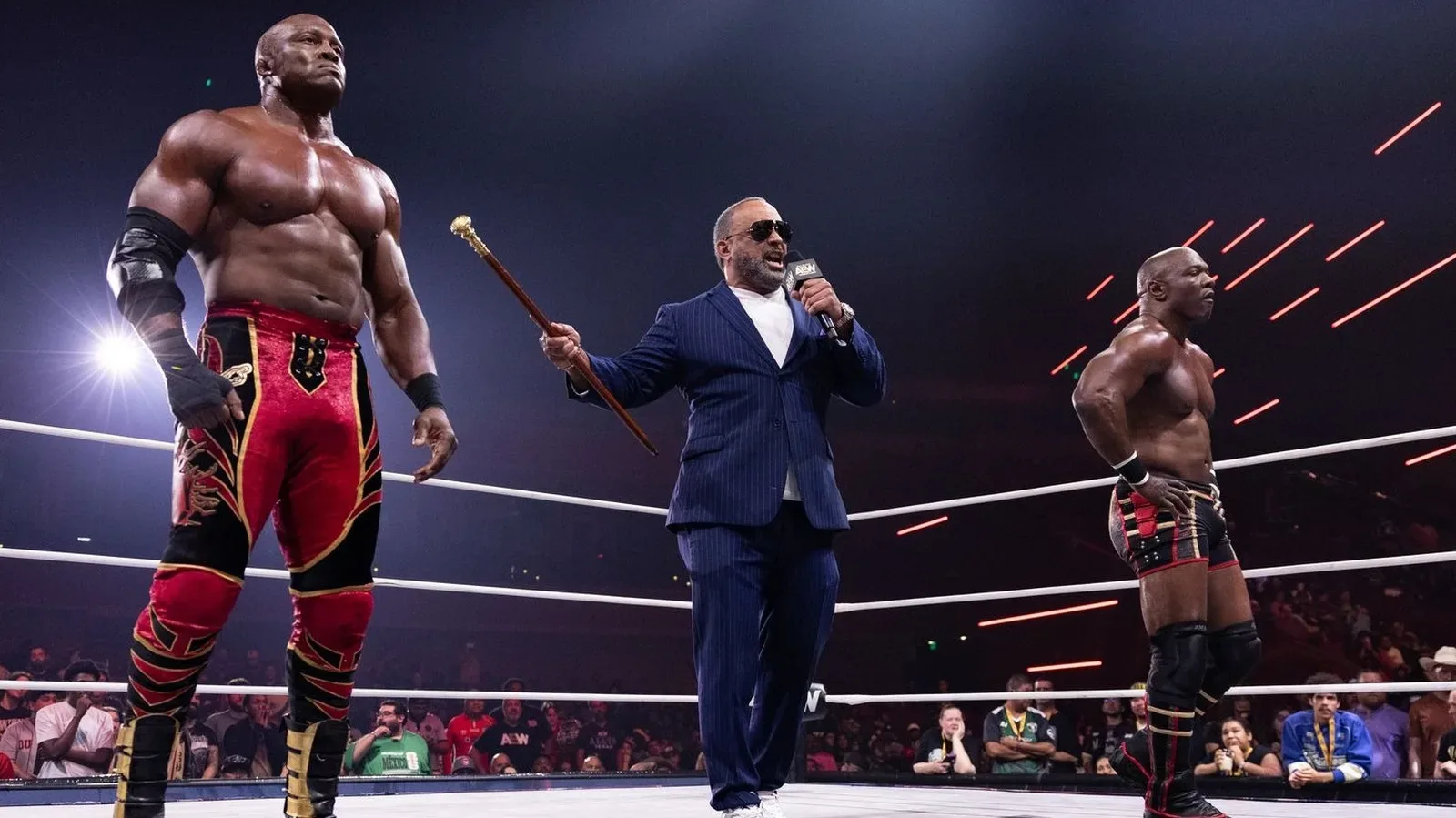
MVP has once again made his feelings about Paul “Triple H” Levesque unmistakably clear.
The AEW star and former WWE performer discussed criticism of his Marking Out with MVP & Dwayne Swayze podcast during a recent episode, responding to a former listener who characterized the program as “anti-Triple H rage-bait.” The critic also contended that every episode of the show had been centered on attacking the WWE Chief Content Officer.
MVP laughed off that description, arguing that regular viewers would know it does not accurately represent the podcast’s content. At the same time, he did not attempt to soften his personal assessment of Levesque, a figure he has repeatedly criticized in public over the years.
“It’s no secret that I don’t like Triple H, that I have zero respect for the dude,” MVP said on Marking Out with MVP & Dwayne Swayze. “I say all the time he’s a spineless coward.”
For more background on this topic, read John Cena Praises Cody Rhodes’ Guile Promotion for Street Fighter.
MVP added that people who have known Levesque personally have expressed similar opinions in publicly available interviews and videos. His point was not that every listener must agree with him, but that criticism of Levesque is not exclusive to him and should not automatically be dismissed simply because of the messenger delivering it.
That distinction was central to MVP’s response. He suggested that audience reactions can be shaped by whether they already like or dislike the person speaking. In his view, critics may label him bitter because of his history with WWE and Levesque, while accepting similar remarks more readily when they come from a wrestler they support.
For MVP, however, the accusation that his podcast is singularly focused on Triple H goes too far. He noted that Marking Out with MVP & Dwayne Swayze has not actually produced an episode devoted entirely to Levesque. He did say that such an episode could happen eventually, making clear that he has no interest in pretending the subject is off limits.
A Longstanding Public Rift
The latest comments are consistent with MVP’s established public position on Levesque. He has previously said he has “zero respect” for the WWE executive and has used the nickname “The Nose” when discussing him. Those remarks have made MVP one of the more outspoken current AEW figures when it comes to criticizing a top WWE decision-maker.
His objections have also extended beyond general dislike. MVP has specifically taken issue with the creative direction surrounding Triple H and Booker T heading into WrestleMania 19. The program remains one of the most debated rivalries in WWE history, in significant part because of the language used during the build to their World Heavyweight Championship match.
MVP has described that presentation as “overtly racist.” That assessment reflects a criticism that has followed the WrestleMania 19 angle for years: that Booker T, a decorated champion, was framed in a storyline where Triple H questioned whether he belonged at the top of WWE. Triple H ultimately defeated Booker T at the event, a result that remains controversial among fans and performers who believe the feud’s setup called for a different conclusion.
By revisiting his broader feelings toward Levesque, MVP did not introduce a new dispute so much as reinforce one that has been public for some time. His remarks on the podcast were prompted by criticism of the show’s tone, but they also showed that he is comfortable standing behind prior statements rather than walking them back for the sake of avoiding backlash.
MVP Pushes Back On The “Bitter” Label
Professional wrestling has a long history of former coworkers publicly disagreeing over creative decisions, career opportunities, workplace culture, and personal conduct. Those disputes often become especially heated when they involve performers who worked for rival major promotions at different points in their careers.
MVP’s situation naturally invites that kind of response. He is currently associated with AEW, while Levesque oversees WWE’s creative direction as Chief Content Officer. Their differing professional positions can make a direct criticism appear, to some observers, like a promotional rivalry or an old grievance being revisited.
MVP’s answer is that listeners should judge the podcast on what it actually contains. He rejected the notion that every installment exists to attack Triple H. A show can cover wrestling culture, current issues, personalities, and opinions across the industry, he argued, without being reduced to its host’s most widely discussed disagreement.
He also raised a broader point about credibility and fan allegiance. Wrestling audiences frequently evaluate comments through the lens of who said them. A performer with a positive reputation among a particular section of the fanbase may be treated as candid or insightful. Someone who has openly clashed with a powerful figure may be branded resentful, regardless of whether others have made comparable observations.
That does not mean all criticism must be accepted as fact, nor does it settle the merits of any individual claim. It does explain why MVP believes the reaction to his comments can become more personal than the comments themselves. He is not presenting himself as neutral on the matter. In fact, he explicitly says the opposite. His argument is that a lack of neutrality does not automatically make the discussion dishonest or make an entire podcast a one-topic campaign.
No Triple H-Centered Episode — Yet
One of the clearest details from MVP’s response was his statement that the podcast has never done a full Triple H-based episode. That directly counters the former viewer’s claim that every show has been structured around “burying” Levesque.
Still, MVP’s acknowledgment that a dedicated episode is likely to come gives the criticism a measure of context. He plainly has a great deal to say about Levesque and does not deny that the WWE executive is a recurring subject when relevant. The difference, from MVP’s perspective, is between discussing someone when the conversation leads there and building an entire program around that person every week.
That future episode, if and when it is produced, would likely draw substantial attention. MVP’s past statements have been forceful, and Triple H remains one of the most influential executives in the wrestling business. Levesque’s WWE role places him at the center of the company’s creative direction, talent development, and wider public identity, making any criticism of him a subject that reaches far beyond a disagreement between two former colleagues.
For now, MVP has not offered an announcement, release date, or detailed outline for a Triple H-focused edition of the podcast. He simply made it clear that the idea exists and that he does not view avoiding the subject as an obligation.
What The Exchange Means
MVP’s comments are unlikely to change the minds of people who already view his criticism of Levesque as overly harsh. They are also unlikely to surprise those familiar with his past remarks. What they do establish is that MVP does not accept the framing that his podcast is nothing more than a vehicle for anger toward WWE’s top creative executive.
He recognizes that his dislike of Levesque is public, direct, and longstanding. Rather than deny it, he has again embraced that position. But he wants the wider work of Marking Out with MVP & Dwayne Swayze evaluated separately from the flashpoint that generates the strongest online reaction.
In an industry where personalities, corporate competition, and decades-old creative debates can all overlap, that may be difficult. Triple H is not merely a former wrestler in the discussion; he is a major WWE executive. MVP is not merely a retired WWE name offering hindsight; he is an active AEW figure with a platform and a stated opinion. The history between their respective worlds gives every new comment added weight.
For MVP, though, the immediate message was straightforward. He is not concealing his opinion of Triple H, he is not apologizing for it, and he is not accepting the claim that it defines every conversation he has on his podcast. A dedicated discussion of Levesque may still be ahead, but MVP says it has not happened yet.
In pictures

Darryl Polo
Darryl Polo is a passionate wrestling fan covering WWE, AEW, TNA and beyond. He loves great rivalries, breakout stars and the moments that keep fans talking long after the bell. How we work.