
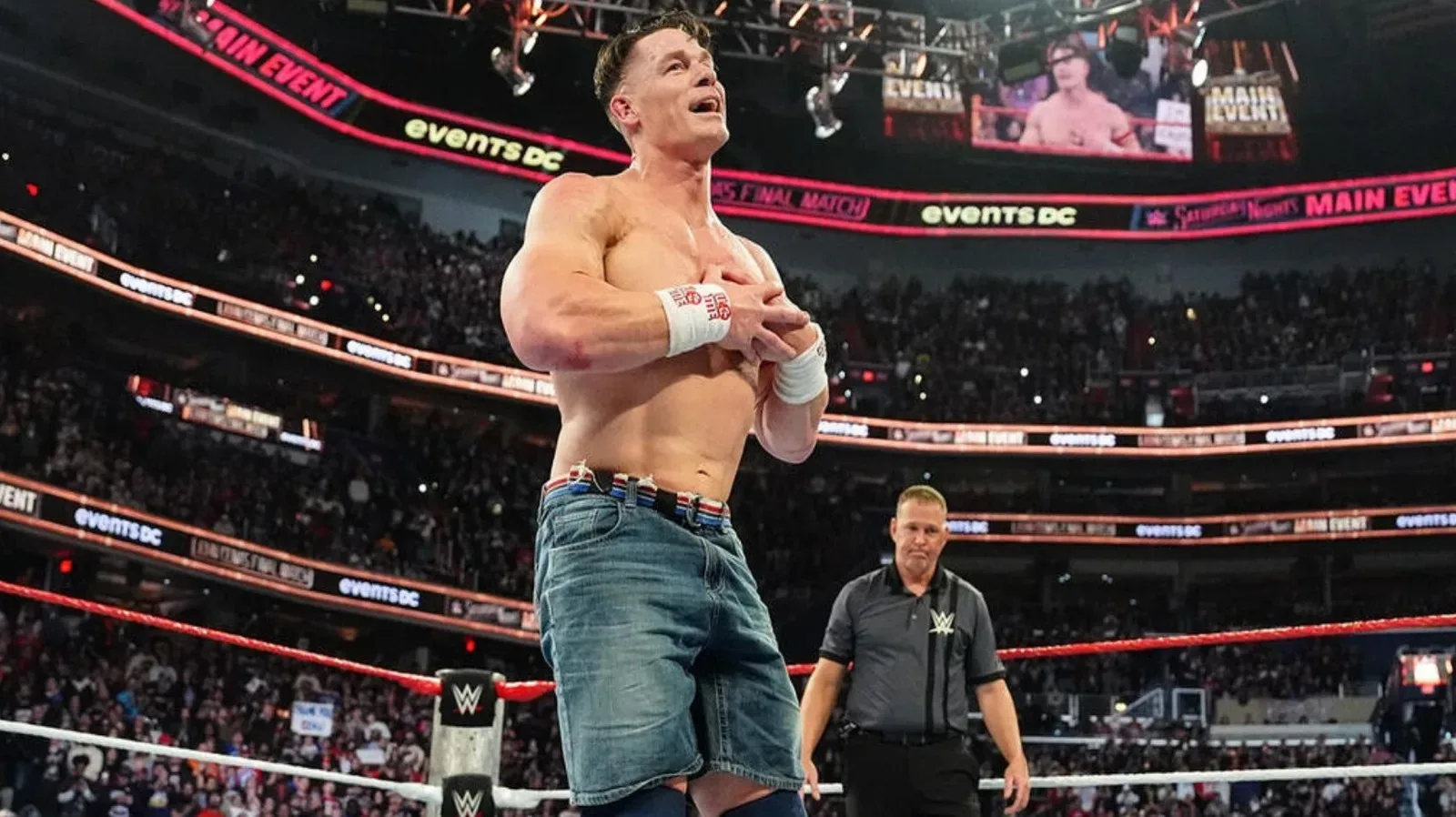
John Cena’s final WWE match was designed as a definitive farewell, but the man at the center of it does not see his retirement as a case of walking away on his own terms.
Cena concluded his in-ring career at WWE Saturday Night’s Main Event in December 2025, tapping out to GUNTHER’s sleeper hold in the middle of the ring. The image was striking: a smiling Cena accepting the result as GUNTHER secured the submission. It closed a year-long retirement run that included a historic 17th world championship reign and Cena’s first heel turn in decades.
From the outside, the story appeared unusually orderly for a wrestler of Cena’s stature. He had a lengthy farewell tour, major moments across the year, a planned final opponent, and a clear final bell. But while discussing his career during an appearance on Happy Sad Confused with Josh Horowitz, Cena argued that a carefully planned exit should not be confused with leaving because he no longer wanted to perform.
“If I have my own story to paint and doing it on my own terms, I’d like to do this forever,” Cena said on Happy Sad Confused.
For more background on this topic, read Cook County Sheriff’s Officer Files Lawsuit Against WWE and Montez Ford Over Raw Segment.
That distinction gets to the heart of Cena’s perspective. His retirement was not presented as an impulsive decision, and he did not suggest that he was forced away by one singular event. Rather, he described it as an acceptance of reality. Cena still has the desire to work, but believes he has reached the point where stepping aside best matches the standards he has set for himself.
“When I retired from WWE, everybody’s like, ‘Man, you’re doing it on your own terms.’ Bulls***. I want to do it forever. I know that it’s time to go. It is within my values. I said, ‘I want to do good work and I want to leave doing good work,’ but my own terms are to do it infinity.”
A Farewell Built Around Perspective
Cena’s comments add a more complicated layer to the final chapter of one of WWE’s most consequential modern careers. Retirement tours in wrestling are frequently accompanied by a sense of celebration, but they can also create the impression that a performer has fully chosen to close the door. Cena’s framing is different. He has not described retirement as the fulfillment of a personal wish. He has described it as the responsible choice.
For Cena, the important idea is not whether he could continue appearing in a ring, but whether he could continue doing the level of work he expects from himself. That is a meaningful standard for a performer whose WWE career was built on consistency at the highest level, both in championship matches and in the demanding public-facing responsibilities that came with being one of the company’s central stars.
He made clear that his preferred outcome would have been to continue indefinitely. Instead, he said he had to evaluate the situation honestly.
“I want to continue to do it,” Cena said. “But, I gotta be realistic and look at the math and be like, ‘Okay, it’s time to step away.’”
The phrase “look at the math” is notable because Cena did not attach it to a specific injury, dispute, or single limitation. His comments were broader, centered on the inevitable end point facing anyone in a physically demanding profession. Cena characterized his acting and wrestling work as part of an occupation that is fragile, one in which he understands that the ability to continue is not entirely within his control.
That outlook also helps explain why the conclusion of his WWE run was treated with such finality. A retirement match is often just another chapter in professional wrestling, where returns are common and farewell stipulations can be revisited. Cena’s words do not change the reality that wrestling history is filled with unexpected comebacks. However, they reinforce that he approached his December 2025 match as a genuine moment to step away while he felt he could still leave behind work he considered worthy of his legacy.
GUNTHER’s Submission Win Closed The In-Ring Chapter
The decision for Cena to submit to GUNTHER was equally significant. Cena did not simply lose a competitive match; he tapped out in the center of the ring to GUNTHER’s sleeper hold. In wrestling, a submission finish carries a particular clarity. It establishes an undeniable conclusion to the contest and, in this case, gave GUNTHER a major victory over a defining figure in WWE history.
Cena’s smile during the moment underscored the emotion of the scene without changing the finality of the outcome. It was an acknowledgment of the occasion, the opponent, and the audience that had followed him through his farewell year. The finish also made GUNTHER part of the closing image of Cena’s wrestling career, a major responsibility for a performer positioned as one of WWE’s most formidable current stars.
The road to that match was not a simple nostalgia run. Cena’s final year included a turn that rewrote a major part of his established WWE identity. After being presented for decades as one of the company’s most prominent heroic figures, Cena turned heel during the retirement tour. The run also featured his 17th world title reign, pushing his championship accomplishments into new territory.
Those developments made the farewell feel less like a passive collection of tribute appearances and more like an active final story. Cena was not merely revisiting old highlights. He was still taking part in consequential WWE programming, altering expectations with the heel turn, and adding another world championship chapter before ultimately losing his final match to GUNTHER.
Cena’s WWE Relationship Continues Beyond Wrestling
Retirement from the ring has not meant a complete departure from WWE. Cena has since become the face of the company’s exclusive Club WWE brand, keeping him tied to the organization even after the end of his active in-ring run. That role is consistent with the distinction he made in his interview: he may have stepped away from wrestling matches, but that does not mean he has lost affection for the industry or the company where he became a global star.
There is also a prospective new connection to WWE’s future through the announced John Cena Classic. The tournament is set to feature WWE NXT talent against main-roster stars. A December timeframe has been rumored, though the timing remains uncertain. The concept gives Cena’s name a potentially meaningful place in the developmental and main-roster pipeline, bringing together emerging talent and established WWE performers under a banner associated with one of the company’s most recognizable names.
It is too early to draw conclusions about exactly how expansive Cena’s post-retirement WWE presence will become. Still, the Club WWE role and the John Cena Classic indicate that the end of his active career does not have to mean the end of his involvement. His comments suggest that he remains emotionally invested in the work, even as he accepts that his role in it has changed.
Not A Desire To Leave, But A Decision To Preserve The Standard
Cena’s message is ultimately less about closing a door than about explaining why he chose to close it when he did. The common description of an athlete or wrestler retiring “on their own terms” often implies total control: the person decides they are finished and leaves satisfied. Cena does not accept that description because, by his own account, he was not ready in the sense of losing the desire to continue.
Instead, he is separating desire from judgment. He wanted to keep going. He also believed it was time to stop before the quality of his work no longer matched his own expectations. In that sense, his choice was deliberate, but not easy.
That makes the final image from Saturday Night’s Main Event more resonant. Cena tapping to GUNTHER’s sleeper hold was not portrayed as a defeat that erased his accomplishments. It was the last act of a career that had already included decades of prominence, championship success, and cultural impact. The smile that accompanied the submission did not mean he wanted the ride to end. It reflected an understanding that even the most enduring careers eventually require a final decision.
For Cena, the retirement match was not the realization of a dream to walk away. It was the difficult recognition that continuing forever was impossible, and that leaving while he could still deliver good work was the choice he needed to make.
In pictures

Darryl Polo
Darryl Polo is a passionate wrestling fan covering WWE, AEW, TNA and beyond. He loves great rivalries, breakout stars and the moments that keep fans talking long after the bell. How we work.