
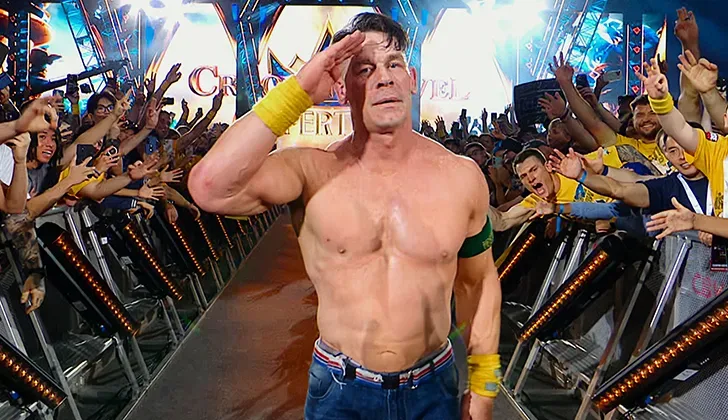
John Cena has spent more than two decades building one of the most recognizable identities in professional wrestling, but he views “John Cena” as more than simply a personal name. It is also a major piece of intellectual property shaped by WWE’s investment, promotion and global reach.
In a recent interview, the former WWE Superstar and 17-time WWE Champion addressed the complicated relationship between his legal identity and the character that became synonymous with WWE’s modern era. Cena also spoke about the public expectation that he serve as a symbol of positive masculinity, the criticism that followed his apology to China after referring to Taiwan as a country, and the challenges of remaining loyal to WWE while the company faces criticism for some of its business decisions.
The remarks offer a measured look at how Cena sees fame, corporate partnership and accountability. While he remains closely identified with WWE even as his acting career has expanded, Cena did not present his connection to the company as simple or free of difficult questions.
Cena Sees His Name as Both Personal Identity and WWE Property
Few wrestlers have become as inseparable from their WWE persona as Cena. His real name has been the name used on television, merchandise, films, video games and countless promotional campaigns. That unusual situation has created an understandable question: where does the person end and the brand begin?
For more background on this topic, read Bully Ray Says Randy Orton’s SmackDown Interview Carried More Conviction Than Cody Rhodes’.
Cena said he recognizes WWE and its parent company TKO as having a legitimate stake in the intellectual property associated with his name and character. Rather than framing that arrangement as a loss of control, he described it as the consequence of a long-running partnership and the choices involved in pursuing a career at that level.
“John Cena is who I am as a human being, and there is a company – WWE/TKO – that has invested hundreds of millions of dollars in the intellectual property of the character John Cena,” Cena said. “And rightfully so; they have earned their share of ownership of that.”
The distinction is significant. Cena is not discussing a traditional wrestling alias that can easily be separated from an individual’s private identity. The same name represents the man, the public figure and a character that WWE helped make valuable on an international scale. His comments acknowledge that WWE’s investment was not limited to booking matches or selling shirts. The company created platforms, campaigns and opportunities that turned Cena into a crossover celebrity.
Cena also emphasized that he prefers to think in terms of choice. He noted that accepting one opportunity necessarily means turning away from others.
“I prefer to use the word choice,” Cena said. “When we say yes to something, we say no to everything else.”
That philosophy applies to the business arrangements that come with becoming a top WWE star. A performer can gain enormous visibility, financial success and cultural influence through the company, but those benefits are connected to obligations and restrictions. Cena’s perspective is that the arrangement should be understood through the commitments both sides have made rather than through a simplistic ownership debate.
Why Cena Does Not Want to Be a Spokesman for Masculinity
For much of his WWE career, Cena was positioned as the company’s leading hero. “Hustle, Loyalty, Respect” became an enduring slogan, while his work with charitable causes and his long-standing Make-A-Wish record further established him as a public role model. That image has led many fans to view him as a candidate to speak for an idealized version of modern masculinity.
Cena is reluctant to take on that role in explicit terms. He said he would rather live authentically than attempt to lead or define a broad cultural movement. In his view, public demand for a particular style of male role model can change rapidly, and anyone who builds their identity around being the approved face of that movement risks becoming disconnected from the audience.
“Rather than trying to take the reins of a movement or be the poster child for something, I’m just trying to be me,” Cena said. “The appetite for a certain kind of manhood is just supply and demand. My advice would be: go get it.”
Cena’s answer did not reject the notion that audiences seek positive examples. Instead, it rejected the idea that one person should claim ownership over what masculinity ought to mean. He suggested the system is fragile and subject to sudden changes in public interest.
“If I say I’m going to be the showcase of masculinity and the supply-and-demand chain pivots in five minutes, I’m **** out of luck,” Cena said.
That caution reflects a recurring theme in Cena’s comments: he is wary of grand titles and easy labels. His public career has placed him in a position where fans, corporations and media can all assign larger meanings to his actions. Cena appears more comfortable accepting responsibility for himself than accepting a formal mandate to represent everyone else.
Cena Reflects on Taiwan Comment and Apology
Cena also revisited one of the most controversial episodes of his public career. During the promotional tour for F9, he referred to Taiwan as a country. The comment became a major political flashpoint, particularly in China. Cena later issued an apology in Chinese, and that decision triggered substantial criticism in the United States, where detractors viewed the apology as capitulation to China.
Rather than defending the original statement with certainty, Cena said he had overestimated his understanding of the situation. He had learned Mandarin, but said knowing the language did not give him sufficient knowledge of the cultural and political context surrounding the issue.
“Just because you know the language doesn’t mean you know the culture,” Cena said. “I got way too overconfident. I thought I was the smartest guy in the room.”
The backlash was severe enough that Cena said he contacted writer-director James Gunn and told him he would understand if Gunn removed him from the Peacemaker project because of the controversy. That detail underlines the level of uncertainty Cena felt at the time. The issue moved beyond a difficult press-tour moment and raised fears about whether it could affect his work outside WWE.
The episode remains a defining example of the pressures placed on global entertainers. Cena’s position as an actor, wrestler and international brand ambassador means his remarks can be examined through political, commercial and cultural lenses at the same time. His reflection focused on his own lack of knowledge rather than attempting to minimize why people reacted strongly.
Loyalty to WWE Does Not Eliminate Difficult Questions
As WWE continues to stage major international events, its relationship with Saudi Arabia remains one of the company’s most debated business issues. Critics have questioned the company’s work in the country because of Saudi Arabia’s human-rights record and the broader concerns attached to its state-backed sports and entertainment investments.
Cena said those kinds of questions are difficult precisely because he believes in WWE. He described the promotion as an entity capable of providing a form of connection across borders.
“WWE offers a universal language of diplomacy,” Cena said. “So, to your question of: ‘Hey, the thing that you’re in is sometimes criticised for the moves that it makes as an entity – is that difficult?’ Of course it is, especially when you believe in the entity.”
His response does not erase the criticism surrounding WWE’s business choices, nor does it suggest every fan will agree with his framing. It does, however, make clear that Cena approaches the subject from the perspective of someone who has experienced WWE as a global institution capable of reaching audiences who may not otherwise share a language, culture or politics.
That is a familiar belief for Cena, whose career has included extensive international touring and a long effort to communicate with audiences around the world. At the same time, his comments recognize that being loyal to an organization does not make criticism easy to dismiss. In fact, he suggested the opposite: belief in the institution makes the tension more difficult.
A Career Defined by Visibility and Consequence
Cena’s remarks connect several issues that are often discussed separately: ownership of a public identity, expectations placed on male celebrities, global political controversy and corporate loyalty. All are consequences of the visibility he has attained through WWE and beyond it.
His approach is notably pragmatic. WWE and TKO have a stake in the John Cena brand because they invested heavily in it. He does not claim the authority to define masculinity for others. He accepts that he was overconfident in handling the Taiwan situation. And he acknowledges that supporting WWE can mean confronting complicated questions about decisions made by the company.
For a performer whose WWE character was built around confidence and certainty, Cena’s willingness to describe limits in his own knowledge stands out. The public may continue to debate his past decisions and WWE’s current business strategy, but Cena’s position is clear: fame and loyalty involve choices, and choices carry consequences that cannot always be separated from the brand he helped build.

Darryl Polo
Darryl Polo is a passionate wrestling fan covering WWE, AEW, TNA and beyond. He loves great rivalries, breakout stars and the moments that keep fans talking long after the bell. How we work.