
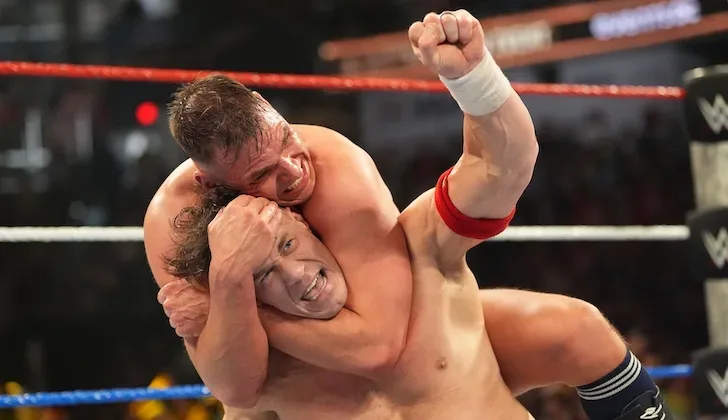
John Cena’s final WWE match was designed to make a statement, and it did. When Cena voluntarily tapped out against Gunther, smiling as he brought his in-ring career to a close, the result gave the next generation’s standard-bearer a defining victory over one of WWE’s greatest icons. It also prompted an immediate question from fans who have spent two decades hearing Cena’s signature message: How could the man behind “Never Give Up” choose to submit?
Cena addressed that apparent contradiction during a fan Q&A at Tampa Bay Comic Con. His answer made clear that he does not see the phrase as a command to cling to every circumstance forever. To Cena, “Never Give Up” has always been about perseverance, engagement, and the willingness to bring one’s best effort to life’s next chapter—even when a current chapter needs to end.
The distinction is important, particularly in the context of the final match. Cena did not frame his loss to Gunther as abandoning the message that has defined his WWE identity. Instead, he viewed it as a conscious, fitting conclusion to a career and a moment of recognition that the time had come to move forward.
Cena defines ‘Never Give Up’ as perseverance
Cena’s words have been printed on shirts, wristbands, signs, and merchandise since the height of his WWE rise. The slogan became inseparable from his public image, especially as he became a hero to younger fans and a central figure in WWE’s work with Make-A-Wish. Its simplicity was always a major part of its power.
For more background on this topic, read Charlotte Flair Says Embracing Flaws Has Helped Refresh Her WWE Character.
But Cena said the phrase should not be understood as refusing to see reality or pretending that nothing ever changes.
“I’m going to clear some things up about perseverance, right? Uh, the words ‘never give up’ to me equate to perseverance,” Cena said. “That doesn’t mean you should just be unaware of your surroundings or what’s going on. ‘Never give up’ for me is a philosophy about life.”
That philosophy, Cena explained, is broader than wrestling. He openly acknowledged that he gave up during his final match and gave up his WWE career, but he does not see either decision as giving up on life itself. For Cena, the message is about waking up each day prepared to make the most of it.
“That doesn’t mean I’m done with life,” Cena said. “Never giving up is the ability to wake up every day and say, ‘Man, I’m going to do the best I can today to have the best day.’”
It is a perspective that places the slogan in a more mature context than a catchphrase about simply refusing defeat. Cena’s point was not that every fight must continue indefinitely. It was that a person can accept an ending, endure a loss, or make a major change without surrendering their curiosity, ambition, or willingness to live fully.
For a performer whose entire WWE career was built around overcoming odds, it is also a natural evolution of the character and message fans have known. Cena was often portrayed as nearly impossible to keep down. His most famous matches centered on relentless comebacks, and his supporters embraced “Never Give Up” as a personal motto. His final act, however, asked fans to consider that perseverance can also include knowing when to step aside with dignity.
Why the Gunther finish mattered
There was no shortage of expectation surrounding Cena’s final match. In professional wrestling, major stars traditionally help elevate the talent positioned to carry a promotion into its future. A veteran making their exit is often expected to leave in a way that gives a meaningful boost to an established or emerging successor.
Many fans anticipated that Cena would lose to Gunther for precisely that reason. Still, the method of defeat caught attention. Cena did not merely take a pinfall or suffer a sudden knockout. He chose to tap out, and the visual was made even more striking by the smile on his face.
Cena said he understood why the response centered on his motto.
“It was interesting to see the fan reaction with me voluntarily tapping out for the last match, cuz they’re like, ‘Oh, you’re the never give up guy. Why’d you give up?’” Cena said.
In his view, the finish was the clearest way to communicate that this was truly his final match. He said the outcome was always going to be the conclusion of that in-ring chapter, regardless of whether he won, lost, or drew. A clean, voluntary submission made the farewell unmistakable while placing Gunther over in a way that fans could immediately understand.
“It was my last match, win, lose, or draw,” Cena said. “From a fan sentiment, I’m not sure if you guys expected me to win, because essentially in the pro wrestling uh cycle of life, that’s not what happens. So I wanted to gracefully bow out in a way that the fans understood that it was my time to go.”
The choice carries significance beyond a conventional retirement-match loss. Gunther’s presentation has centered on physical authority, discipline, and a punishing in-ring style. Having Cena submit gave his victory a decisive quality. It did not leave room for the argument that Cena was caught by surprise, narrowly escaped, or was simply beaten by a lucky opening. Cena visibly and willingly accepted the result.
At the same time, the smile changed the emotional tone. It was not presented as humiliation or desperation. Cena described it as a graceful bow out, one that allowed him to make the purpose of the match clear and leave with peace rather than bitterness.
Ending chapters is not the same as quitting
Cena expanded on his thoughts by comparing life to a book made up of chapters. Each assignment, appearance, relationship, opportunity, and stage in life eventually concludes. That conclusion does not erase the value of what came before, nor does it mean a person has failed by moving on.
Using the convention appearance as an example, Cena said he wanted to be fully present for the questions in front of him. He knew the Q&A would end when it was time to leave the stage, after which he would take photos and sign autographs. Those sessions would end as well. In his view, those are not acts of defeat; they are transitions from one moment to the next.
“Now, the things that life deals us become, in my eyes, like chapters in our book,” Cena said. “I want to do the best I can here for this Q&A by answering your questions as genuine as I can. So, I’m putting my best forward to this.”
He then emphasized that even a successful and meaningful experience has a natural endpoint.
“They’re going to bring out the hook in like 15 minutes and I’m going to have to get off stage. We’re going to have to end this chapter,” Cena said. “So, essentially, I’m going to ‘give up’ the stage and then I’m going to go back and take some more pictures and do some more autographs, but each of those sessions is going to conclude and then I will give up.”
That explanation directly addresses the emotional challenge behind retirement, especially for an athlete or performer whose identity has been tied to a single pursuit for decades. There is a difference between walking away because one has no desire to continue living with purpose and choosing to complete a role in order to pursue the next responsibility. Cena sees the latter as an act of awareness.
A message of awareness and moving forward
Cena also rejected the idea that “Never Give Up” should trap someone in a situation that has run its course. He referred to necessary changes as “pivots,” a word that reflects movement rather than surrender. The core of the message, he said, lies in maintaining a high quality of life through active participation in it.
“Does ‘never give up’ sometimes box you into a rabbit hole when you know you got to move onward in life? No,” Cena said. “Awareness of what’s going on is certainly a good indicator of like, man, I got to pivot. I call them pivots. That way you’re not just giving up all the time.”
He concluded by returning to the central idea that has carried through both his wrestling career and his outlook away from the ring.
“But the never give up thing comes to the quality of life,” Cena said. “And as long as I’m alive, man, I want to stay curious and active about life.”
That is why Cena’s submission to Gunther does not need to be viewed as the undoing of his defining motto. It was an acknowledgment that his WWE career had reached its final page, coupled with a deliberate effort to give Gunther a career-shaping moment. Cena ended the match on his own terms, put over the man moving forward, and offered fans a reminder that perseverance is not about refusing every ending.
For Cena, “Never Give Up” remains intact because the message was never limited to winning a wrestling match. It is about what comes after the bell, after the farewell, and after one chapter closes: waking up ready to give the next one everything you have.

Darryl Polo
Darryl Polo is a passionate wrestling fan covering WWE, AEW, TNA and beyond. He loves great rivalries, breakout stars and the moments that keep fans talking long after the bell. How we work.