
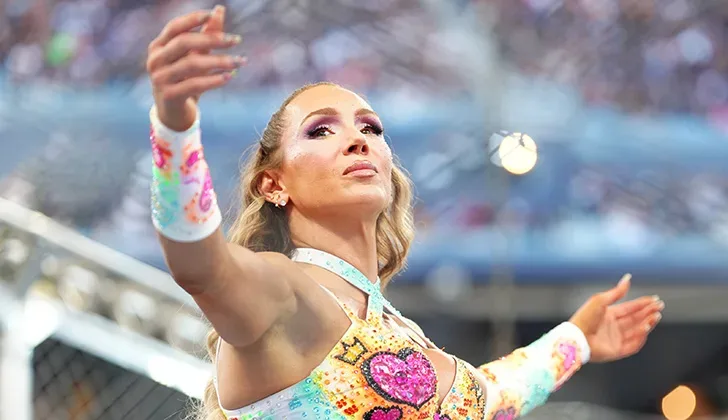
Charlotte Flair has never lacked confidence in her accomplishments, but she believes a willingness to show imperfection has opened a new chapter for her WWE character.
Speaking during an appearance on Power Hour With Ilona Maher, Flair discussed why audiences have often had a complicated reaction to her. The conversation went beyond ordinary villain-versus-hero crowd responses, with host Ilona Maher asking why some fans appeared resistant not only to the Charlotte Flair character but to Flair herself.
For Flair, part of the answer is that the performance side of professional wrestling did not come as naturally as her athletic abilities. She said learning to communicate charisma in the particular, larger-than-life language of WWE has been a long process.
“The entertainment-side charisma did not come natural at all, like at all, really,” Flair said.
For more background on this topic, read Eric Bischoff Says The Undertaker’s WrestleMania Streak Should Have Remained Untouched.
That admission offers an important lens for understanding Flair’s career. She entered WWE carrying one of the most recognizable surnames in wrestling history as the daughter of Ric Flair, while also facing enormous expectations to establish herself as more than an extension of that legacy. Her presentation, ring work, championship success, and self-assured style made her an elite-level star, but those same traits could make it difficult for audiences to see her as vulnerable or easy to root for.
Flair acknowledged that being Ric Flair’s daughter created an obvious character avenue that she could have leaned into more heavily. She could have portrayed the spoiled beneficiary of a famous family name, openly embracing the perception that opportunities were handed to her.
“Now that I’m like what, 13 years in, being [Ric] Flair’s kid, I want the fans to like me cuz I work really hard,” Flair said. “But it could have been easier character-wise to be, like, ‘I’m Ric Flair’s daughter. I get everything handed to me. I don’t even do back exercises. I just have a great back.’”
The remark was delivered with the kind of humor and confidence that have long been central to her presentation. At the same time, it illustrated the balance Flair has been trying to strike. Her family connection cannot be separated from how fans first viewed her, but her body of work has been built through sustained performance, training, and a drive to stand at the top of the industry.
A Different Way to Connect With the Audience
Flair did not dismiss her own standing or diminish what she has achieved. Instead, she identified a basic emotional truth in wrestling storytelling: fans frequently gravitate toward competitors fighting upward rather than those who appear impossible to beat.
“I’m not taking away how good I am and what I have done for the industry,” Flair said. “But I think what has helped my career so much in the last year is, like, you don’t want to cheer for someone who always wins. You know what I mean? You want the underdog to win.”
It is an especially significant observation from a performer whose identity has so often been tied to the title picture. Flair said that being away from the main championship scene, after becoming so synonymous with it, created a different perspective. When a wrestler is regularly positioned as the dominant champion or presumed favorite, the audience may respect that athlete while still reserving its deepest emotional investment for the person trying to overcome the odds.
That does not mean Flair is abandoning ambition. Quite the opposite: she made clear that her pursuit remains centered on being regarded as the greatest of all time, without drawing a distinction between men’s and women’s wrestling. But she sees more value now in allowing the audience to witness a fuller range of her character rather than presenting only an untouchable champion.
“Everything that I do right now, like every second, every minute, every hour, every day is I just want to be the greatest of all time,” Flair said. “Literally doesn’t matter, male or female.”
That is the central tension of the current Flair conversation. She is still motivated by supremacy and legacy, two ideas that have powered much of her WWE run. Yet she recognizes that constantly projecting perfection can leave limited room for a fan to identify with the person behind the accomplishments.
Perfection Can Be a Barrier
In WWE, a polished champion can be aspirational, but a flawless champion can also become emotionally distant. Flair’s comments suggest she has become more conscious of the difference. A superstar who always appears certain, victorious, and in control may generate admiration, but admiration does not automatically become support.
Flair said the ability to reveal flaws and acknowledge personal difficulties has helped give her character a renewed dimension. Rather than treating vulnerability as something that weakens her image, she sees it as a way to create a more honest and compelling connection with viewers.
“Me showing my flaws and like stuff that I’ve gone through in my personal life,” Flair said. “And actually being, like, it’s okay not to be that perfect champion of what you think is a champion has what has allowed me to have this fresh layer paint for the character.”
That “fresh layer” is not a rejection of everything Flair has represented. Her confidence, competitiveness, and high standards remain essential parts of who Charlotte Flair is on WWE television. The difference is in making room for setbacks, uncertainty, and humanity alongside the championship-level swagger.
For a star with Flair’s resume and public profile, that can be a difficult adjustment. Dominance has been a major part of her appeal. The expectation that she will excel, rise to major occasions, and chase the biggest prizes is deeply embedded in her identity. Moving outside of that familiar framework requires a different kind of performance skill than simply entering a match as the established favorite.
It also addresses the long-running audience perception that success came easily to her. Flair’s remarks did not deny the privilege of growing up in a wrestling family or the immediate scrutiny that came with it. Instead, she emphasized that the work behind her career has mattered to her, and that she wants fans to recognize more than the famous name.
Flair’s Evolution Continues
Professional wrestling careers are often defined by reinvention, and Flair’s comments point to evolution rather than a wholesale reinvention. The competitive foundation is intact. So is her belief that she belongs in the greatest-of-all-time discussion. What appears to be changing is the manner in which she wants that greatness to be received.
There is a clear difference between demanding admiration and giving an audience a reason to invest emotionally. Flair’s perspective is that her recent growth has come from understanding that distinction. Fans do not always want the superstar who appears destined to win. They often want to see the person who has something to prove, who can fall short, and who must fight through adversity.
That can be a powerful shift for Flair because it does not require her to stop being Charlotte Flair. It asks her to reveal more of what exists beneath the image of the dominant, championship-focused athlete. Her remarks indicate she is increasingly comfortable with that process, even if entertainment charisma was once the part of wrestling that felt least instinctive to her.
Flair’s career has been built on the ability to perform at a rare level under intense pressure. Now, she is framing a new layer of that performance around openness rather than invincibility. Whether fans fully embrace that evolution will be determined over time, but Flair’s own goal is clear: maintain the confidence of an all-time great while showing that greatness does not have to look perfect every second of every day.

Darryl Polo
Darryl Polo is a passionate wrestling fan covering WWE, AEW, TNA and beyond. He loves great rivalries, breakout stars and the moments that keep fans talking long after the bell. How we work.